
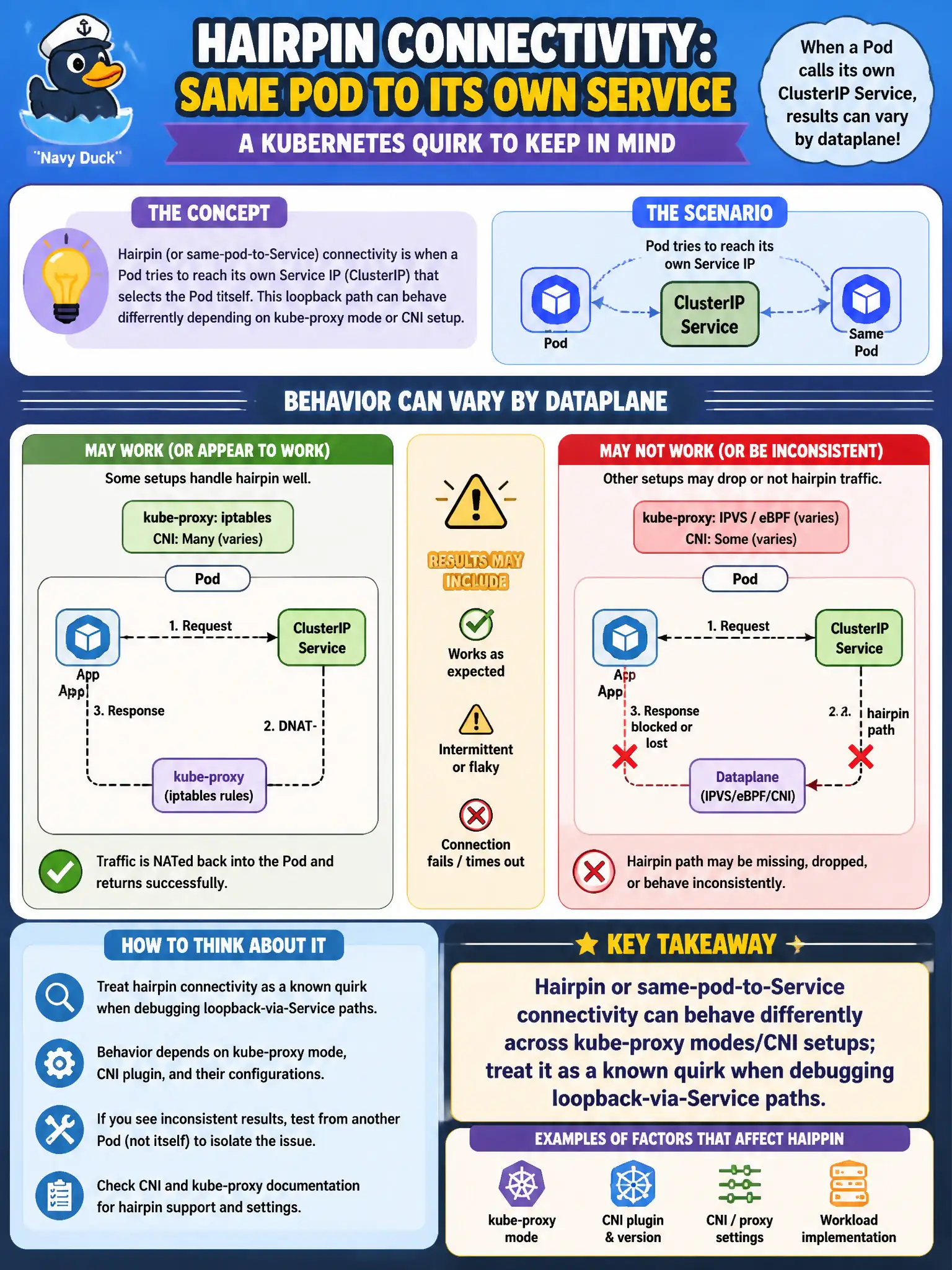
A sanitation Pod tries to reach its own ClusterIP Service address and sees inconsistent or surprising behavior depending on the dataplane. What concept should the administrator keep in mind?
Select an answer to reveal the explanation.
Short Explanation
Calling your own Service IP from inside the Pod is like mailing yourself a letter through the post office—some sorting rooms loop it cleanly, others get weird. Know the hairpin quirk.
Full Explanation
Hairpin or same-pod-to-Service connectivity—when a sanitation Pod reaches its own ClusterIP—can behave differently across kube-proxy modes and CNI setups. Administrators should treat surprising results as a known quirk when debugging loopback-via-Service paths rather than assuming one universal behavior. Pods can resolve their own Service DNS name under normal CoreDNS setups; claiming they never can is false. ClusterIP traffic from a Pod to its Service does not always hairpin through the API server; the API server is not the Service dataplane. The pattern is not limited to LoadBalancer Services; ClusterIP hairpin quirks are the classic case. Exam caveat: kube-proxy iptables mode historically needed hairpin features; eBPF dataplanes differ. Prefer connecting to Pod IPs for self-checks or use another client Pod. Operational check: Reproduce from a second client Pod versus self-via-ClusterIP, note the dataplane mode, and adjust the sanitation health check to a supported path. In municipal production practice, record the finding in the incident ticket with command output snippets, confirm the fix under change control, and re-validate the user-facing civic service before closing the change window.