
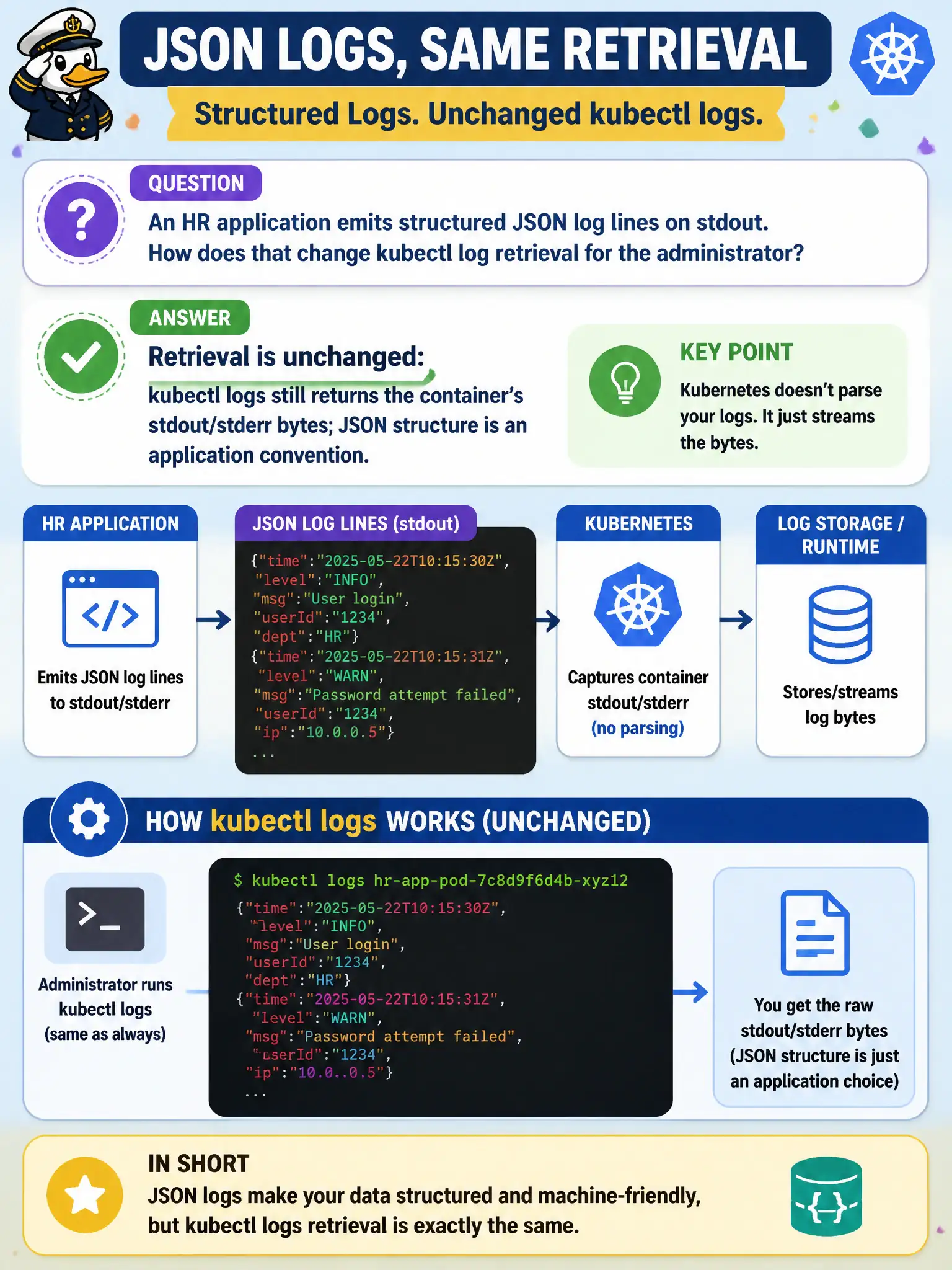
An HR application emits structured JSON log lines on stdout. How does that change kubectl log retrieval for the administrator?
Select an answer to reveal the explanation.
Short Explanation
JSON on stdout is still just bytes on the wire—kubectl logs doesn’t care if it’s poetry or JSON. The format is the app’s convention; the retrieval path stays the same.
Full Explanation
When an HR application emits structured JSON log lines on stdout, retrieval with kubectl logs is unchanged: the command still returns the container's stdout/stderr bytes. JSON structure is an application convention for downstream parsers; kubectl does not require a sidecar to convert JSON to plain text before anything appears. kubectl logs can still retrieve the stream without a sidecar converting JSON to plain text; JSON is valid stdout content. A ConfigMap does not need to redefine the container's logging driver before any bytes appear for JSON lines on stdout. JSON on stdout does not require enabling hostNetwork for the node to parse the lines; hostNetwork is unrelated to log retrieval. Exam caveat: Pretty-printing JSON is a client-side concern (jq, etc.). Ensure apps still flush lines usefully and avoid multi-line JSON without markers if shippers expect line-oriented logs. Operational check: kubectl logs the HR pod, pipe to jq if desired, confirm fields needed for alerts exist, and keep shipping stdout to the municipal log platform. In municipal production practice, record the finding in the incident ticket with command output snippets, confirm the fix under change control, and re-validate the user-facing civic service before closing the change window.