
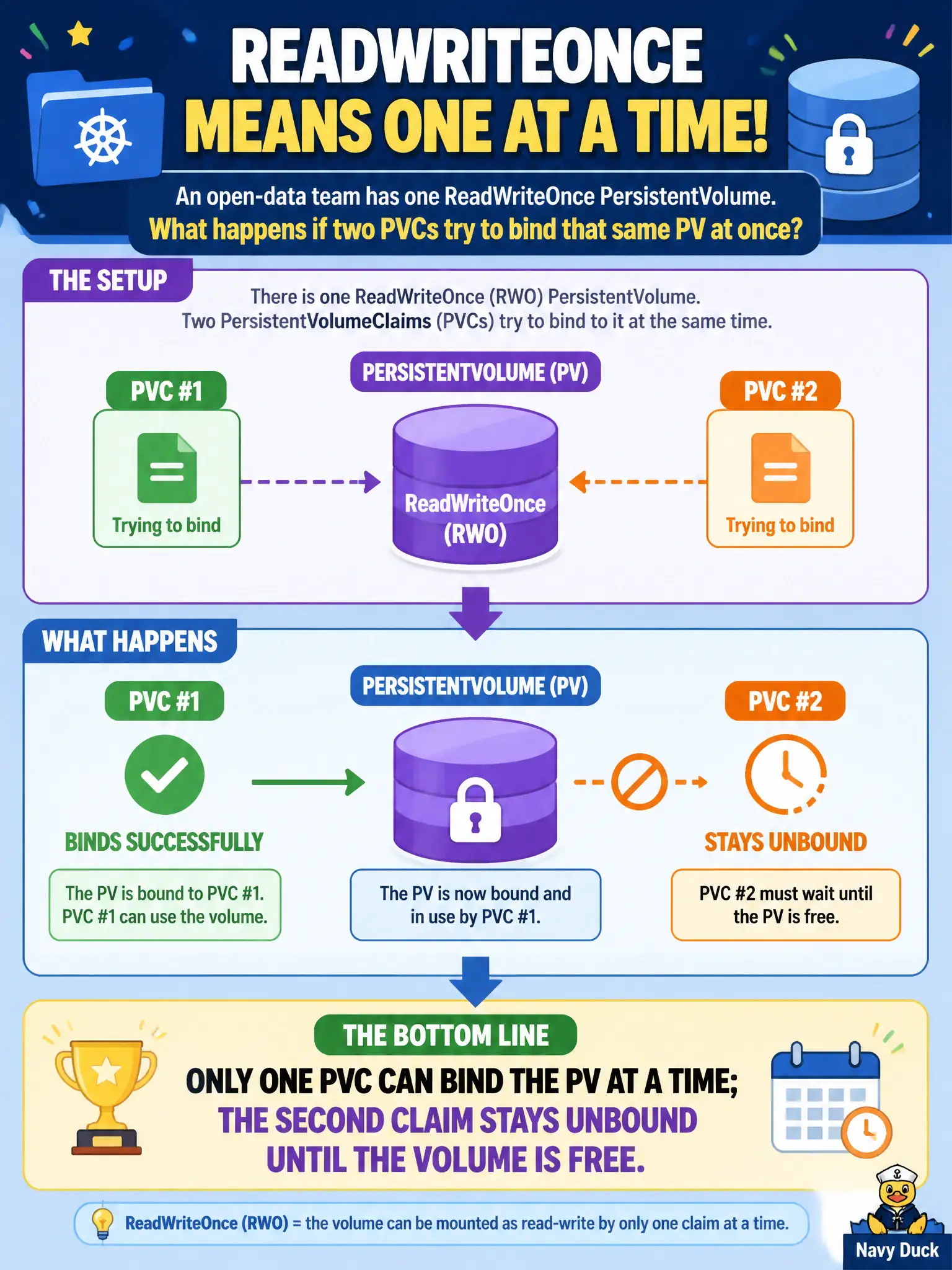
An open-data team has one ReadWriteOnce PersistentVolume. What happens if two PVCs try to bind that same PV at once?
Select an answer to reveal the explanation.
Short Explanation
One key, one lease. A single PV binds to one PVC; a second claim doesn’t get to share that lock just because it wants to.
Full Explanation
If an open-data team has one ReadWriteOnce PersistentVolume and two PVCs try to bind that same PV at once, only one PVC can bind the PV; the second claim stays unbound until the volume is free. One key, one lease—a single PV binds one-to-one with a PVC. RWO’s multi-node mount rules are separate from this binding exclusivity.
Both PVCs do not bind simultaneously because RWO allows two writers across namespaces. Kubernetes does not merge the two PVCs into a single hashed claim. The second PVC does not automatically convert the PV access mode to ReadWriteMany.
Exam caveat: after the first PVC is deleted and the PV is Available again (depending on reclaim), another PVC may bind. Until then the second claim remains Pending.
Operational check: create two PVCs aimed at the same PV (via volumeName or tight selectors), observe only one Binds, release the first, and confirm the second can bind only after the PV is free and Available. Keep civic change tickets precise: record object names, namespaces, and before/after observations so the next on-call engineer can replay the fix without guesswork. Keep civic change tickets precise: record object names, namespaces, and before/after observations so the next on-call engineer can replay the fix without guesswork.