
A school-district operator deletes a PVC while pods still mount it. What should the administrator understand about release behavior?
Select an answer to reveal the explanation.
Short Explanation
Yank the claim while apps still have the volume open and things get sticky—the delete waits or disrupts, and only then does reclaim policy decide the disk’s fate.
Full Explanation
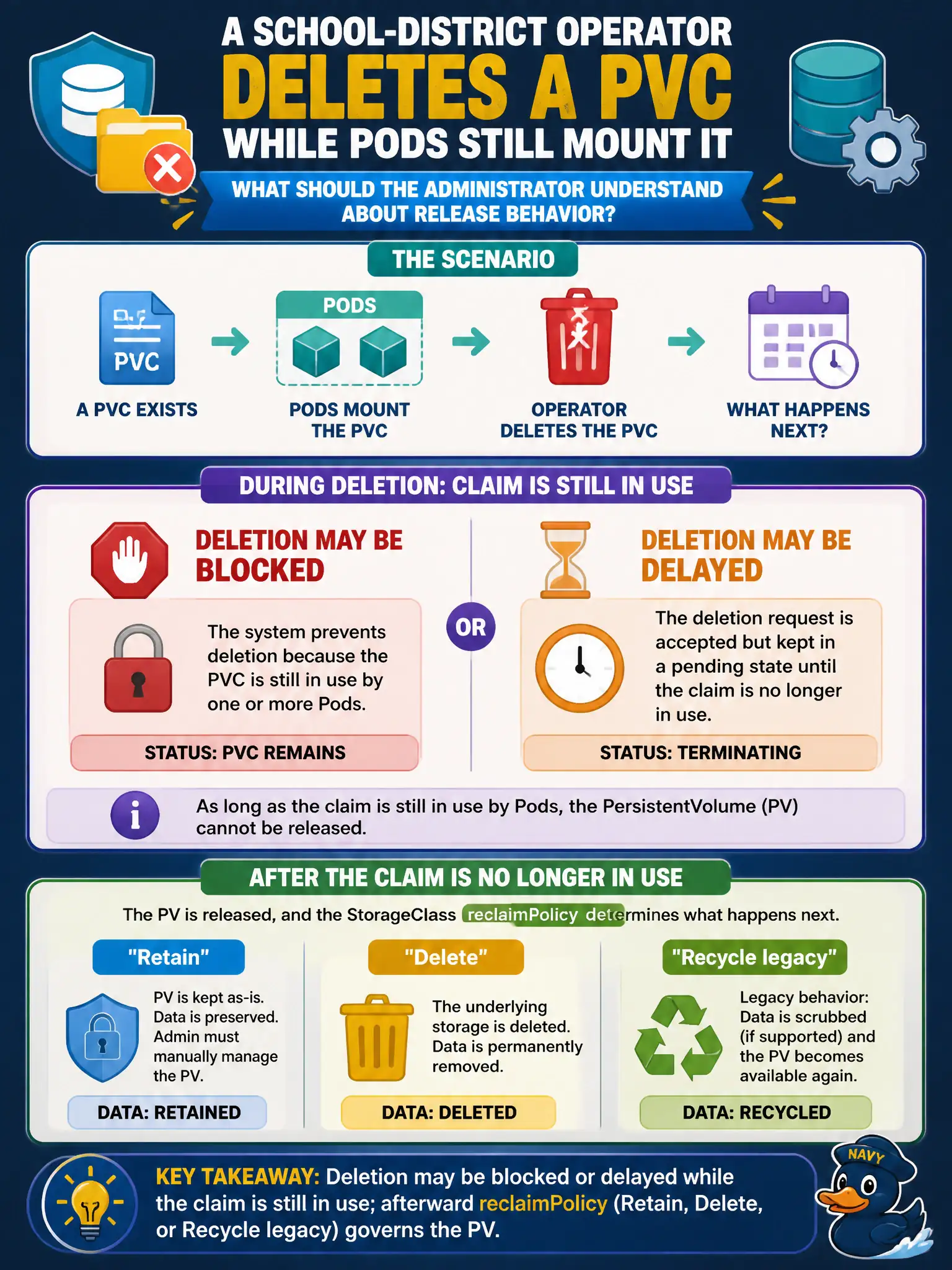
If a school-district operator deletes a PVC while Pods still mount it, deletion may be blocked or delayed while the claim is still in use; afterward reclaimPolicy (Retain, Delete, or legacy Recycle) governs the PV. Yanking the claim while apps still have the volume open gets sticky—the delete waits or disrupts, and only then does reclaim decide the disk’s fate.
Kubernetes does not always immediately wipe PV data and detach every mount with no delay. Deleting a PVC does not convert every PV to hostPath on the control-plane node. Mounted PVCs do not ignore deletion forever such that reclaimPolicy never runs.
Exam caveat: storage object protection finalizers commonly prevent removing a PVC still in use. After release, Retain keeps data for admins; Delete typically destroys dynamic backend disks.
Operational check: before deleting claims, drain or stop mounting Pods, delete the PVC, observe Released/Deleted PV behavior per reclaimPolicy, and verify application impact in a district staging cluster first. Keep civic change tickets precise: record object names, namespaces, and before/after observations so the next on-call engineer can replay the fix without guesswork. Keep civic change tickets precise: record object names, namespaces, and before/after observations so the next on-call engineer can replay the fix without guesswork.