
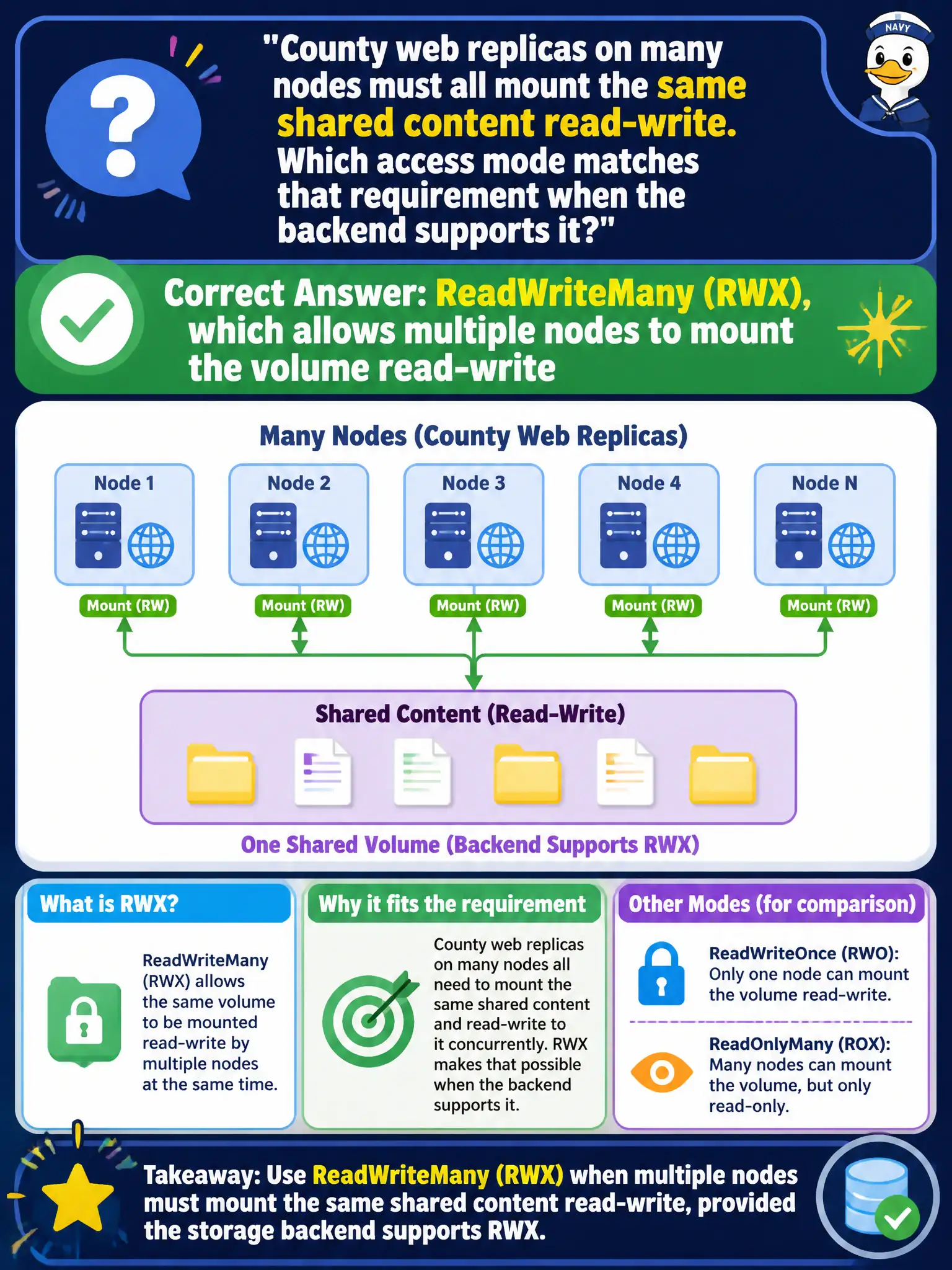
County web replicas on many nodes must all mount the same shared content read-write. Which access mode matches that requirement when the backend supports it?
Select an answer to reveal the explanation.
Short Explanation
Many cashiers editing the same shared binder need a real shared drive, not a laptop disk stuck in one drawer. That’s ReadWriteMany—multi-node read-write—when your storage backend actually supports it. ROX is read-only, and hostPath won’t magically become NFS.
Full Explanation
County web replicas on many nodes that must all mount the same shared content read-write need ReadWriteMany (RWX) when the storage backend supports it. RWX is the shared binder many cashiers can edit—not a laptop disk stuck in one drawer. Choosing RWX without a supporting provisioner still fails, so platform and storage teams must agree on NFS or equivalent CSI file storage for municipal shared content.
ReadWriteOncePod is not required for every multi-node web Deployment; it restricts to a single Pod and is the wrong direction. ReadOnlyMany grants multi-node read-only access, not write access just because Pods share a Namespace. HostPath with RWO is not rewritten by Kubernetes into a shared NFS export.
Exam caveat: many block CSI disks are RWO-only; asking for RWX on those classes leaves PVCs Pending. Confirm accessModes on both PVC and StorageClass/PV capabilities.
Operational check: provision an RWX-capable StorageClass, mount the PVC from Pods on at least two nodes, write from each, and verify shared visibility before onboarding county web teams. Keep civic change tickets precise: record object names, namespaces, and before/after observations so the next on-call engineer can replay the fix without guesswork.