
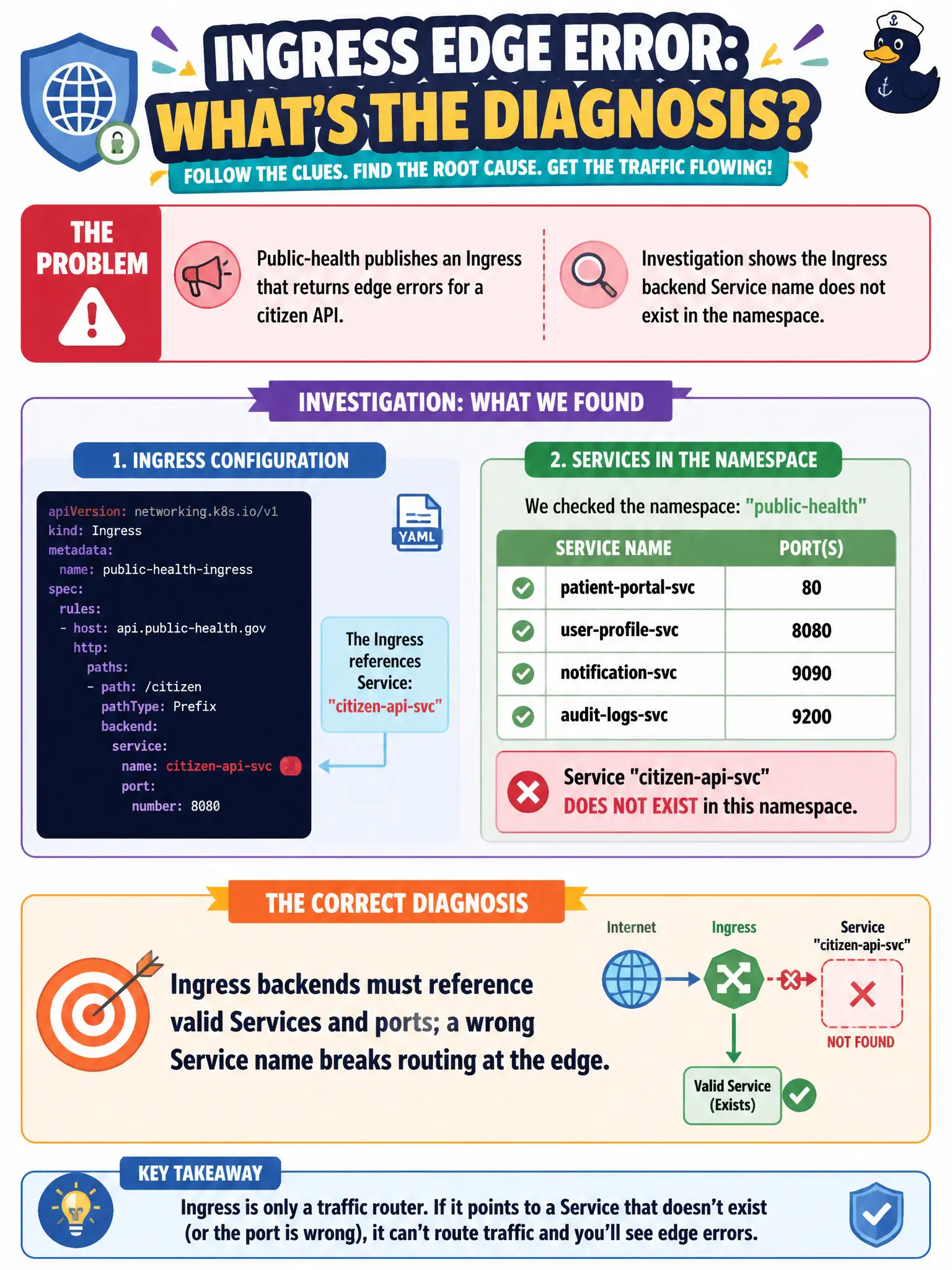
Public-health publishes an Ingress that returns edge errors for a citizen API. Investigation shows the Ingress backend Service name does not exist in the namespace. What is the correct diagnosis?
Select an answer to reveal the explanation.
Short Explanation
The Ingress is a map to a suite number that is not on the directory. If the backend Service name is wrong or missing, the edge has nowhere sensible to send the request—fix the Service name and port.
Full Explanation
When a public-health Ingress returns edge errors and investigation shows the backend Service name does not exist, the correct diagnosis is that Ingress backends must reference valid Services and ports. The Ingress is a map to a suite number missing from the directory: without a resolvable Service, the controller cannot populate upstreams to healthy Pods, and citizen API calls fail at the edge even if differently named workloads are fine. Correct the Service name and port, then confirm Endpoints or EndpointSlices are ready.
Ingress does not ignore Service names and select Pods by Deployment UID. Missing Services are not auto-created from Ingress host fields within sixty seconds. Misspelled Service names do not silently fall back to default/kubernetes.
Exam caveat: classic Ingress backends are same-namespace Service references unless an extension says otherwise. Port name versus number mismatches are as fatal as a wrong Service name. Controller events often spell out “no endpoints” after you fix naming.
Operational check: compare kubectl get svc,endpoints to the Ingress backend fields, repair mismatches, kubectl describe ingress for controller messages, and retest the citizen API hostname and path.