
A library wants catalog.library.example and events.library.example to reach different backend Services through one Ingress. Which capability are they using?
Select an answer to reveal the explanation.
Short Explanation
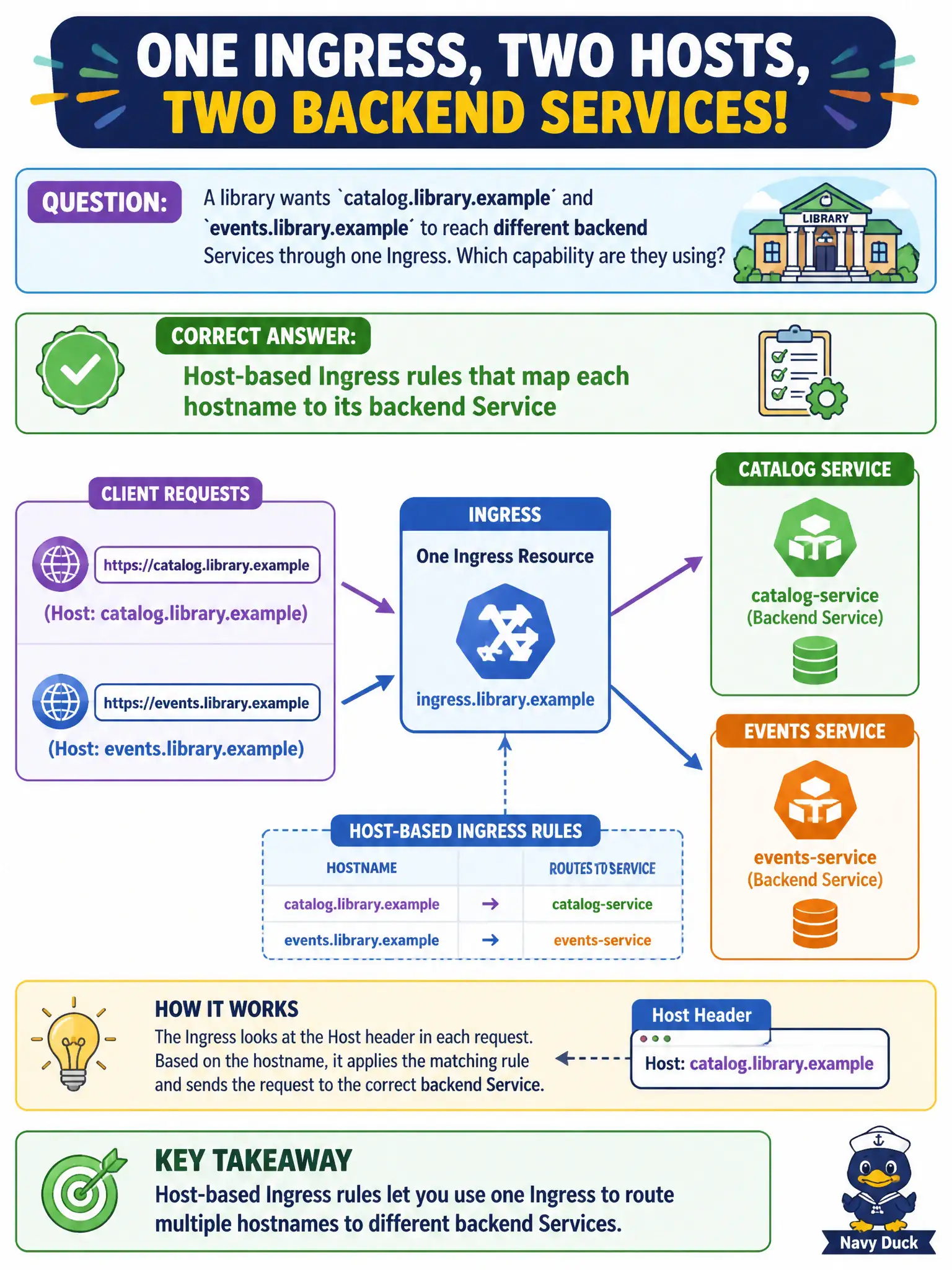
One front door, two nameplates: Ingress host rules send catalog traffic one way and events traffic another. The hostname on the request picks the backend Service.
Full Explanation
A library serving catalog.library.example and events.library.example through one Ingress is using host-based rules: each hostname maps to its own backend Service while sharing a single entrypoint. That multiplexing is a core reason municipal platforms put many apps behind one edge address and certificate strategy. The Host header (and SNI for TLS) selects which rule applies.
Ingress does not automatically create a LoadBalancer Service per path fragment without host fields as the mechanism for this scenario—the question is about host-based mapping. Pod hostname fields do not override Service DNS for external clients through Ingress. NetworkPolicy FQDNs that open NodePorts for domains are not how Ingress host routing works; NetworkPolicy is authorization of connections, not HTTP host multiplexing.
Exam caveat: path rules can further split within a host; TLS hosts in spec.tls should align with rule hosts. Controllers may treat missing hosts as catch-all—know your implementation defaults for exam scenarios.
Operational check: inspect Ingress rules for both hosts and Services, confirm DNS A/AAAA or LB aliases for both names point at the shared entry, and curl each Host header separately to prove backend separation.