
After applying an HTTPRoute for an open-data API, operators want to confirm the shared Gateway actually accepted the attachment. Where should they look first?
Select an answer to reveal the explanation.
Short Explanation
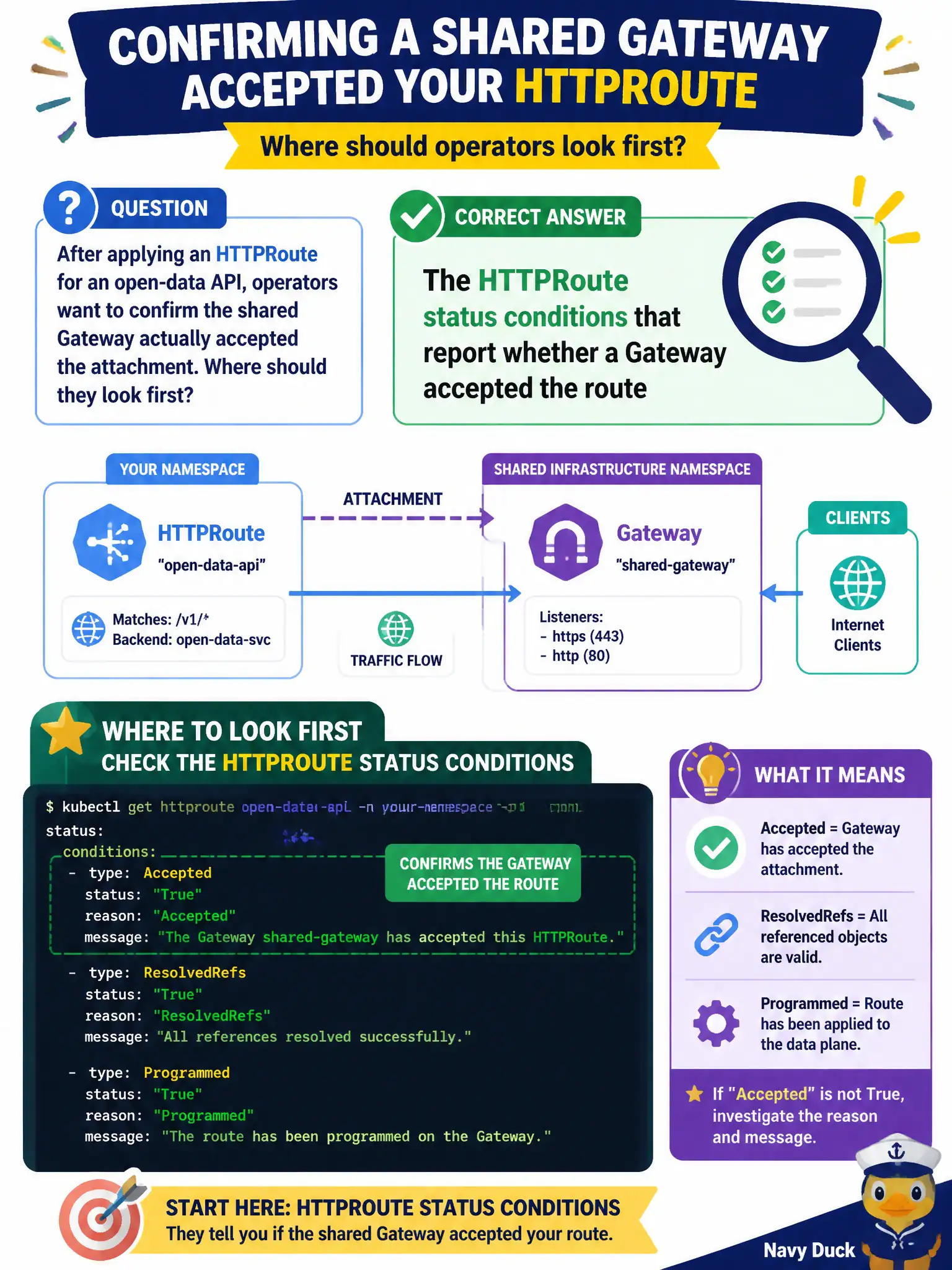
Do not guess from node health—check the HTTPRoute’s own status. It tells you whether the Gateway accepted the attachment, like a stamp on a permit application.
Full Explanation
After applying an HTTPRoute for an open-data API, operators should inspect the HTTPRoute’s own status conditions to see whether the intended Gateway accepted the attachment. Gateway API publishes parent and resolution conditions on Routes so platforms get an explicit permit stamp—Accepted, resolved refs, or reasons for rejection—rather than inferring success from unrelated cluster signals. That status is the first-line confirmation that the shared Gateway actually took the route.
Node Ready on workers reflects kubelet heartbeats and node health, not HTTPRoute acceptance. Etcd compaction revisions on GatewayClass are unrelated to route attachment bookkeeping. Hunting kubelet logs on the control plane for a fictional HTTPRouteSynced=true string is not the supported acceptance signal; controllers reconcile via the API and surface results on resource status.
Exam caveat: a Route can be Accepted by one parent and rejected by another; always check the parent ref you care about. ResolvedRefs failures often mean a bad Service name or cross-namespace grant missing (ReferenceGrant), which status will hint at.
Operational check: kubectl describe httproute (or get -o yaml) and read status.parents/conditions; fix listener allow lists or backend refs until Accepted is true, then generate traffic and confirm the open-data responses.