
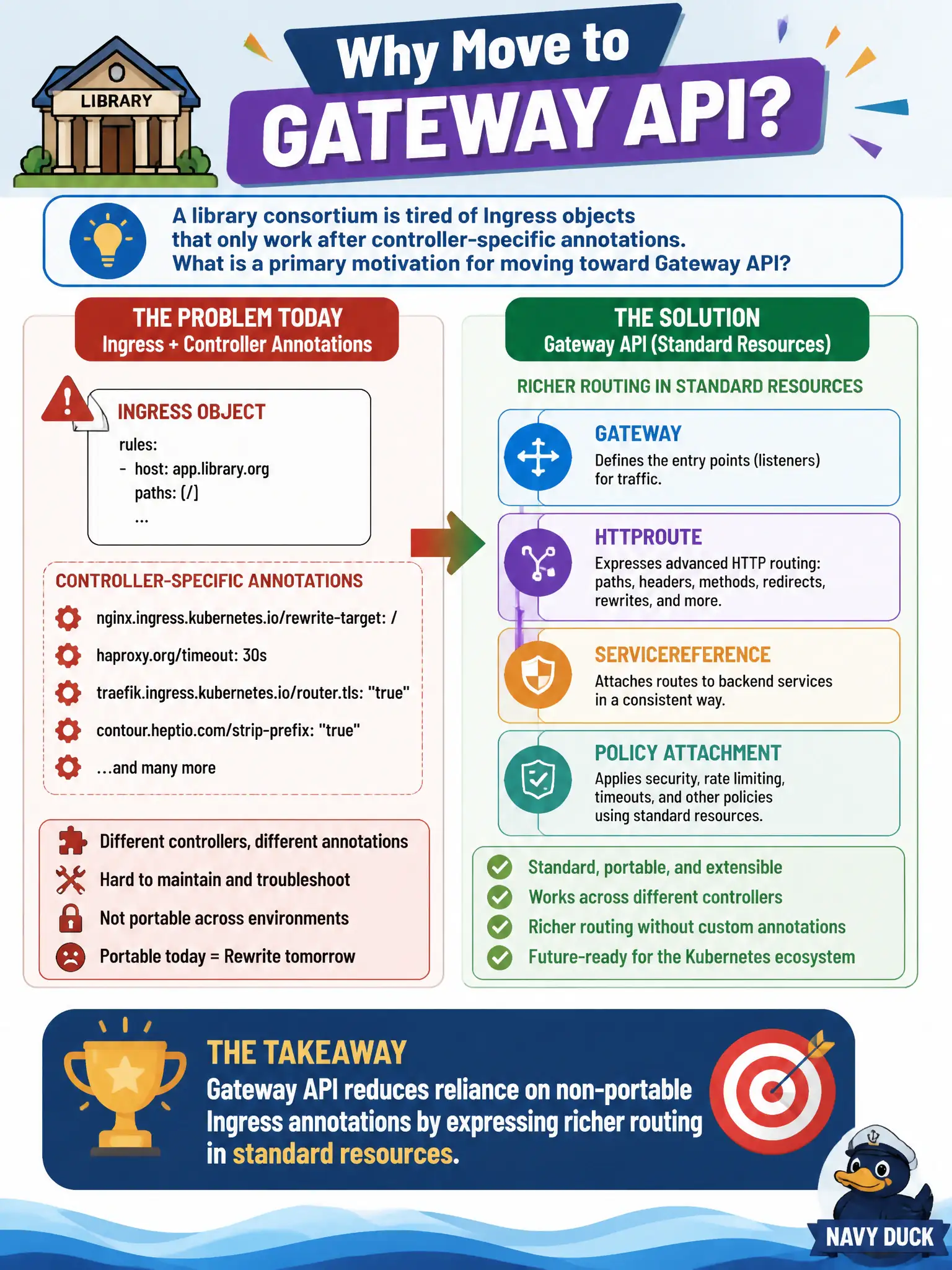
A library consortium is tired of Ingress objects that only work after controller-specific annotations. What is a primary motivation for moving toward Gateway API?
Select an answer to reveal the explanation.
Short Explanation
Classic Ingress often becomes a pile of vendor sticky notes (annotations) that do not travel well. Gateway API pushes more of that routing intent into standard objects so libraries are less locked to one controller’s dialect.
Full Explanation
A primary motivation for Gateway API in a library consortium is escaping Ingress annotation lock-in. Classic Ingress often parks advanced routing—rewrites, canaries, header matches, vendor snippets—in controller-specific annotations that do not travel when you change implementations. Gateway API pushes richer routing intent into standard resources (Gateways, listeners, Routes, and related policy types) so municipal catalogs describe behavior in a portable contract rather than sticky notes that only one controller understands. Controllers still reconcile the API; the win is a clearer shared language across vendors.
Gateway API does not remove the need for any controller by compiling Routes into etcd-only static files—objects without a data-plane implementation do nothing at the edge. It does not replace kube-proxy or eliminate ClusterIP Services; east-west Service traffic and endpoint programming remain. It is not limited to TCP NodePorts: HTTP host and path routing are central Gateway API use cases for north-south citizen traffic.
Exam caveat: Ingress remains valid and widely deployed; Gateway API is the evolution path for portability and role separation, not a claim that every Ingress annotation is illegal. Some features still depend on implementation support even under Gateway API—read status and documentation for your controller.
Operational check: inventory Ingress objects heavy with vendor annotations, map equivalent Gateway/HTTPRoute fields, install a Gateway controller, migrate one library hostname, and compare behavior without carrying over non-portable annotation keys.