
A city platform team wants one shared north-south HTTP entrypoint that can host many municipal host and path routes with portable, role-friendly resources. Which Kubernetes approach best matches that goal?
Select an answer to reveal the explanation.
Short Explanation
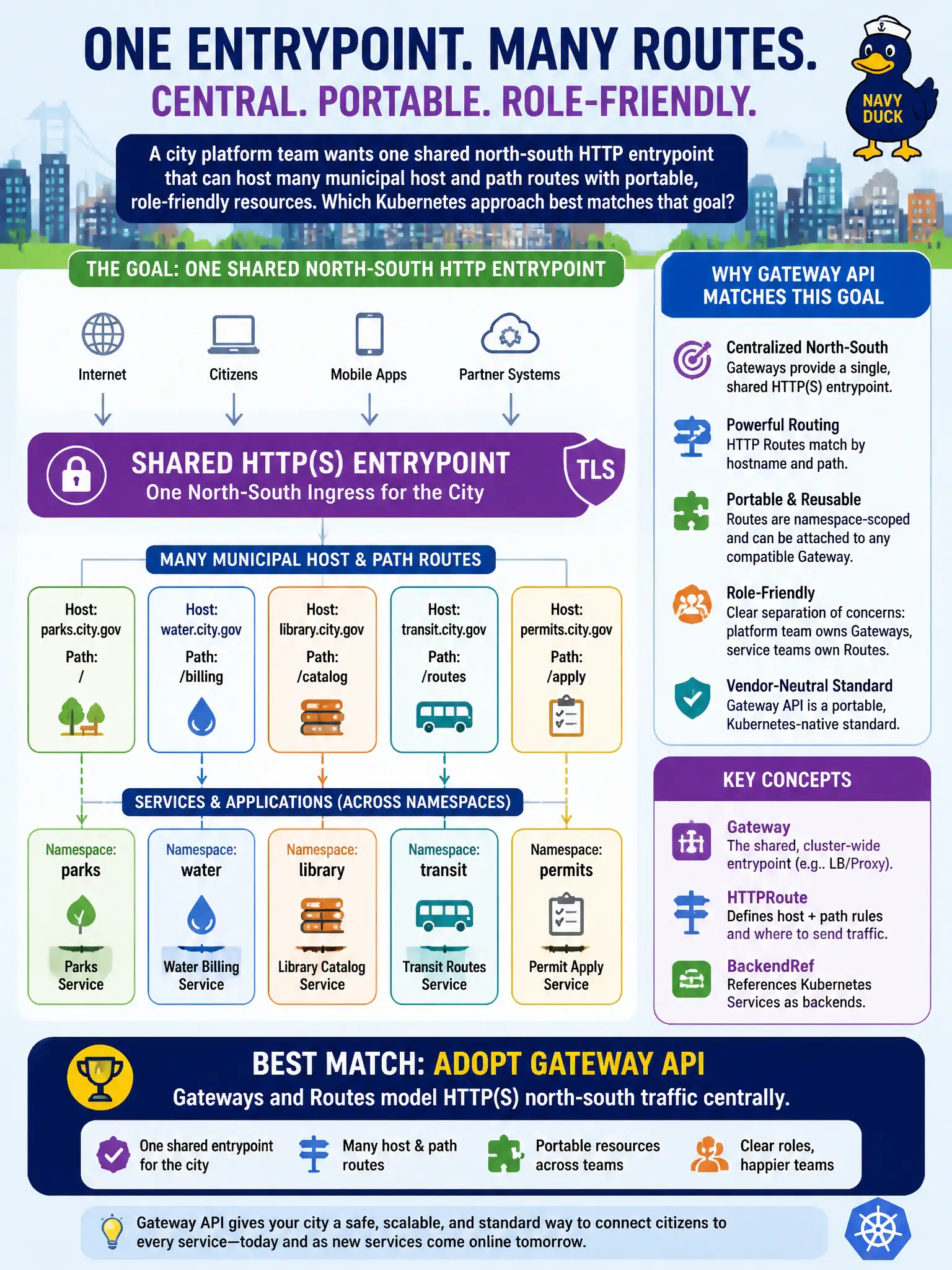
Think of Gateway API as the city’s shared front desk: one doorway (Gateway) and labeled routes for each department’s apps. It is built for hosting lots of HTTP host and path rules in a cleaner, more portable way than annotation-heavy Ingress spaghetti.
Full Explanation
Gateway API is the municipal platform’s shared north-south HTTP(S) contract: Gateway and Route resources attach to listeners so many host and path rules can live on one portable entrypoint without annotation-heavy Ingress dialect. City platform teams adopt it when they want role-friendly objects—operators own the doorway, application teams own routes—while still speaking a standard API that travels across implementations. ClusterIP Services remain the stable in-cluster frontends for Pods; Gateway API fronts citizen traffic to those Services rather than inventing a new east-west discovery model.
Publishing every app as NodePort with raw node IPs fails the goal conceptually: NodePort is L4 per-Service exposure on node addresses, not a shared L7 host/path multiplex with portable route objects. Storing public URLs only in ConfigMaps and relying on pod DNS short names confuses configuration data with an edge entrypoint and never creates north-south HTTP routing. Disabling CoreDNS and hard-coding LoadBalancer IPs into Deployments destroys in-cluster discovery and couples workloads to ephemeral external addresses—the opposite of a declarative shared gateway.
Exam caveat: Gateway API does not remove the need for a controller implementation, Services, or DNS; CRDs alone are paperwork until a Gateway controller reconciles them into a data plane. Ingress may still exist in legacy municipal portals—Gateway API is the richer, more portable direction for shared HTTP entry, not a mandate that kube-proxy disappear.
Operational check: install a Gateway controller and GatewayClass, apply a Gateway with listeners, attach HTTPRoutes that target real Services, then confirm route status shows Accepted and curl the municipal hostnames through the shared address before declaring the front desk open.