
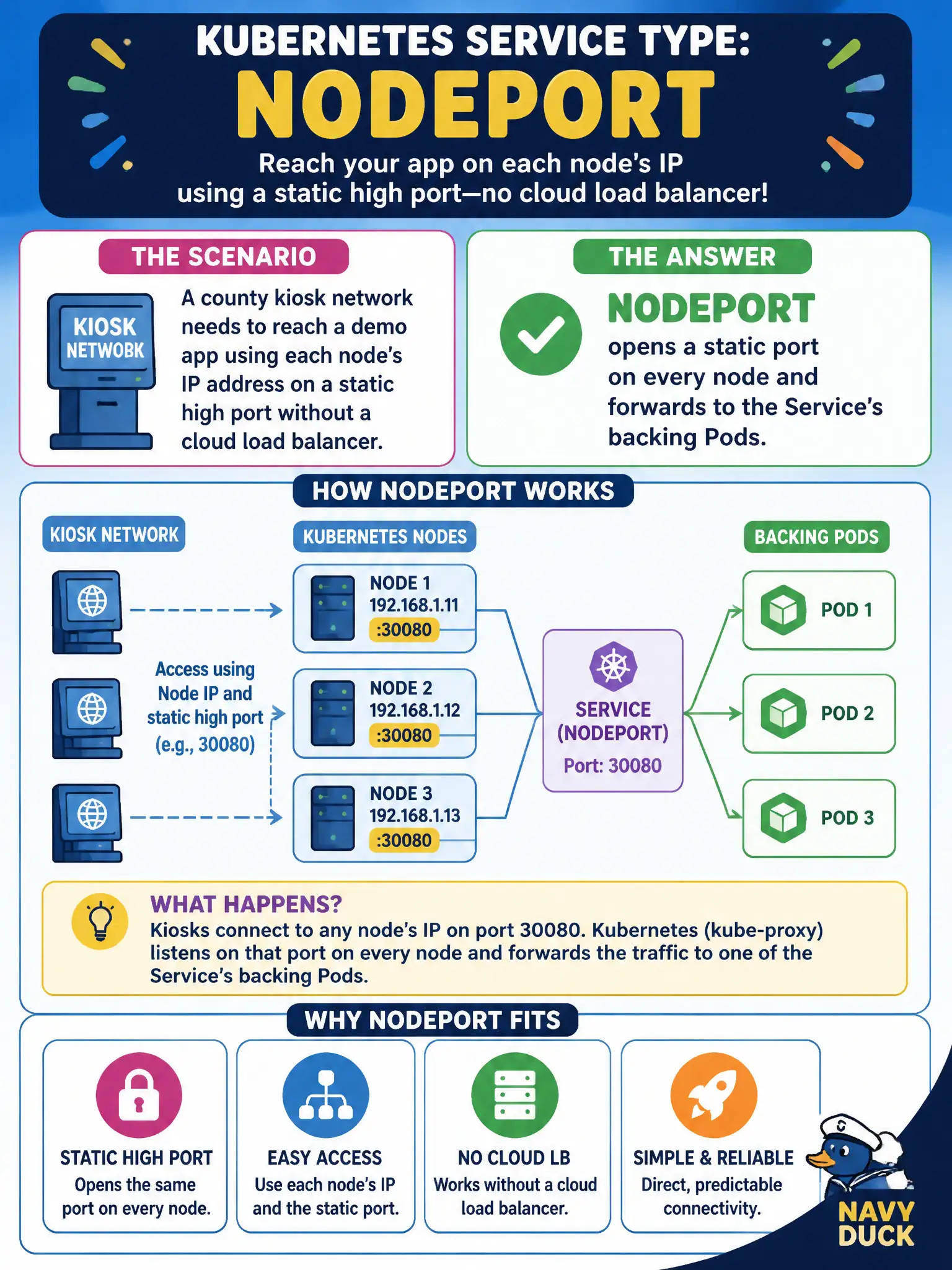
A county kiosk network needs to reach a demo app using each node's IP address on a static high port without a cloud load balancer. Which Service type fits?
Select an answer to reveal the explanation.
Short Explanation
Need a sticky port on every node's street address? That's NodePort — ClusterIP stays inside; ExternalName is just a DNS alias.
Full Explanation
A county kiosk network that needs to reach a demo app using each node's IP address on a static high port without a cloud load balancer should use NodePort, which opens a static port on every node and forwards to the Service's backing Pods. Kiosks can target any node IP plus the NodePort and reach the demo without provisioning an external load balancer—classic CKA Service-type knowledge for constrained civic networks.
ClusterIP alone does not publish the same hostPort on the physical NIC of every worker. ExternalName does not bind a node hostPort equal to the Service port automatically. Headless ClusterIP None does not always allocate ports in the 30000–32767 range on nodes; that range is the NodePort allocation band.
Exam caveat: NodePort exposes on every node; firewall and security groups must allow the port, and traffic policies affect client source IPs. Operational check: create a NodePort Service, curl nodeIP:nodePort from the kiosk network, and confirm backends receive traffic. This distinction matters on the CKA because distractors often mix adjacent objects that sound related but solve a different control-plane problem. This distinction matters on the CKA because distractors often mix adjacent objects that sound related but solve a different control-plane problem.