
A school-district Pod runs a main API container and a sidecar. How do those containers reach each other on the network by default?
Select an answer to reveal the explanation.
Short Explanation
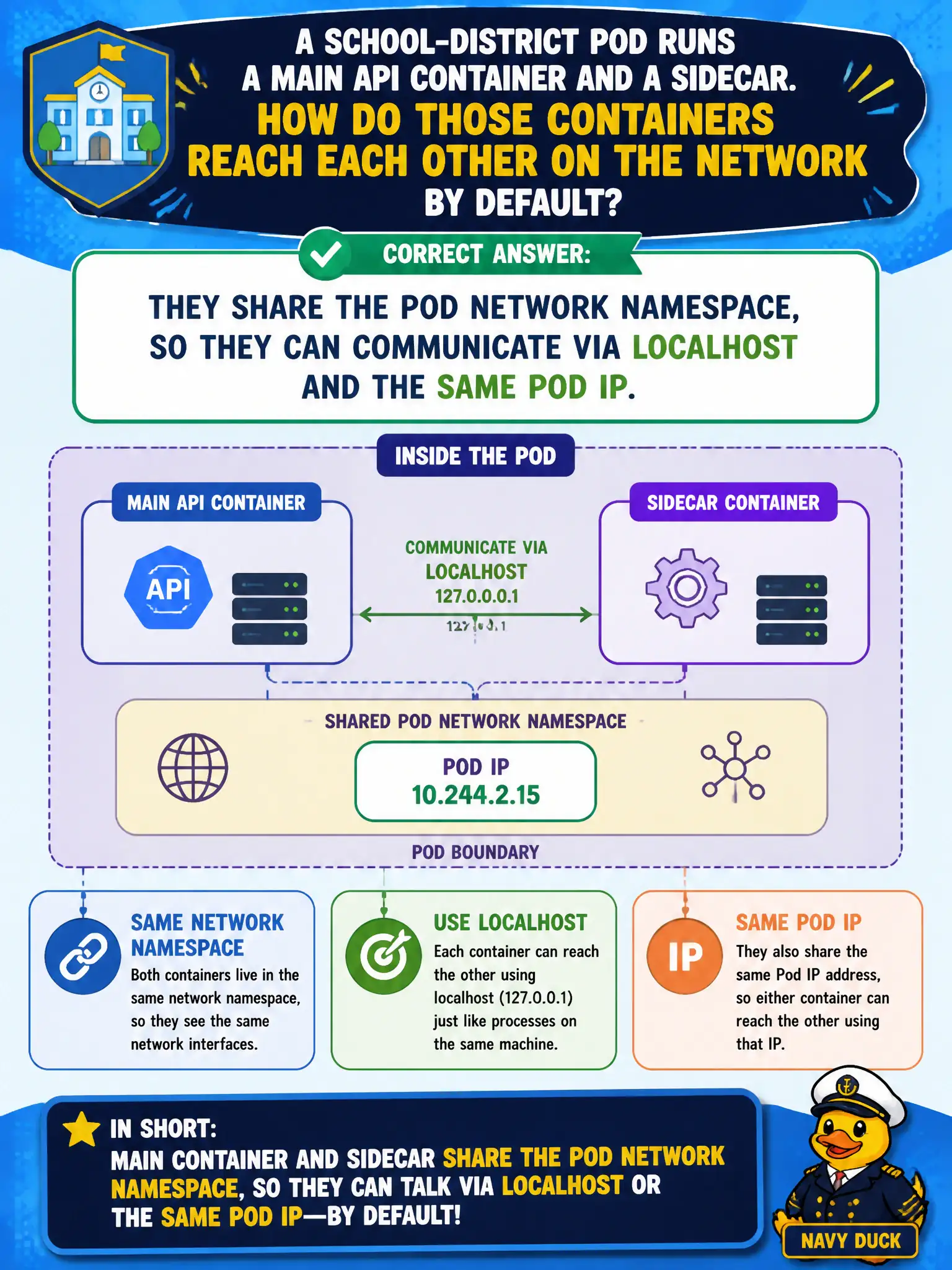
Containers in one Pod are roommates sharing one network stack—localhost and one Pod IP for all of them. They do not need a Service just to whisper to each other.
Full Explanation
A school-district Pod that runs a main API container and a sidecar reaches between those containers on the network by default because they share the Pod network namespace, so they can communicate via localhost and the same Pod IP. Containers in a Pod share network namespace and often volumes by declaration; sidecars commonly listen on localhost ports for proxy, logging, or mesh patterns without needing a Service for intra-Pod calls in education workloads.
Each container does not get a separate Pod IP requiring a ClusterIP Service to talk. They are not limited to communicating only through the node kubelet admin port. Sidecars are not forced onto hostNetwork while the main container stays on CNI by default.
Exam caveat: shared network namespace is not the same as shared process namespace; hostPID and shareProcessNamespace are separate settings. Operational check: exec into either container and curl localhost on the sibling port to validate the district sidecar pattern. This distinction matters on the CKA because distractors often mix adjacent objects that sound related but solve a different control-plane problem. This distinction matters on the CKA because distractors often mix adjacent objects that sound related but solve a different control-plane problem.