
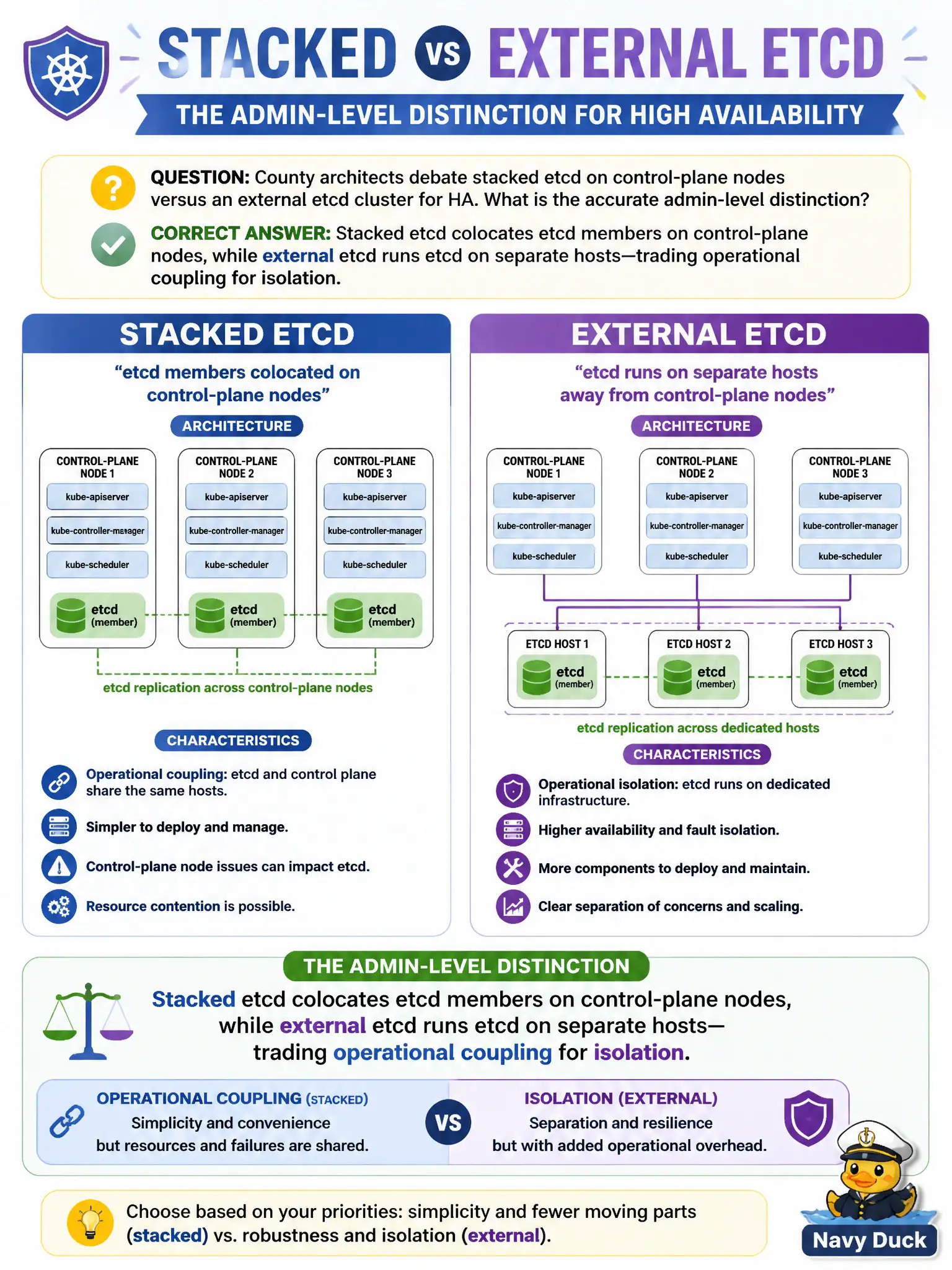
County architects debate stacked etcd on control-plane nodes versus an external etcd cluster for HA. What is the accurate admin-level distinction?
Select an answer to reveal the explanation.
Short Explanation
Stacked etcd is roommates—etcd lives on the same boxes as the control plane, simple but cozy. External etcd is a separate apartment—more moving parts, clearer blast radius. Neither magically deletes the need for quorum and backups; they just place the furniture differently.
Full Explanation
Stacked etcd colocates etcd members on control-plane nodes, while external etcd runs etcd on separate hosts—trading operational coupling for isolation. Stacked is roommates; external is a separate apartment. Neither removes the need for quorum and backups; they place the furniture differently for county HA designs. Stacked and external etcd are not operationally identical; topology changes failure domains and management. External etcd is not mandatory for every cluster larger than one worker regardless of HA goals. Stacked etcd does not store objects on workers only, nor does external etcd store objects only in Git. Exam caveat: Choose topology for ops tradeoffs; always plan odd quorum and snapshots either way. Operational check: Document which topology the civic cluster uses, verify member list and endpoints, and test backup/restore against that layout. In municipal platform operations, record the rationale in the change ticket so future on-call staff know which control was chosen and which failure modes the rejected options would create for city services. Re-validate after the next maintenance window that the same control still holds under the cluster’s current minor version and addon revisions used by the civic platform team.