
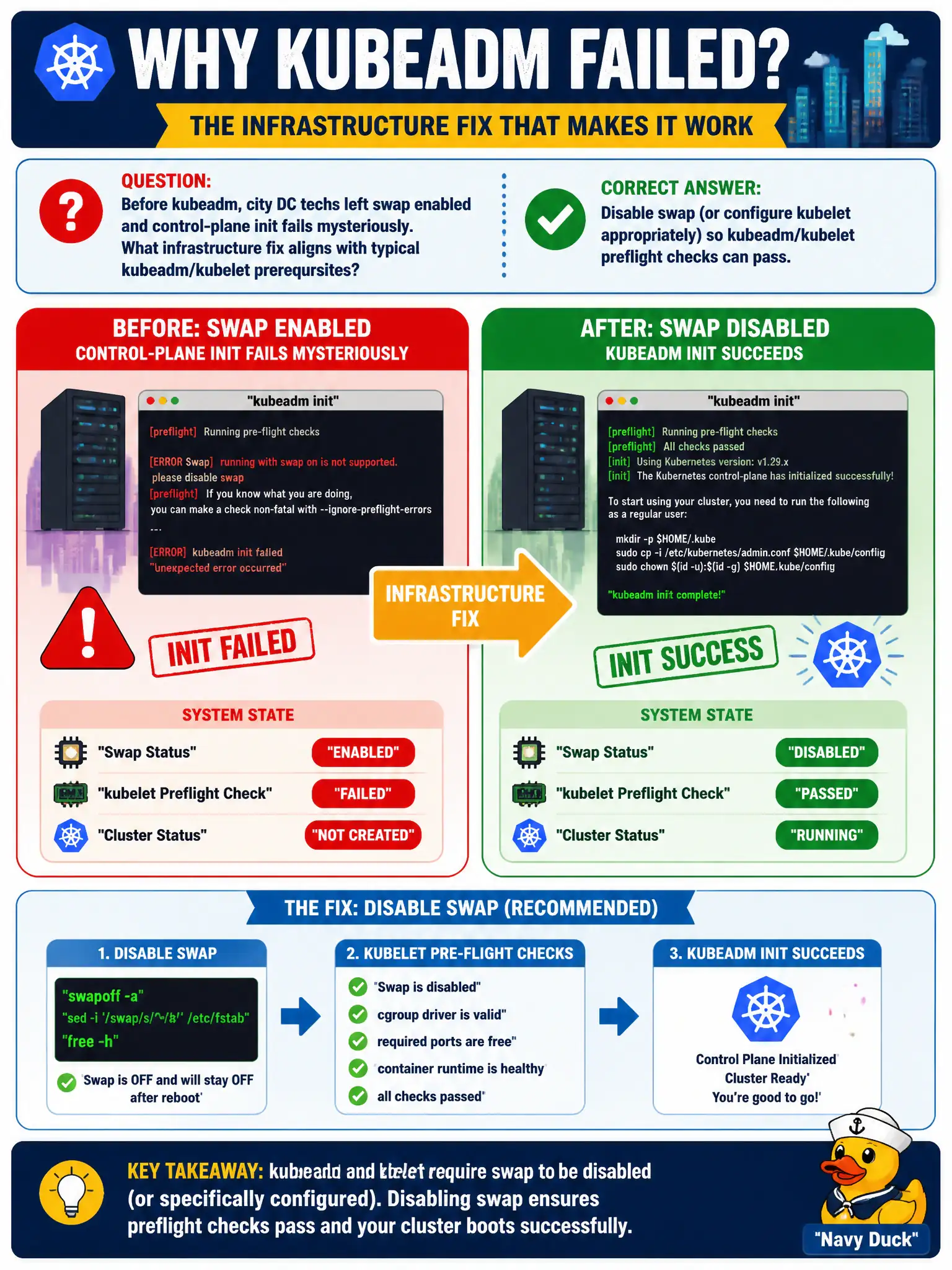
Before kubeadm, city DC techs left swap enabled and control-plane init fails mysteriously. What infrastructure fix aligns with typical kubeadm/kubelet prerequisites?
Select an answer to reveal the explanation.
Short Explanation
Kubernetes nodes like firm ground, not a trampoline of swap. Turn swap off (or follow the supported kubelet config path) before kubeadm init so preflight stops complaining. More swap usually makes the mystery worse, not better.
Full Explanation
Before kubeadm, city DC techs who leave swap enabled often fail control-plane init because kubeadm and kubelet preflight historically expect swap disabled unless the administrator intentionally configures supported kubelet swap settings. Disabling swap—or following the documented kubelet configuration path—is the infrastructure fix that aligns with typical prerequisites. Kubernetes nodes want firm ground for scheduling and eviction math, not a trampoline of host paging that surprises civic control-plane bring-up. Increasing swap size so kubelet can page etcd more aggressively usually worsens instability and still fails the common preflight expectation. Moving swap to networked iSCSI for shared paging across nodes does not satisfy kubeadm’s usual host checks and adds fragile storage dependencies. Disabling the container runtime until swap usage drops below 50% leaves the node unable to run containers and does not correct the swap prerequisite itself. Exam caveat: know the classic kubeadm preflight items—swap, required ports, container runtime, and kernel settings—before blaming static Pod manifests. Operational check: disable swap with swapoff -a, remove or comment swap entries in fstab as appropriate, confirm free -h shows no swap in use (unless kubelet is explicitly configured per current docs), then rerun kubeadm init and archive the preflight output in the change record.