
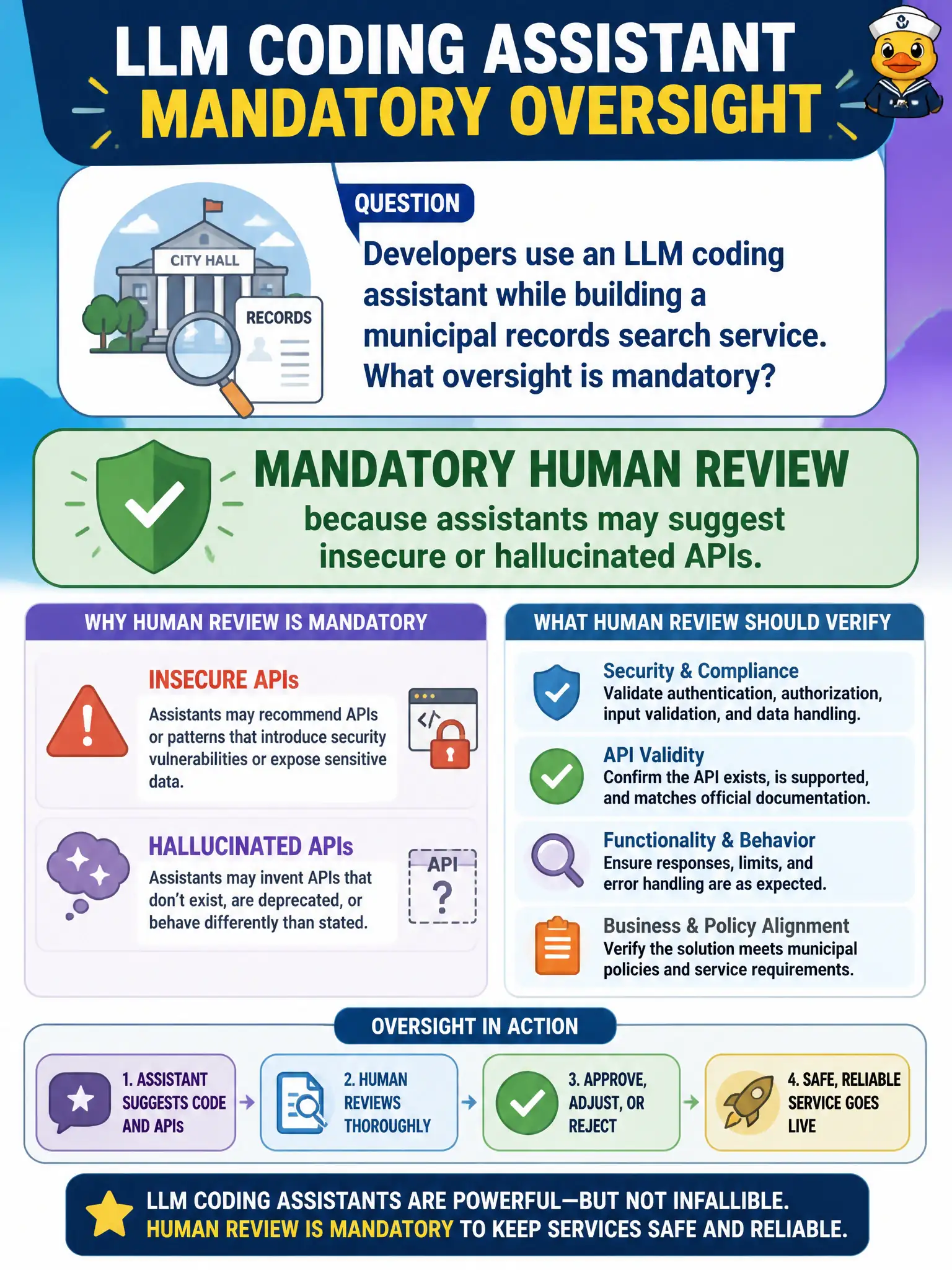
Developers use an LLM coding assistant while building a municipal records search service. What oversight is mandatory?
Select an answer to reveal the explanation.
Short Explanation
The coding assistant is a fast intern who sometimes invents library calls that do not exist—and sometimes invents insecure ones that do. Human review stays mandatory for city code. AI speed without review is just faster technical debt.
Full Explanation
LLM coding assistants can accelerate municipal records-search development but may suggest insecure patterns, outdated APIs, or entirely hallucinated library calls that do not exist or behave differently than claimed. Mandatory human review—code review by qualified developers against secure coding standards—is required before assistant-generated code merges. Assistants are productivity tools, not accountable authors; the city remains responsible for authenticity, licensing, and security of shipped logic that may touch public records.
Accepting every suggested snippet because models cannot hallucinate APIs is false; hallucination and insecure defaults are well-documented failure modes.
Pasting production secrets into prompts to improve completion quality leaks credentials into vendor logs and training-adjacent systems and may violate policy and law.
Disabling code review whenever the assistant writes more than half the file inverts risk—the more generated code, the more review is needed, not less.
Exam caveat: human oversight of AI-assisted coding is the expected control; do not treat model output as inherently safe. Operational check: ban secret paste into prompts, require PR review on AI-assisted changes for records systems, run SAST/secret scanning regardless of authorship, and document assistant use in team standards so reviewers know to scrutinize unfamiliar APIs.