
The city adopts a managed enterprise HR module plus third-party add-ons. What risk posture change should leadership recognize?
Select an answer to reveal the explanation.
Short Explanation
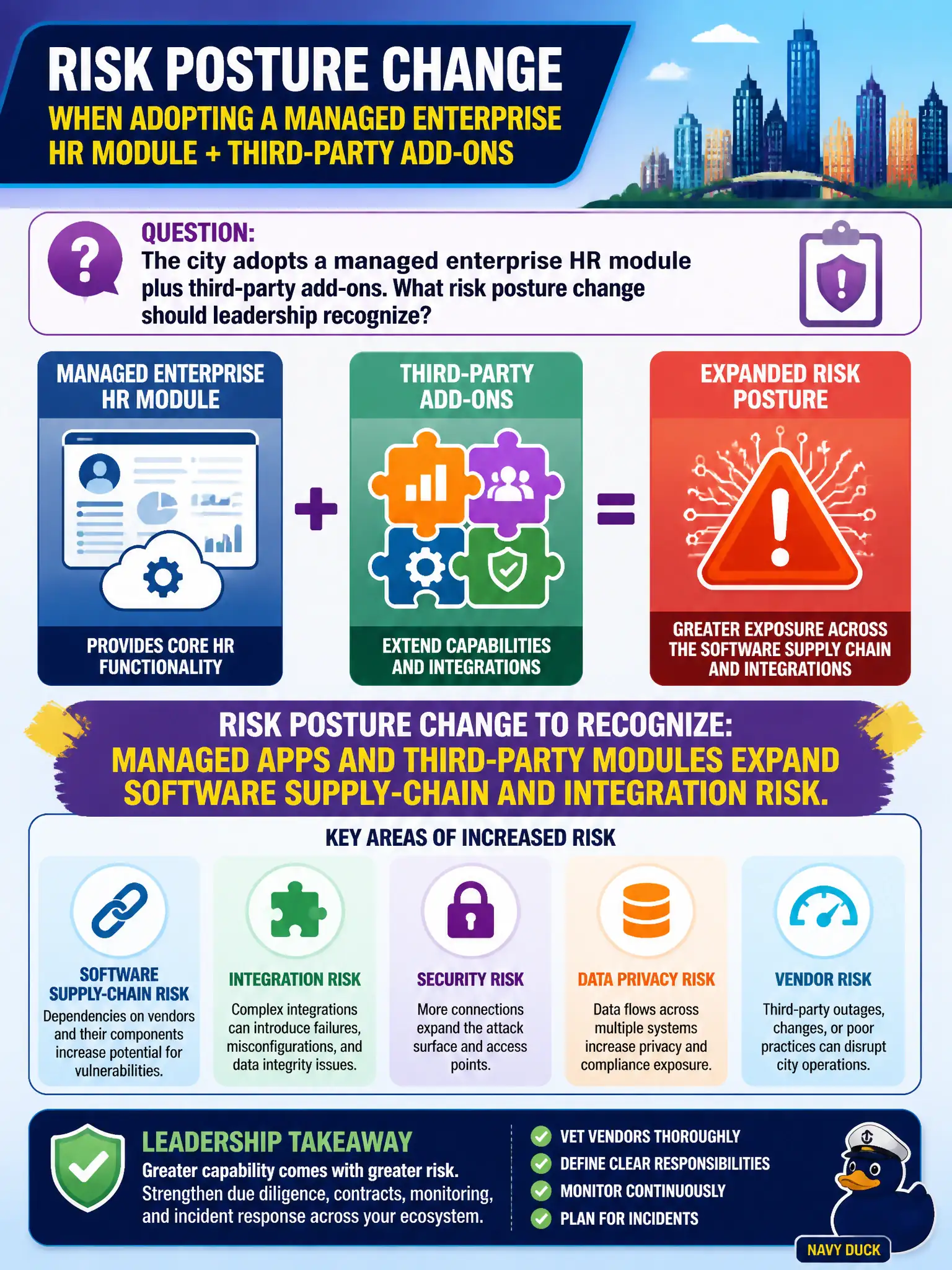
Handing HR to a managed suite feels tidy until you count every plug-in and connector in the chain. Each third-party module is another link that can bend. Leadership should treat that expanded supply chain as real risk, not invisible magic.
Full Explanation
Adopting a managed enterprise HR module plus third-party add-ons expands software supply-chain and integration risk. Each managed app, plug-in, connector, and identity integration is another party that can introduce vulnerabilities, overly broad OAuth scopes, data exfiltration paths, or outages affecting payroll and employee PII. Outsourcing operations does not delete residual risk; it redistributes and often multiplies dependency on external update cadence and security posture.
Claiming outsourcing eliminates all residual application risk for the municipality is false; the city remains accountable for employee data and service outcomes.
Add-ons do not inherit the city's FedRAMP authorization automatically; authorizations are boundary-specific and product-specific, and add-ons may sit outside the authorized stack.
Assuming third-party modules never process sensitive employee data is unsafe—HR add-ons frequently touch identity, banking, benefits, or performance information.
Exam caveat: supply-chain and integration risk grow with managed apps and plug-ins; shared responsibility remains. Operational check: inventory every HR add-on, review scopes and data flows, require vendor security terms, monitor integration accounts, and remove unused modules that silently widen the municipal HR attack surface.