
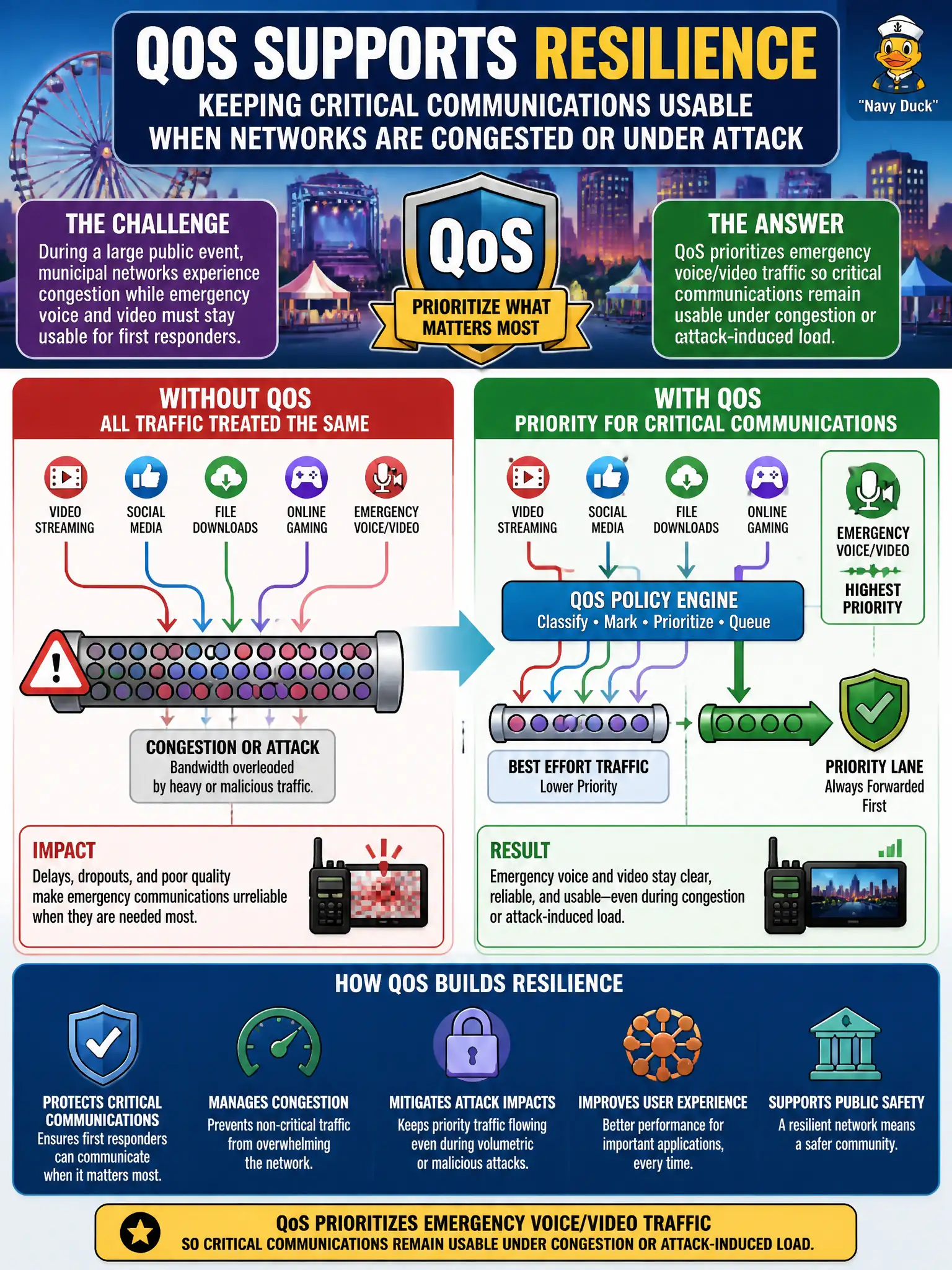
During a large public event, municipal networks experience congestion while emergency voice and video must stay usable for first responders. How does QoS support resilience here?
Select an answer to reveal the explanation.
Short Explanation
When the network is jammed, QoS is the express lane for 911-grade voice and video. Backups can wait; responders cannot.
Full Explanation
Quality of Service (QoS) supports resilience by classifying and prioritizing latency-sensitive traffic so emergency voice and video remain usable when municipal networks face congestion—whether from a large public event’s surge or from attack-induced load that floods links. Marking and queuing policies give first-responder communications preferential treatment over bulk transfers, keeping command coordination available when ordinary best-effort traffic would otherwise collapse interactive sessions.
Claiming QoS replaces the need for any alternate communications paths overstates its role; prioritization on a failed or fully saturated path still needs diverse routes and failover plans. Deprioritizing emergency voice so bulk file backups finish first inverts operational priority and can endanger life-safety response. Treating QoS as only a billing feature ignores its operational resilience function in security and network operations for public-safety traffic.
Exam caveat: QoS is a network mechanism that can protect critical services under congestion; it is complementary to redundancy, not a full substitute. Exam scenarios often pair emergency communications with prioritization under load. Attack-induced congestion (for example flooding) is a valid resilience context for QoS discussion alongside capacity and filtering.
Operational check: before major events, validate QoS policies on civic networks pathing emergency voice/video, confirm monitoring shows those classes receive priority under load tests, and verify backup communications paths still exist if primary links fail entirely.