
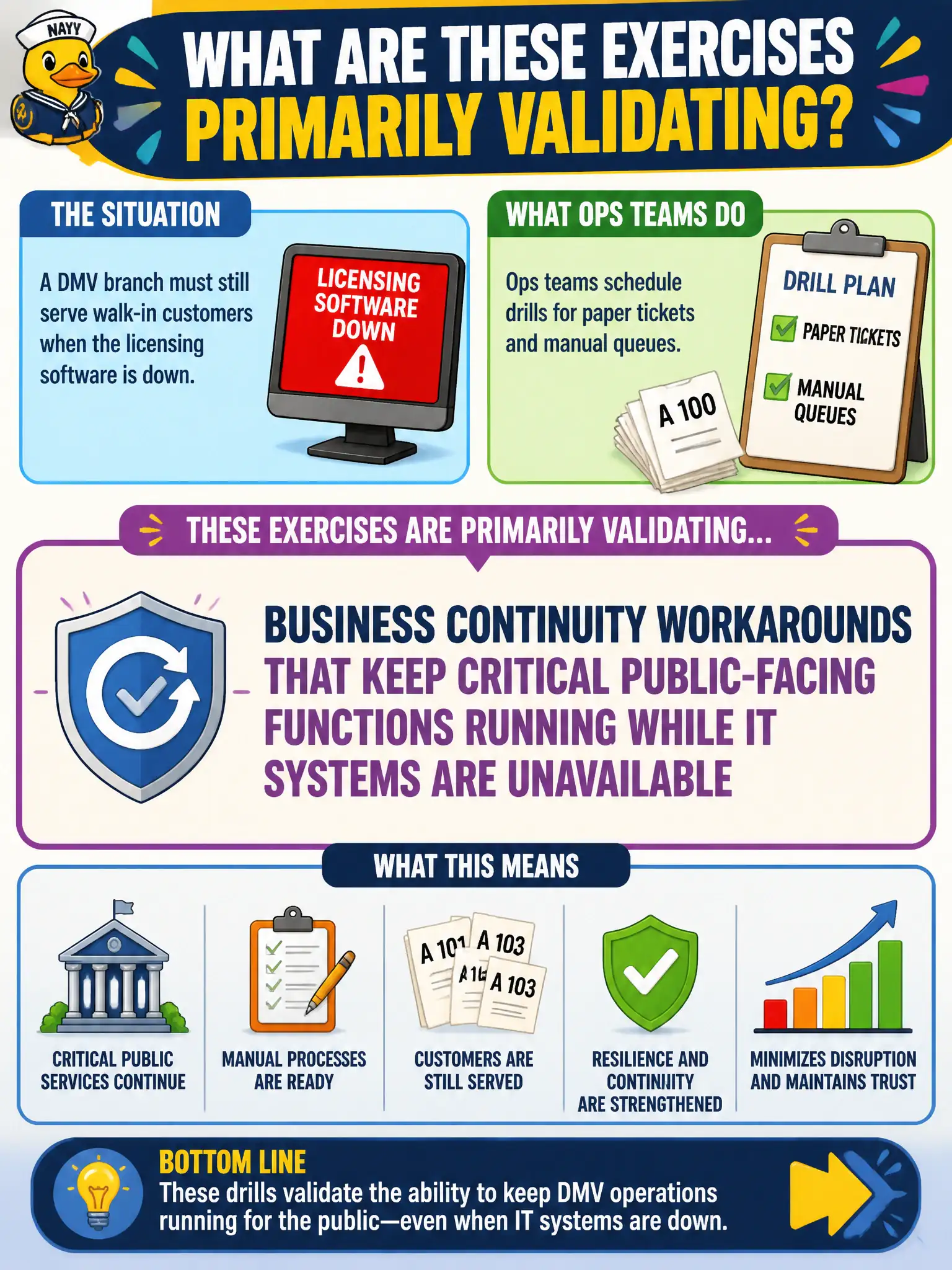
A DMV branch must still serve walk-in customers when the licensing software is down. Ops teams schedule drills for paper tickets and manual queues. What are these exercises primarily validating?
Select an answer to reveal the explanation.
Short Explanation
When the screens are dark but the lobby is full, paper tickets and manual lines are BC muscle memory. You’re practicing serving people—not just failing over a server rack.
Full Explanation
Drills that practice paper tickets and manual queues at a DMV branch primarily validate business continuity workarounds: the ability to keep critical public-facing functions running when licensing software is unavailable. Those exercises prove staffing patterns, form handling, identity verification without the usual app, queue management, and reconciliation steps once systems return. They are continuity muscle memory for serving residents—not a substitute for datacenter failover tests, but an essential complement when walk-in demand continues during IT outages.
Treating the drills as only datacenter failover DR misses the point; paper processes are classic BC measures precisely because they are unrelated to failing over a server rack. Penetration testing of licensing code is a software security activity, not what manual-queue drills validate. Using full interruption of building electrical service as the sole continuity measure tests facilities resilience narrowly and does not prove customer-service workarounds when the outage is application-centric rather than power-centric.
Exam caveat: distinguish BCP exercises (people, processes, alternate modes) from DR tests (IT recovery). Manual procedures and alternate workflows are frequently correct BC answers in public-service scenarios. One exercise type does not cover all continuity risk.
Operational check: after each DMV manual-operations drill, measure transaction throughput, error rates, and privacy handling on paper forms; update the continuity playbook; and confirm staff know when to invoke manual mode versus waiting for DR failover.