
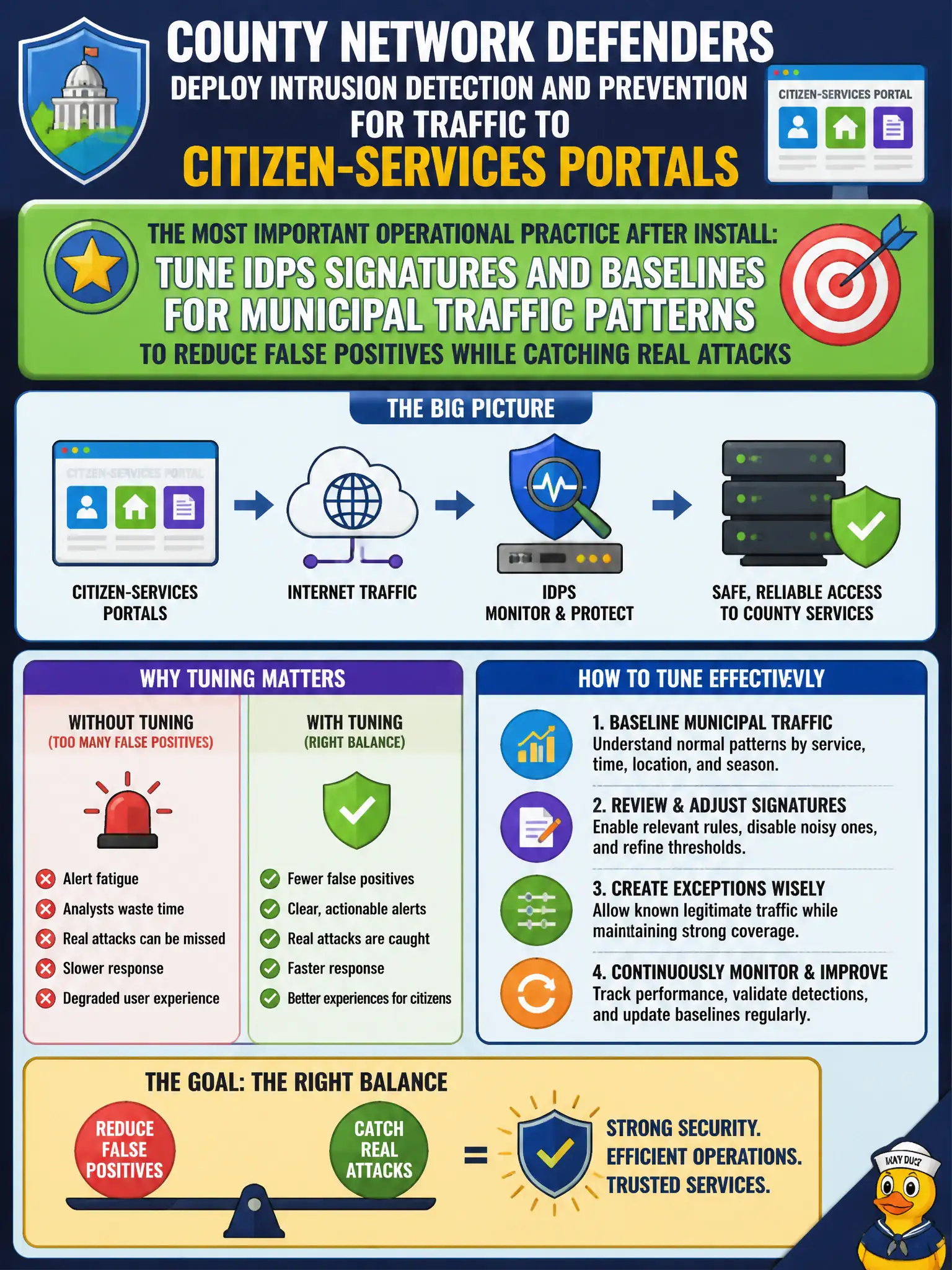
County network defenders deploy intrusion detection and prevention for traffic to citizen-services portals. What operational practice is most important after install?
Select an answer to reveal the explanation.
Short Explanation
An IDS/IPS straight out of the box is like a smoke alarm that screams for toast — useful only after you tune it to the building. Match signatures and baselines to city traffic and keep the alert path alive. Set-and-forget noise or offline sensors waste the investment.
Full Explanation
Intrusion detection and prevention systems deliver value for municipal networks only when signatures, baselines, and response workflows match real traffic and operational cadence. City environments often include public Wi-Fi, SCADA/OT segments, citizen portals, and bursty batch windows that differ from generic enterprise defaults. Tuning reduces false positives that train staff to ignore alerts while preserving sensitivity to attacks against those patterns. Keeping sensors online with a ticketed alert path ensures detections become investigations rather than unread printer output. Periodic review of tuned rules, exception lists, and blocked actions prevents both drift toward noise and dangerous over-blocking of legitimate emergency services traffic.
Leaving every signature enabled forever without review regardless of noise guarantees alert fatigue and wasted analyst time. Placing sensors offline except during annual tabletop exercises means real attacks outside drill week go unseen. Forwarding IDPS alerts only to a printer in a locked closet with no ticket workflow creates the appearance of monitoring without response accountability. Exam caveat: prevention mode changes must be change-controlled—false positives in inline IPS can become availability incidents for 911 or utility networks. Operationally, baseline normal municipal flows, tune in detect-then-protect stages where appropriate, and measure mean time from alert to ticket as a health metric for the IDPS program.