
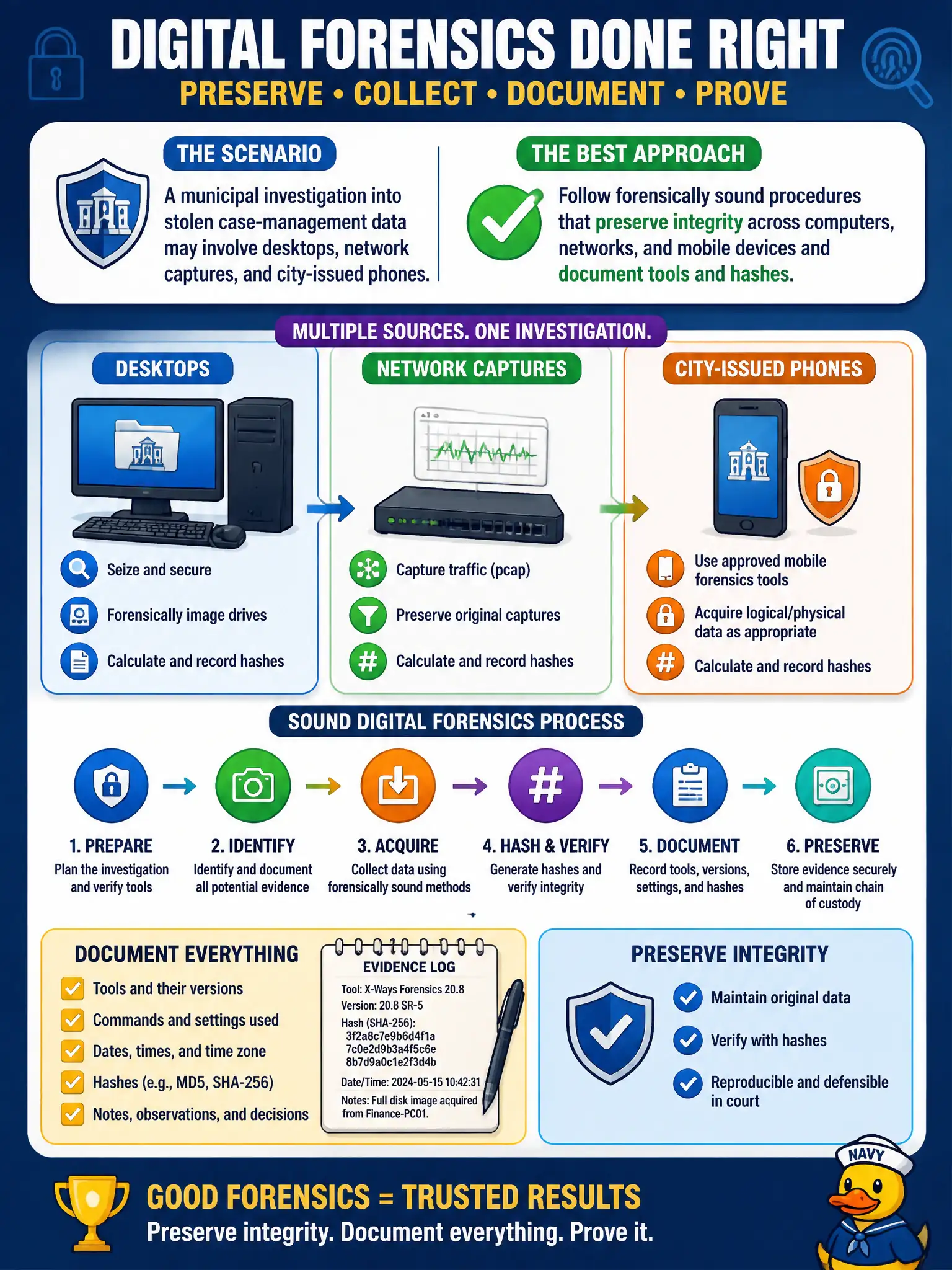
A municipal investigation into stolen case-management data may involve desktops, network captures, and city-issued phones. What approach best reflects sound digital forensics practice?
Select an answer to reveal the explanation.
Short Explanation
Forensics is careful packing, not shaking the gift to see what rattles. Use sound procedures, hash what you collect, and cover hosts, nets, and mobiles the case actually touches. Power-cycling for fun or letting suspects pick their own files is how artifacts vanish.
Full Explanation
Forensically sound procedures protect the integrity and admissibility of electronic evidence across the devices and channels a municipal investigation actually touches—workstations, servers, network captures, and mobile devices. Sound practice typically includes using validated tools, documenting versions and operators, acquiring with write-blocking where appropriate, computing cryptographic hashes before and after acquisition, and maintaining notes that allow another examiner to understand what was done. Covering hosts, networks, and mobiles in scope prevents missing chat, MFA prompts, or cloud sync artifacts that live outside a single laptop image. Documentation is not bureaucracy; it is how the city defends the method when findings are challenged.
Power-cycling every device repeatedly before imaging to clear volatile clues can destroy RAM-resident evidence, disrupt encryption key material in memory, and alter system state in ways that complicate timelines. Asking suspects to export their own selected files without oversight invites spoliation, selective disclosure, and disputes over authenticity. Relying solely on verbal interviews and never touching electronic artifacts forgoes corroboration that digital records often provide and weakens cases that later need technical proof. Exam caveat: order of volatility and integrity preservation guide collection priorities—do not “clean” a system first. Operationally, maintain a forensics kit and playbook that lists approved tools, hash algorithms, and storage procedures, and train first responders not to casually reboot or browse suspect devices.