
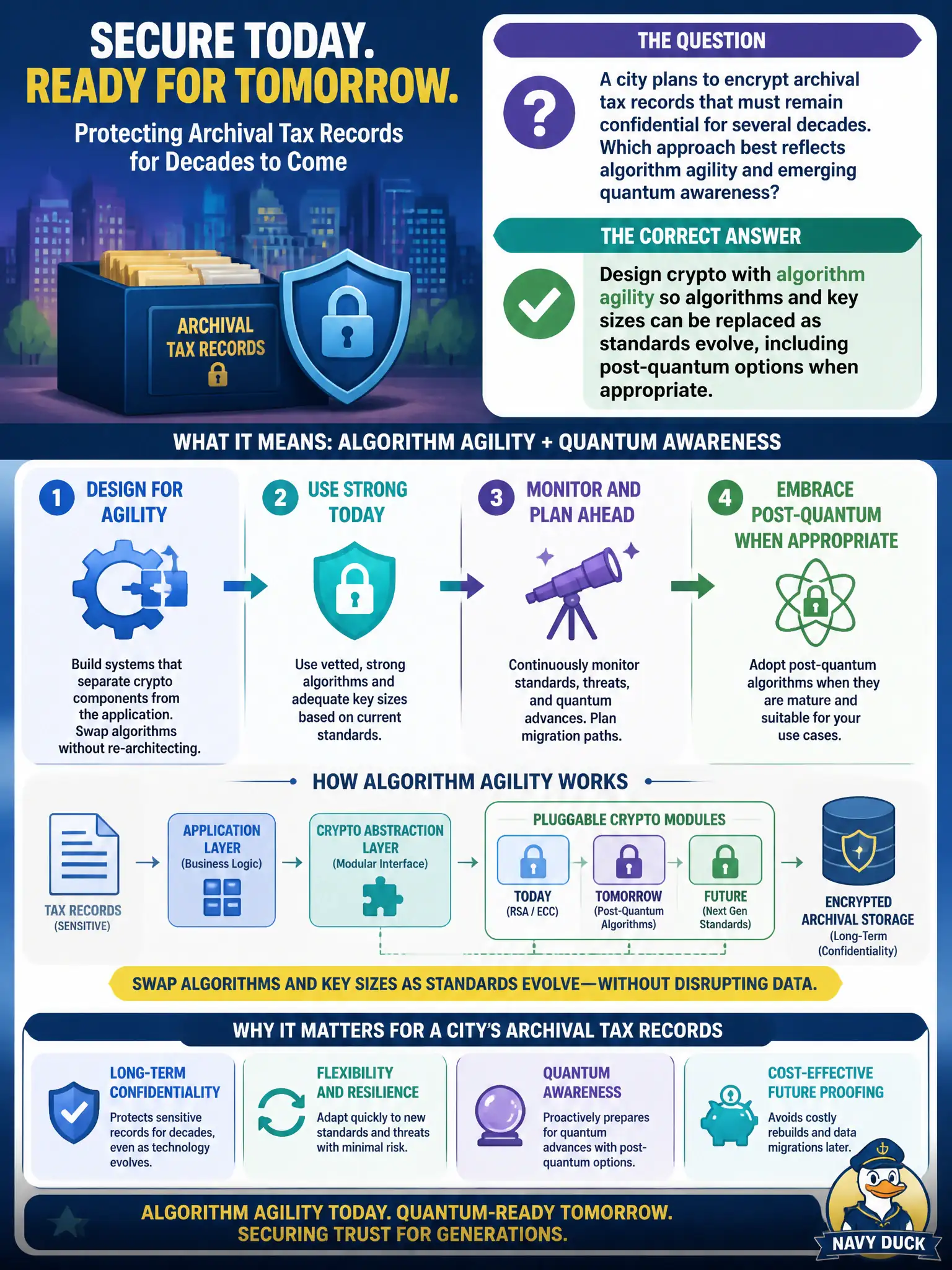
A city plans to encrypt archival tax records that must remain confidential for several decades. Which approach best reflects algorithm agility and emerging quantum awareness?
Select an answer to reveal the explanation.
Short Explanation
Long-lived secrets outlive today's favorite algorithm. Build so you can swap ciphers and keys later—including when post-quantum standards mature—instead of welding one brittle choice into the archive forever.
Full Explanation
Archival tax records that must stay confidential for decades will outlive today’s preferred classical algorithms and key sizes. Algorithm agility means designing storage formats, key metadata, and re-encryption paths so algorithms and parameters can be substituted as standards evolve—including adopting post-quantum or hybrid schemes when municipal policy and standards bodies deem them appropriate. Quantum awareness at the planning level reinforces that long confidentiality lifetimes increase harvest-now-decrypt-later risk, so lock-in to a single brittle cipher is an architectural failure.
Hard-coding a proprietary cipher with no migration path maximizes vendor and cryptanalytic lock-in and contradicts agility. Leaving archives in cleartext behind only physical vault locks protects premises, not copies, media mishandling, or insider access to readable bits over decades. Choosing the shortest key for performance and never revisiting it deliberately under-provisions strength against future compute growth.
Exam caveat: CISSP stresses crypto agility and awareness of emerging threats such as quantum computing against long-lived secrets; the correct answer is design for change, not permanent attachment to one algorithm brand.
Operational check: store algorithm identifiers with ciphertext; maintain KEK/DEK hierarchies that support re-wrap and re-encrypt campaigns; track NIST and municipal crypto standards; schedule periodic cryptographic reviews for tax archives; pilot hybrid or PQC options in nonproduction before mandated cutovers.