
Election-night tabulation virtual machines share hypervisors with public web servers, and a research HPC cluster adds further multi-tenant exposure. What architectural concern is most critical?
Select an answer to reveal the explanation.
Short Explanation
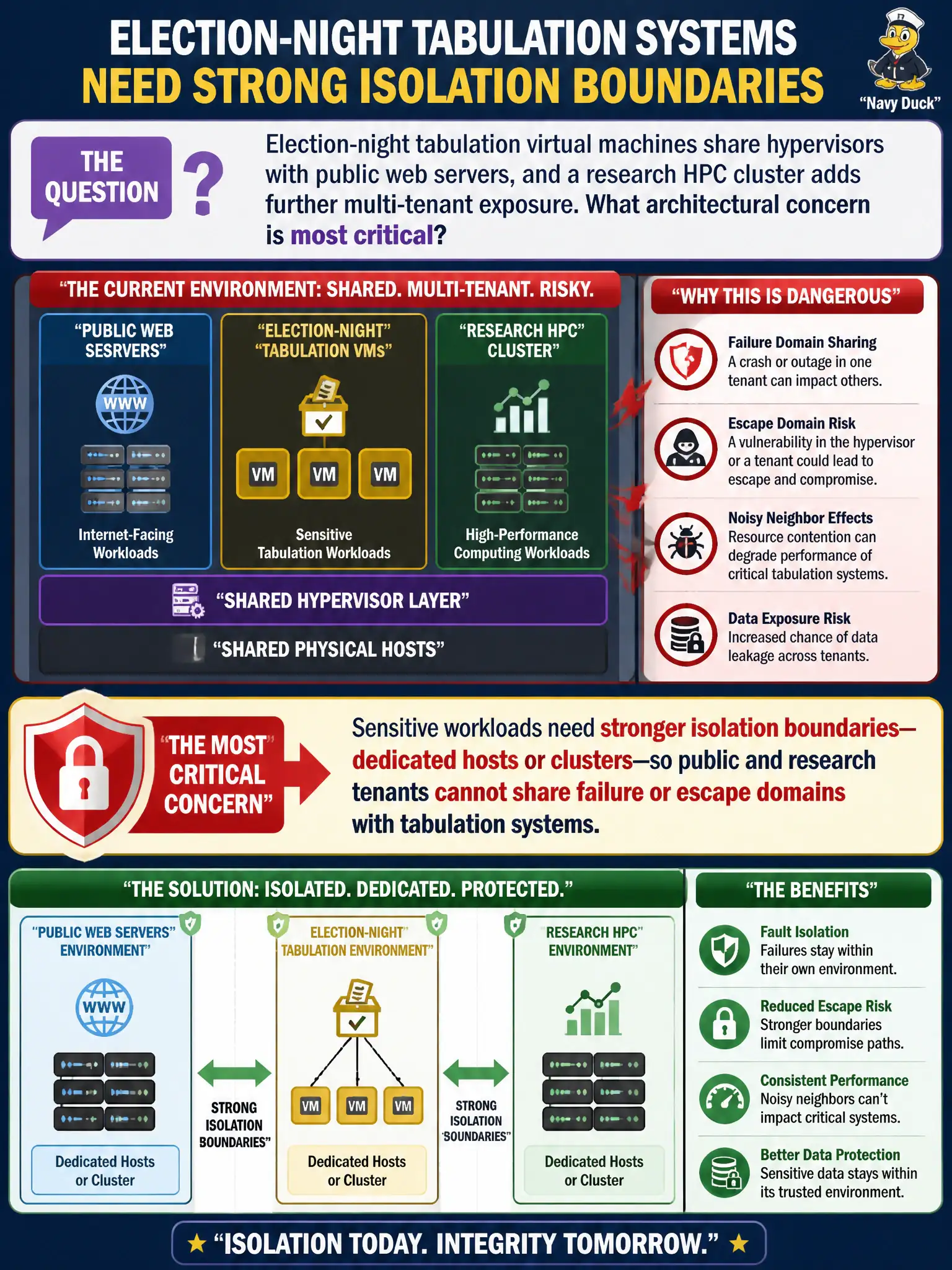
Election tabulation next to a public website on the same hypervisor is roommate roulette. Sensitive workloads need their own building—or at least their own floor—not a bunk bed with the internet.
Full Explanation
Election-night tabulation virtual machines sharing hypervisors with public web servers—and further multi-tenant exposure from a research HPC cluster—creates a critical isolation failure for a high-stakes integrity and confidentiality workload. Sensitive workloads need stronger isolation boundaries, such as dedicated hosts or separate clusters, so public and research tenants cannot share failure domains, side-channel proximity, or hypervisor-escape impact with tabulation systems. Virtualization does not guarantee perfect isolation regardless of workload sensitivity; shared kernels and hypervisors remain high-value targets. Co-locating public web tiers with election tabulation for cheaper licensing prioritizes cost over separation that election security demands. Short-lived HPC jobs do not eliminate the need for segmentation; tenancy and escape risk persist while jobs run and through residual misconfiguration. Exam caveat: multi-tenancy and sensitivity drive isolation strength; “virtualization equals security” is a classic false comfort. Operational check: migrate tabulation VMs to dedicated election infrastructure with separate admin planes, block shared storage/network with public tiers, validate no HPC project can schedule onto those hosts, and document isolation in the election security architecture package.