
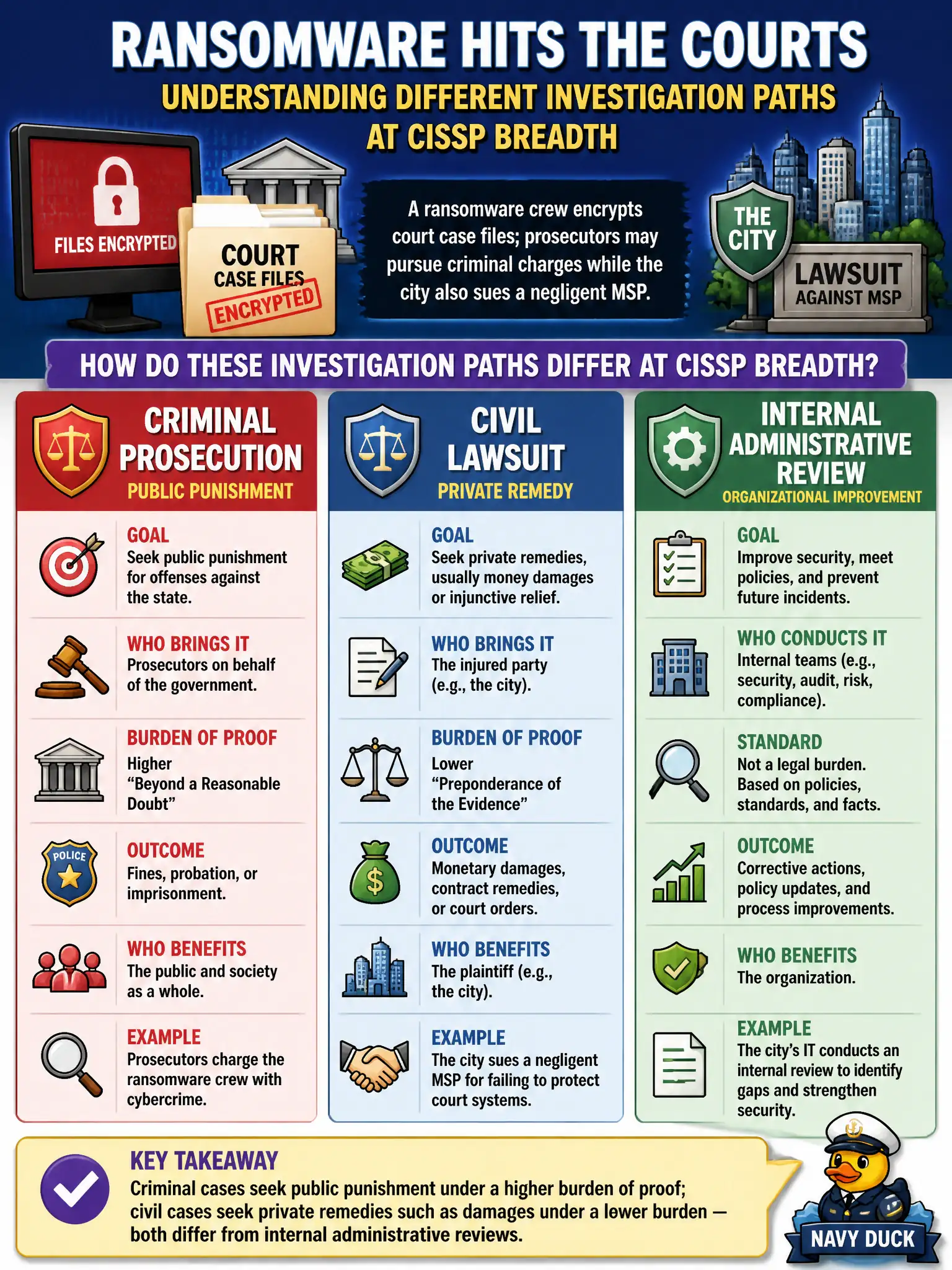
A ransomware crew encrypts court case files; prosecutors may pursue criminal charges while the city also sues a negligent MSP. How do these investigation paths differ at CISSP breadth?
Select an answer to reveal the explanation.
Short Explanation
Prosecutors chase crime with a high bar for guilt; the city suing a sleepy MSP chases money or performance with a lower bar. Neither path is the same as an internal write-up. Ransomware can trigger all three lanes, so know which lane you are in.
Full Explanation
Criminal, civil, and administrative paths differ in purpose, parties, remedies, and burden of proof. Criminal cases seek public punishment and generally require proof beyond a reasonable doubt; civil cases seek private remedies such as damages or performance under a lower burden; both differ from internal administrative reviews that test policy compliance. After ransomware encrypts court case files, prosecutors may pursue criminals while the city sues a negligent MSP—those are distinct lanes that can run in parallel with internal lessons-learned processes.
Claiming criminal and civil investigations use identical standards and remedies erases the burden and purpose distinctions CISSP expects. Asserting that civil suits always require proof beyond a reasonable doubt reverses the usual burdens, and saying criminal cases never involve digital evidence is factually wrong. Believing MSP negligence suits replace forensic preservation after ransomware is dangerous: litigation and prosecution both often need preserved artifacts, and skipping preservation can destroy remedies.
Exam caveat: Memorize the triad of investigation types and their burdens/remedies; parallel tracks are common after major incidents.
Operational check: Preserve forensic images and logs early, coordinate with counsel on criminal referrals versus civil claims against the MSP, keep administrative after-action separate, and avoid reuse of the same untracked evidence copies across teams.