
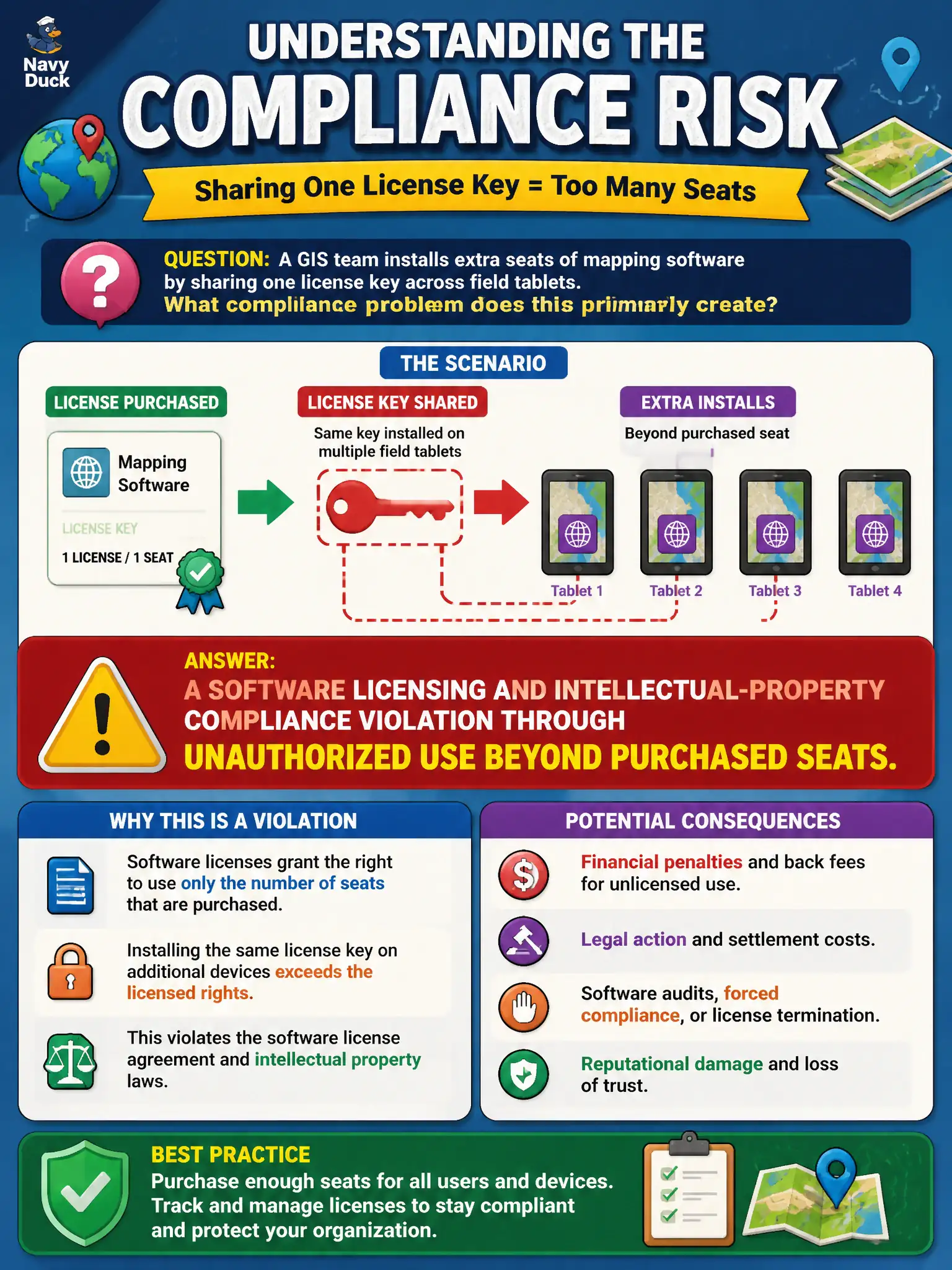
A GIS team installs extra seats of mapping software by sharing one license key across field tablets. What compliance problem does this primarily create?
Select an answer to reveal the explanation.
Short Explanation
One paid key on ten tablets is like one concert ticket used by ten people at the gate. The vendor's license is intellectual property; oversharing seats breaks it. That is a compliance problem, not a cable-lock or bandwidth story.
Full Explanation
Software licensing is an intellectual-property and compliance obligation. Sharing one paid GIS license key across multiple field tablets to create unauthorized seats primarily creates a licensing and IP compliance violation: the organization is using more instances than purchased rights allow. Municipal thrift does not override vendor license terms, and field productivity does not legalize key sharing. Auditors and software publishers treat over-deployment as unauthorized use even when every tablet serves a legitimate public-works task.
Cryptography export rules about map tiles crossing county lines are a distractor; domestic seat overuse is not an export-control story and invents a regulatory frame the scenario never supports. Missing cable locks may be a physical-security weakness on field gear but is not what the shared-key behavior primarily creates. Suggesting license keys consume bandwidth and cause availability outages misstates both the technical effect and the compliance nature of the problem—the core failure is entitlement abuse, not capacity exhaustion.
Exam caveat: Unlicensed or over-deployed software on the exam maps to IP/licensing compliance, not to CIA triad wordplay or physical-security side issues. Prefer the answer that names unauthorized use beyond purchased seats.
Operational check: Reconcile installed GIS clients to purchased entitlements, deploy a license server or named-user controls, remove shared keys from device images, educate field supervisors that one key is not a site license unless the contract says so, and include software asset management in periodic compliance audits.