
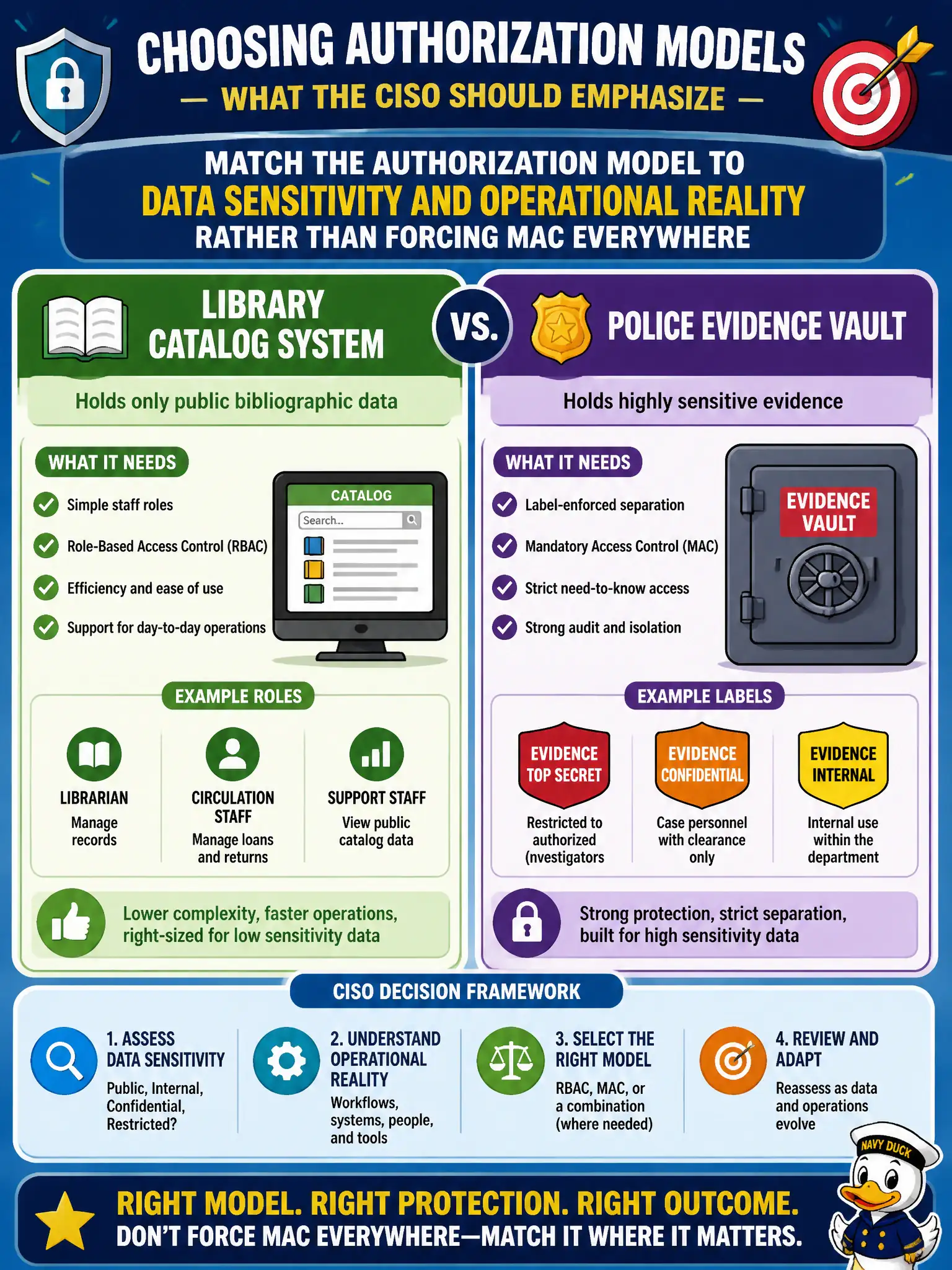
A library catalog system holds only public bibliographic data and needs simple staff roles, while a police evidence vault needs label-enforced separation. What should the CISO emphasize when choosing authorization models?
Select an answer to reveal the explanation.
Short Explanation
Not every filing room needs a SCIF stamp. Public catalog? Simple roles are fine. Evidence vault? Bring the labels. Pick the model that fits the data and how people actually work—do not MAC the whole city for sport.
Full Explanation
Authorization model selection is a risk and operations decision: match enforcement strength and friction to data sensitivity, threat, and how staff actually work. A library catalog of public bibliographic data needs simple staff roles (often RBAC) with low classification overhead, while a police evidence vault needs label-enforced separation characteristic of MAC. The CISO’s emphasis should be proportional design—right model per system—rather than a one-size-fits-all mandate that ignores municipal diversity of data.
Applying multilevel MAC to every city system, including the public catalog, imposes clearance workflows and labeling costs that do not buy meaningful confidentiality for already-public records and may stall library operations. Using only DAC on the evidence vault lets detectives freely re-share case files, which is precisely the uncontrolled lateral sharing evidence handling must prevent. Skipping authorization modeling in favor of annual password resets addresses authenticator hygiene at best and leaves entitlement design unaddressed.
Exam caveat: Domain 5 expects you to select and justify models per context; “more MAC everywhere” is rarely the professional answer when sensitivity differs. Operational check: inventory city systems by classification and collaboration need, document chosen model and residual risk with data owners, and revisit when a low-sensitivity system begins holding regulated or investigative content.