
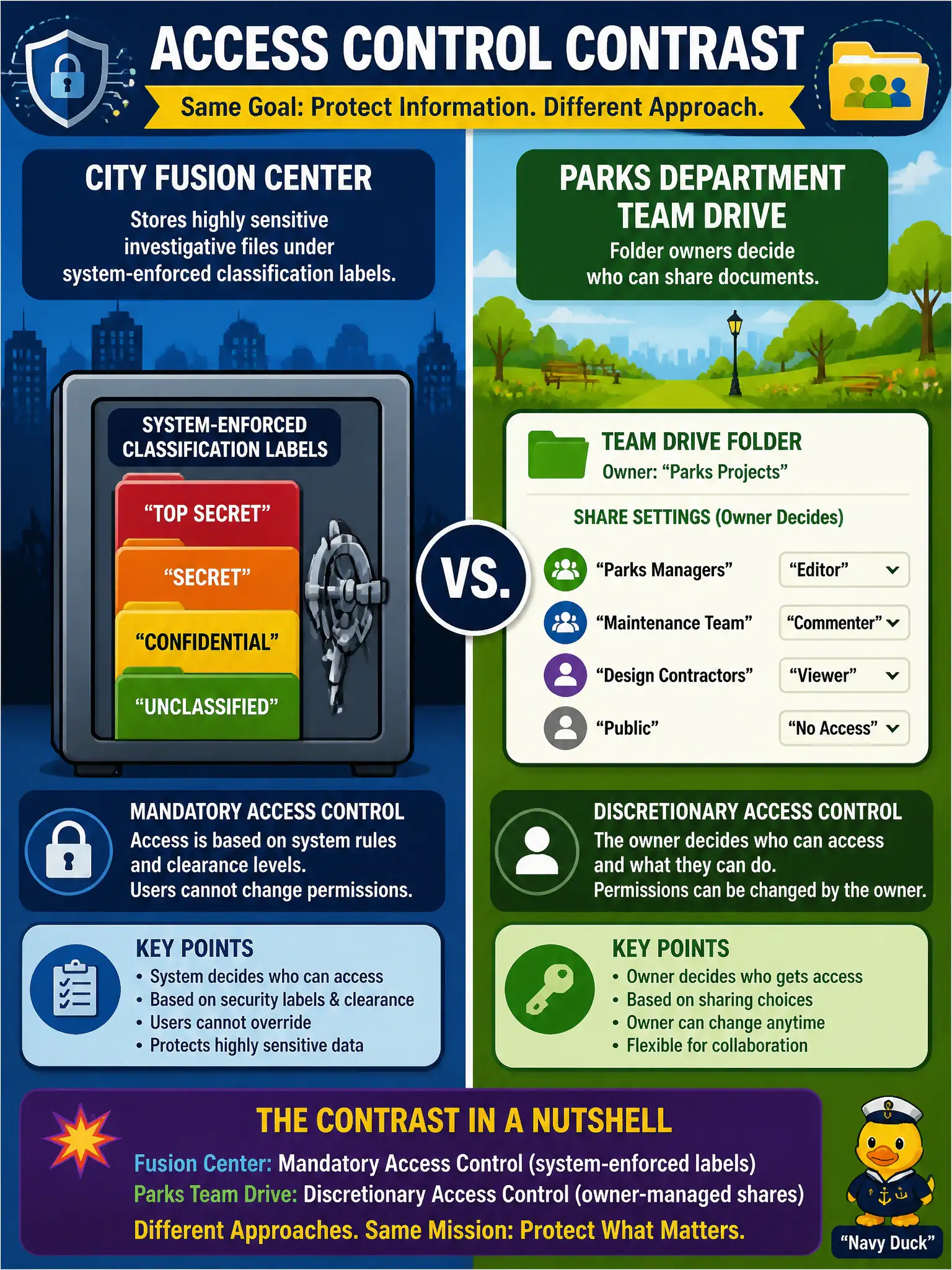
A city fusion center stores highly sensitive investigative files under system-enforced classification labels, while a parks department team drive lets folder owners decide who can share documents. Which access-control contrast best describes these two approaches?
Select an answer to reveal the explanation.
Short Explanation
Picture two filing cabinets: one where a security officer stamped SECRET and no clerk can peel the sticker, and one where the folder owner hands out keys. Fusion-center labels are MAC; the team drive's owner shares are DAC. Different trust models for different data.
Full Explanation
Mandatory access control (MAC) binds objects to centrally administered classification labels and subjects to clearances; neither fusion-center analysts nor file owners can freely downgrade, re-share, or peel those labels when policy forbids it. That system-enforced rigidity is exactly what highly sensitive investigative holdings need in a municipal fusion center. Discretionary access control (DAC), by contrast, places grant and revoke authority with the object owner, which matches collaborative parks-department team drives where peer sharing is an operational feature rather than a breach path. Choosing MAC for labeled investigative stores and DAC for owner-managed collaboration therefore maps authorization mechanics to sensitivity and business use, not to a single citywide fashion.
Role-based access control fails as a single answer for both systems because job titles alone neither stamp classification labels nor explain owner-driven sharing; RBAC may layer on top of either model but does not erase the MAC-versus-DAC contrast the scenario highlights. Swapping ABAC onto the team drive and DAC onto fusion-center labels inverts the sensitivity fit: dynamic attribute engines are powerful, yet the fusion center’s defining need here is centrally enforced labels, while the drive’s defining trait is owner discretion. Treating both problems as rule-based firewall ACLs collapses authorization into network filtering; share permissions and classification decisions live above the packet filter and must still be modeled correctly.
Exam caveat: CISSP Domain 5 questions often pair models in one stem—pick the contrast that matches enforcement locus (system labels versus owner discretion), not the buzzword that appears most often in municipal IT. Operational check: for each city data store, document whether owners can re-share, whether labels are system-enforced, and whether residual risk from DAC on sensitive content or MAC friction on public collaboration has been accepted by the data owner.