
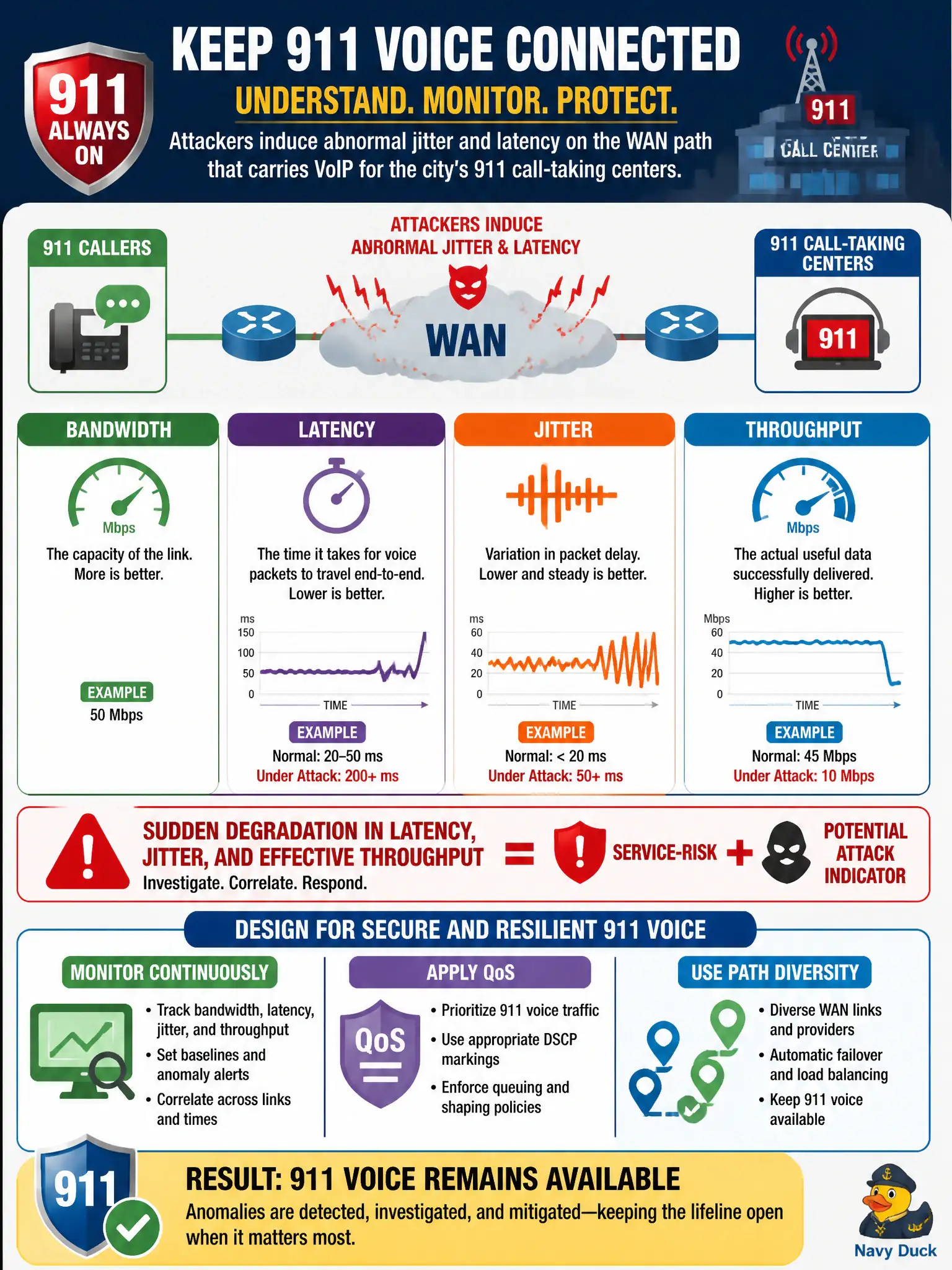
Attackers induce abnormal jitter and latency on the WAN path that carries VoIP for the city’s 911 call-taking centers. Which statement best reflects how bandwidth, latency, jitter, and throughput should inform secure and resilient design?
Select an answer to reveal the explanation.
Short Explanation
911 voice hates jitter the way a live concert hates skipping tracks. Weird latency spikes aren’t just 'the network being slow'—they can be an attack or a fault that takes emergency calls down. Watch the metrics and design for voice first.
Full Explanation
For 911 call-taking VoIP, latency, jitter, and effective throughput are availability and safety metrics, not mere comfort knobs. Sudden degradation can signal congestion, path failure, or active interference and must be monitored as both service risk and potential attack indication. Secure resilient design pairs QoS that prioritizes emergency voice with path diversity so a single impaired WAN link does not silence call centers, and it feeds performance anomalies into investigation workflows rather than dismissing them as routine slowness. Bandwidth headroom without jitter control still drops syllables; jitter awareness without investigation still misses an attack.
Declaring performance metrics purely operational with no security relevance after QoS tags are set ignores that adversaries and faults both manifest as quality collapse on critical voice paths. Prioritizing bulk file backups over voice during congestion inverts public-safety needs—voice is harder to retransmit usefully in real time than backup blocks. Ignoring jitter whenever average utilization stays below fifty percent misses microburst and path-impairment scenarios that destroy call quality without filling the average bandwidth gauge.
Exam caveat: CISSP availability and network performance topics treat quality metrics as inputs to secure design for time-sensitive services. QoS labels alone do not equal assurance; monitoring and path diversity complete the picture for emergency voice.
Operational check: baseline latency and jitter SLOs for 911 VoIP paths; alert on sustained or sudden violations; confirm QoS markings survive WAN handoffs; test failover to alternate paths under load; and include performance anomalies in SOC/NOC triage runbooks alongside classic IDS alerts.