
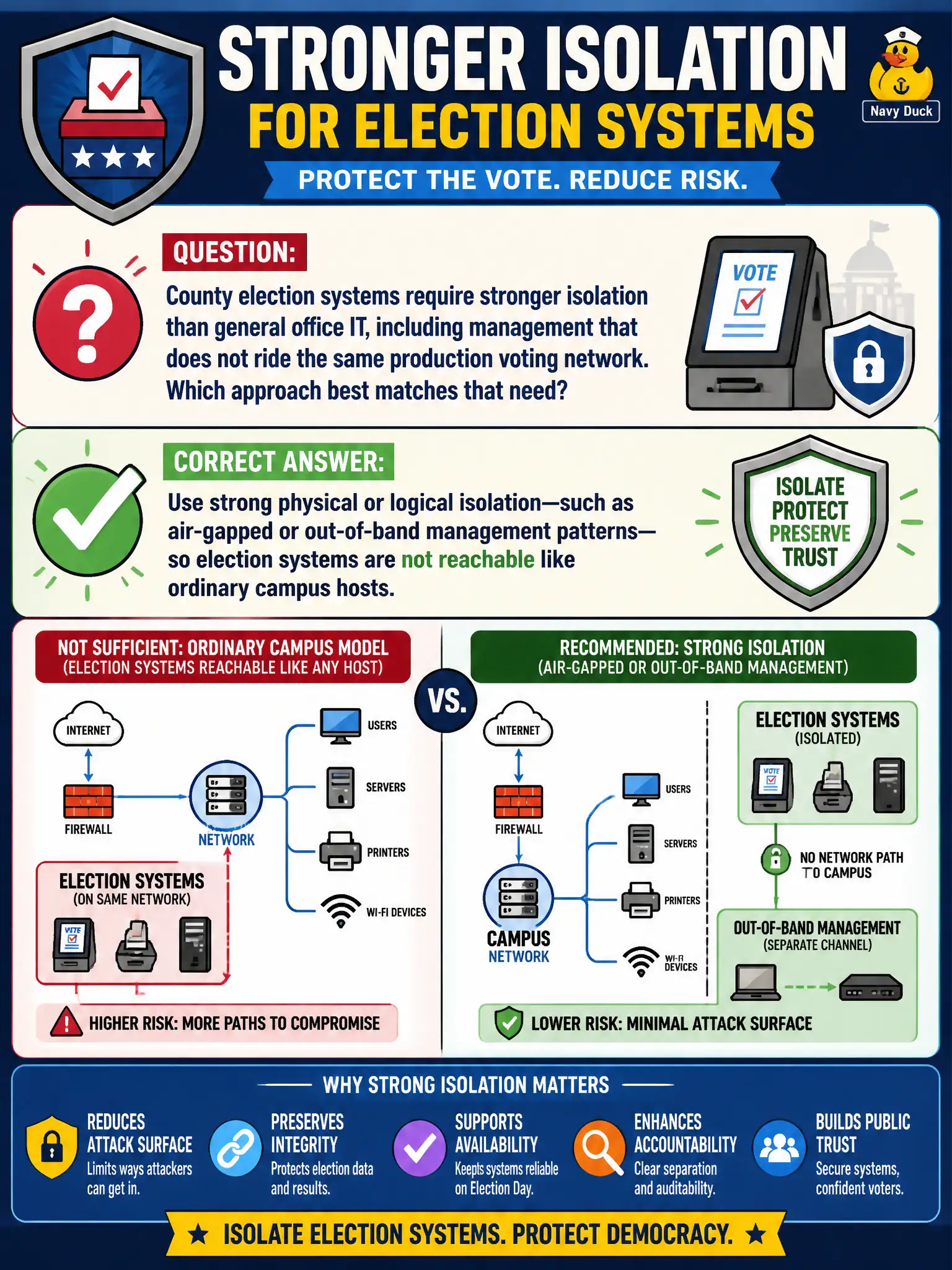
County election systems require stronger isolation than general office IT, including management that does not ride the same production voting network. Which approach best matches that need?
Select an answer to reveal the explanation.
Short Explanation
Election gear should not share a hallway with everyday office traffic. Air gaps or out-of-band management keep admin paths off the voting network. Convenience VLANs are the wrong shortcut.
Full Explanation
County election systems warrant stronger isolation than general office IT, including management paths that do not ride the production voting network. Air-gapped or tightly controlled logical isolation, plus out-of-band management patterns, reduces remote attack surface and accidental connectivity to campus services. High-assurance civic systems treat reachability itself as a risk control: election hosts should not be ordinary domain citizens on flat networks.
Placing election servers on guest Wi-Fi for election-night convenience maximizes hostile adjacency. Unrestricted remote desktop from any city laptop collapses isolation. Merging election and payroll VLANs to simplify Active Directory prioritizes directory convenience over election integrity and confidentiality.
Exam caveat: CISSP allows physical segmentation and OOB management as deliberate architecture for critical systems; convenience connectivity is a frequent distractor.
Operational check: document allowed interfaces to election environments; use dedicated management networks or physically separate admin workstations; prohibit general campus routing into voting segments; control removable media; test that scanners and jump hosts cannot reach election VLANs except via approved paths; rehearse election-night support without breaking isolation.