
City VoIP phones and iSCSI storage traffic share the same congested campus links with no QoS and no segmentation. What risk assessment conclusion is most accurate?
Select an answer to reveal the explanation.
Short Explanation
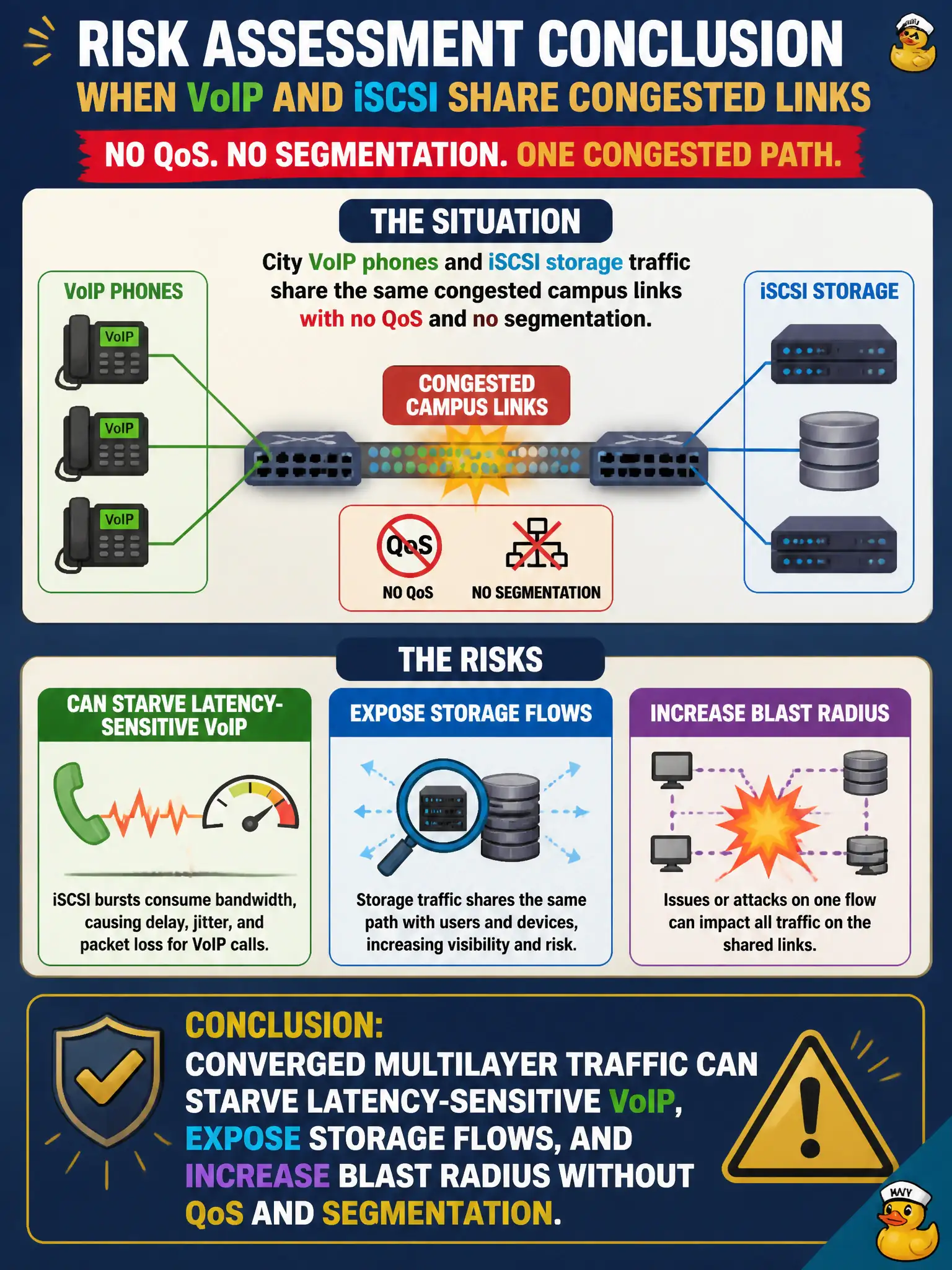
Voice calls and storage blocks on one crowded pipe fight each other—and a breach on that flat path hits both. Converged networks need QoS and segmentation, not hope.
Full Explanation
When city VoIP and iSCSI storage share congested campus links without QoS or segmentation, converged multilayer traffic creates real risk. Latency-sensitive voice can be starved by bulk storage flows, harming call quality for municipal operations. Flat shared paths also expand blast radius: compromise or misconfiguration on one traffic class can affect or expose the other. Accurate risk assessment concludes that missing QoS and segmentation threaten both availability and confidentiality/integrity of sensitive storage traffic.
Asserting converged protocols never interact denies basic contention and path-sharing behavior. Claiming iSCSI automatically encrypts and isolates VoIP signaling confuses storage transport with voice security controls. Treating QoS as a full replacement for access control on storage networks addresses scheduling, not authorization or isolation.
Exam caveat: CISSP highlights implications of converged protocols—performance isolation and security segmentation must both be designed, not assumed.
Operational check: classify voice and storage into separate VLANs/VRFs or fabrics where feasible; apply QoS markings and queues for VoIP; restrict iSCSI to authorized initiators; encrypt storage and voice signaling/media per policy; monitor drops and latency; retest after campus upgrades.