
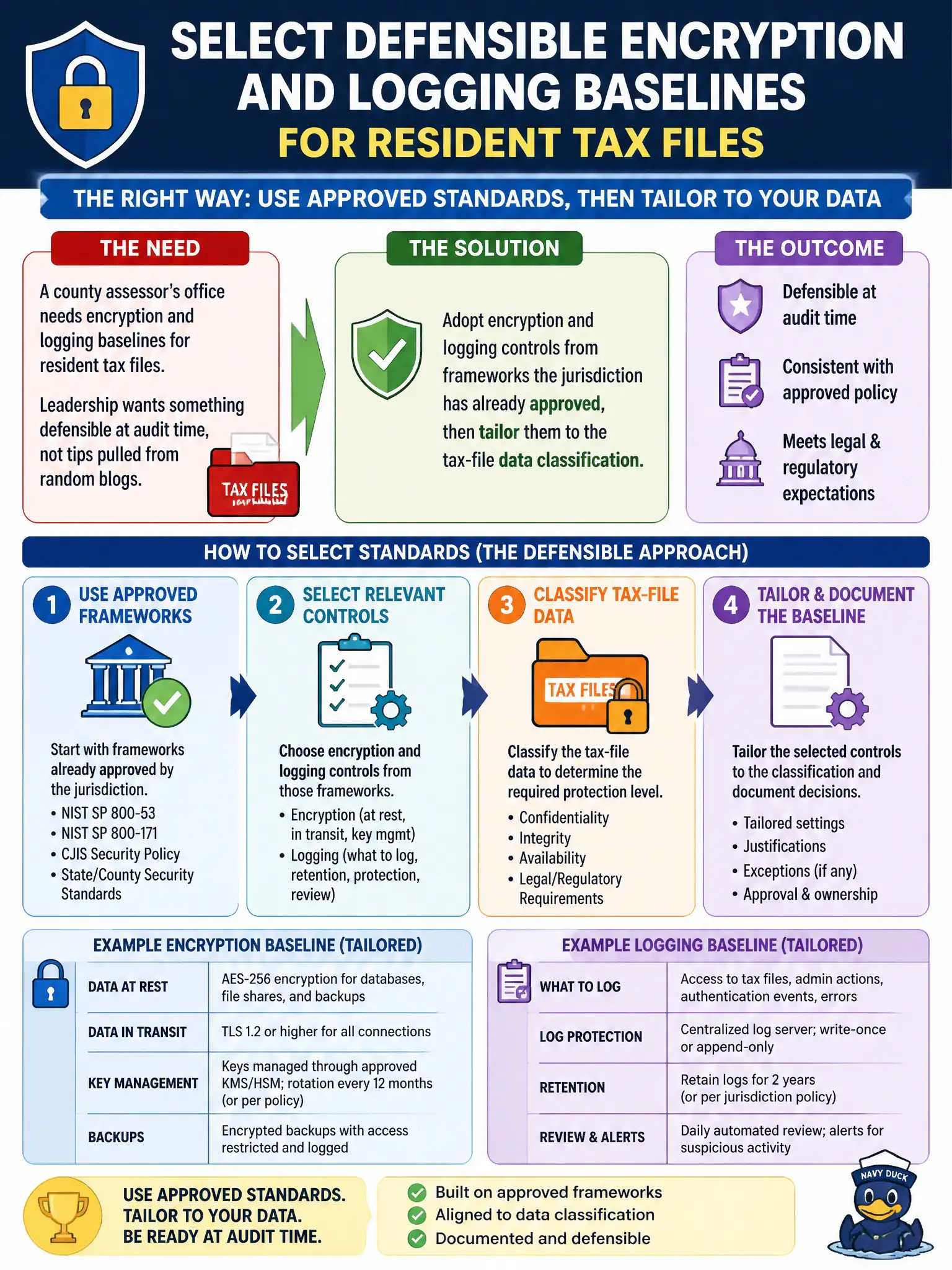
A county assessor’s office needs encryption and logging baselines for resident tax files. Leadership wants something defensible at audit time, not tips pulled from random blogs. How should the security architect select those standards?
Select an answer to reveal the explanation.
Short Explanation
Think of standards like building codes for the courthouse—you follow what the city already adopted, then tweak for the tax vault. Grabbing random blog ciphers is like wiring the building from a weekend DIY video: clever until the inspector shows up.
Full Explanation
Selecting encryption and logging baselines for resident tax files is a governance decision, not a scavenger hunt through forum threads. A defensible approach starts with standards the jurisdiction has already adopted—state cybersecurity frameworks, NIST-aligned control catalogs, CJIS or tax-data handling mandates, or citywide technical baselines—and then maps those controls to the classification and handling requirements of tax records. Tailoring means choosing approved algorithms, key lengths, key-management practices, and audit-log retention that match the sensitivity and retention of assessor data, then documenting why those choices satisfy policy and audit criteria. Forum-driven cipher shopping fails because popularity is not authorization: unvetted algorithms, ad-hoc configurations, and max-verbosity logging everywhere create noise, performance drag, and inconsistent protection that auditors will reject. Deferring standards until after a breach treats control selection as forensics theater; recovery can reveal gaps, but it does not invent a pre-incident baseline or satisfy due care. Per-workstation invented passphrase policies destroy enterprise key management, break recoverability, and guarantee drift across clerks. Exam caveat: CISSP expects candidates to prefer recognized, organizationally approved standards over novel or crowd-sourced crypto choices, then apply risk-based tailoring—not copy-paste every control blindly. Operational check: confirm the county’s approved crypto and logging standards list, verify tax-file classification drives the selected profile, and produce an audit package showing control source, tailoring rationale, and evidence that clerk systems inherit the shared baseline rather than local improvisation.