
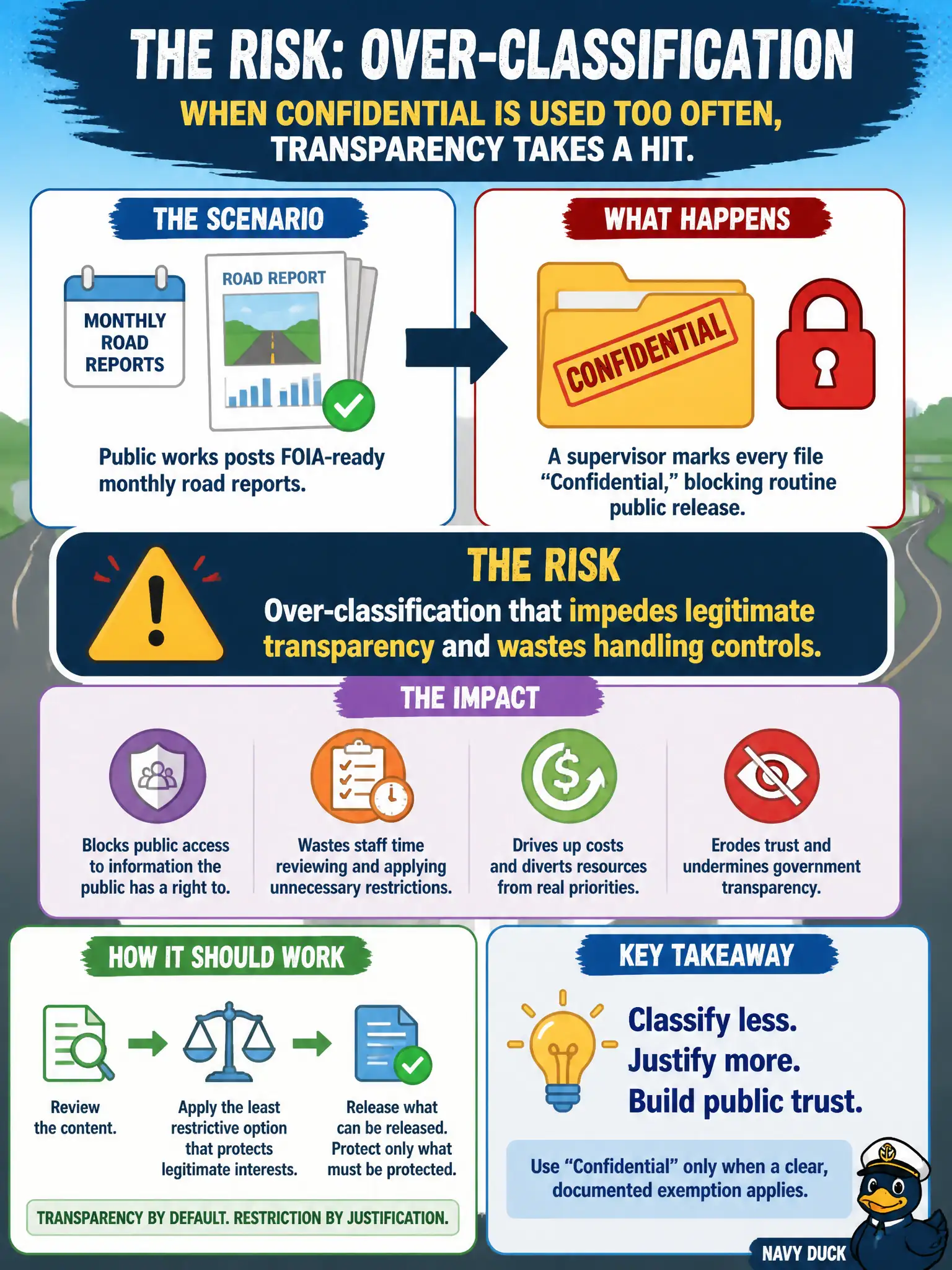
Public works posts FOIA-ready monthly road reports, but a supervisor marks every file Confidential, blocking routine public release. What risk does this primarily illustrate?
Select an answer to reveal the explanation.
Short Explanation
Locking the town bulletin board behind a vault door is not "more secure"—it just keeps citizens from reading what they are supposed to see. Over-classifying public reports burns staff time on needless controls and blocks lawful transparency. Classification should match actual sensitivity, not a one-size-fits-all Confidential stamp.
Full Explanation
Over-classification that impedes legitimate transparency and wastes handling controls is the primary risk when FOIA-ready monthly road reports are stamped Confidential by default. Classification must track real impact of unauthorized disclosure, alteration, or loss. Public works reports prepared for routine citizen release do not warrant Confidential handling; false elevation burns staff time on needless encryption and access friction while blocking lawful open-government obligations. Accurate labeling protects what is sensitive and keeps what is public actually public.
Calling this under-classification fails by concept: the files are over-restricted, not left unprotected on a portal. Treating Confidential as a correct default for all municipal documents fails because cities routinely produce Public and Internal records; blanket Confidential is not governance, it is risk aversion that breaks transparency. Framing the problem as retention failure fails because classification does not automatically shorten retention calendars; retention and classification are related but distinct asset-security controls.
Exam caveat: over-classification is a classic CISSP trap answer twin to under-classification—both misalign protection with impact, and public-sector scenarios often test the transparency cost of over-marking. Operational check: map road-report templates to Public (or Internal) criteria, require justification when Confidential is applied, and measure FOIA delays caused by unnecessary markings.