
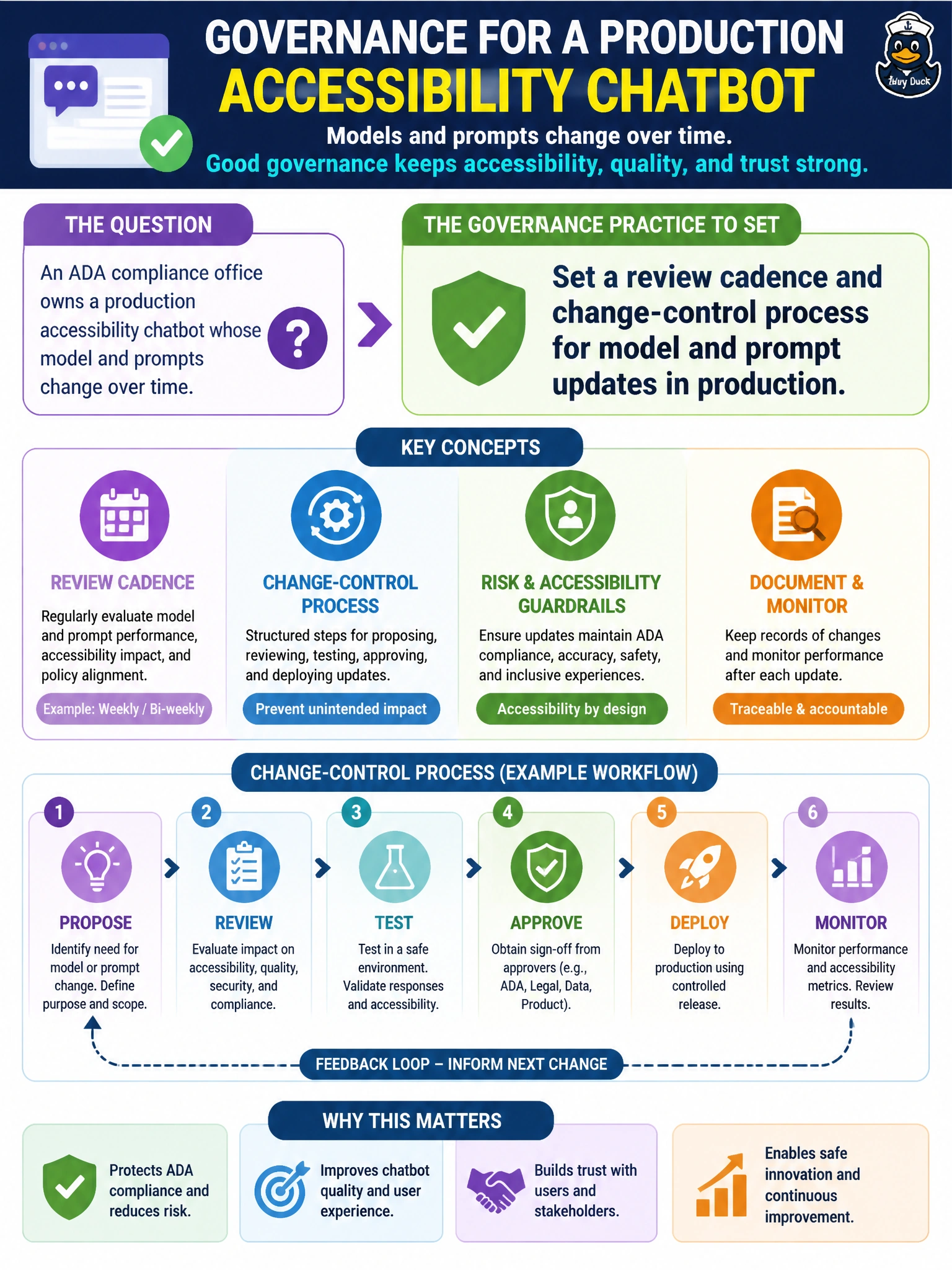
An ADA compliance office owns a production accessibility chatbot whose model and prompts change over time. What governance practice should they set?
Select an answer to reveal the explanation.
Short Explanation
Production bots drift when models and prompts get drive-by edits. Put changes on a review schedule so accessibility stays intentional, not accidental.
Full Explanation
For a production accessibility chatbot owned by an ADA compliance office, governance should set a review cadence and change-control process for model and prompt updates. Production behavior drifts when models, system prompts, or retrieval corpora change without review; accessibility guidance can silently regress or introduce non-compliant advice. Scheduled review plus controlled promotion keeps policy intent and accessibility outcomes intentional as the stack evolves rather than accidental after drive-by edits.
Allowing any engineer to push prompt changes directly to production without review invites uncontrolled drift and untested harmful answers. Freezing the system forever and never updating model or prompts avoids change risk but also blocks security fixes, accuracy improvements, and regulatory updates—an unsustainable extreme. Measuring success only by how often prompts change, not by accessibility outcomes, optimizes for churn instead of resident benefit and compliance quality.
Exam caveat: change control paces updates; it is not a ban on improving the bot. Operational check: require tickets or pull requests for prompt and model changes, run accessibility regression checks against a fixed question set, define a review cadence such as monthly, block hot-edits to production system prompts, and record who approved each release.