
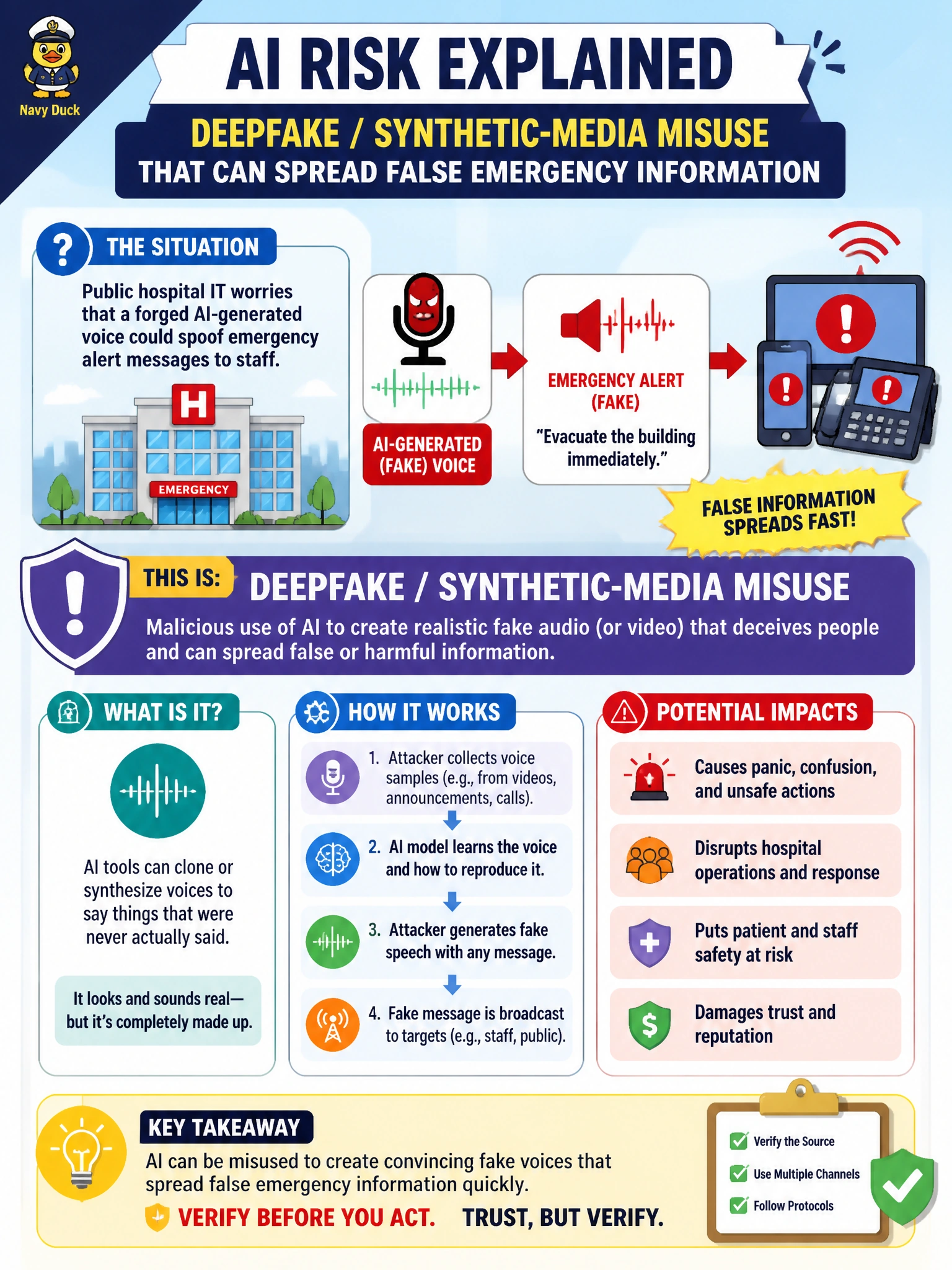
Public hospital IT worries that a forged AI-generated voice could spoof emergency alert messages to staff. Which AI-specific risk is that primarily describing?
Select an answer to reveal the explanation.
Short Explanation
A fake voice that sounds like the incident commander is not a Wi-Fi hiccup—it’s synthetic media doing social engineering at scale. Treat deepfake alerts as an AI misinformation risk, not a printer quirk.
Full Explanation
Public hospital IT concern that a forged AI-generated voice could spoof emergency alert messages to staff primarily describes deepfake / synthetic-media misuse that can spread false emergency information. Generative audio can impersonate trusted commanders or administrators, bypassing human trust cues that historically made voice messages feel authentic. In a clinical or emergency operations context, a synthetic “evacuate” or “all-clear” message is an AI-specific misinformation and security risk with direct safety impact, not a routine facilities or office-IT glitch.
Ordinary packet loss on hospital Wi-Fi during shift change is a network reliability issue; it may drop or garble messages but does not forge a trusted speaker’s voice. A printer firmware bug that misaligns badge stickers is an endpoint print problem unrelated to synthetic audio alerts. A spreadsheet formula that rounds bed counts incorrectly is a data-quality error in capacity reporting, not generative impersonation of emergency communications.
Exam caveat: deepfake risk is about synthetic media used to deceive, not every AI feature in the hospital. Operational check: establish out-of-band verification for emergency voice/video alerts (second channel, code words, signed digital channels), train staff to treat unexpected voice orders with verification, and include deepfake alert scenarios in tabletops.