
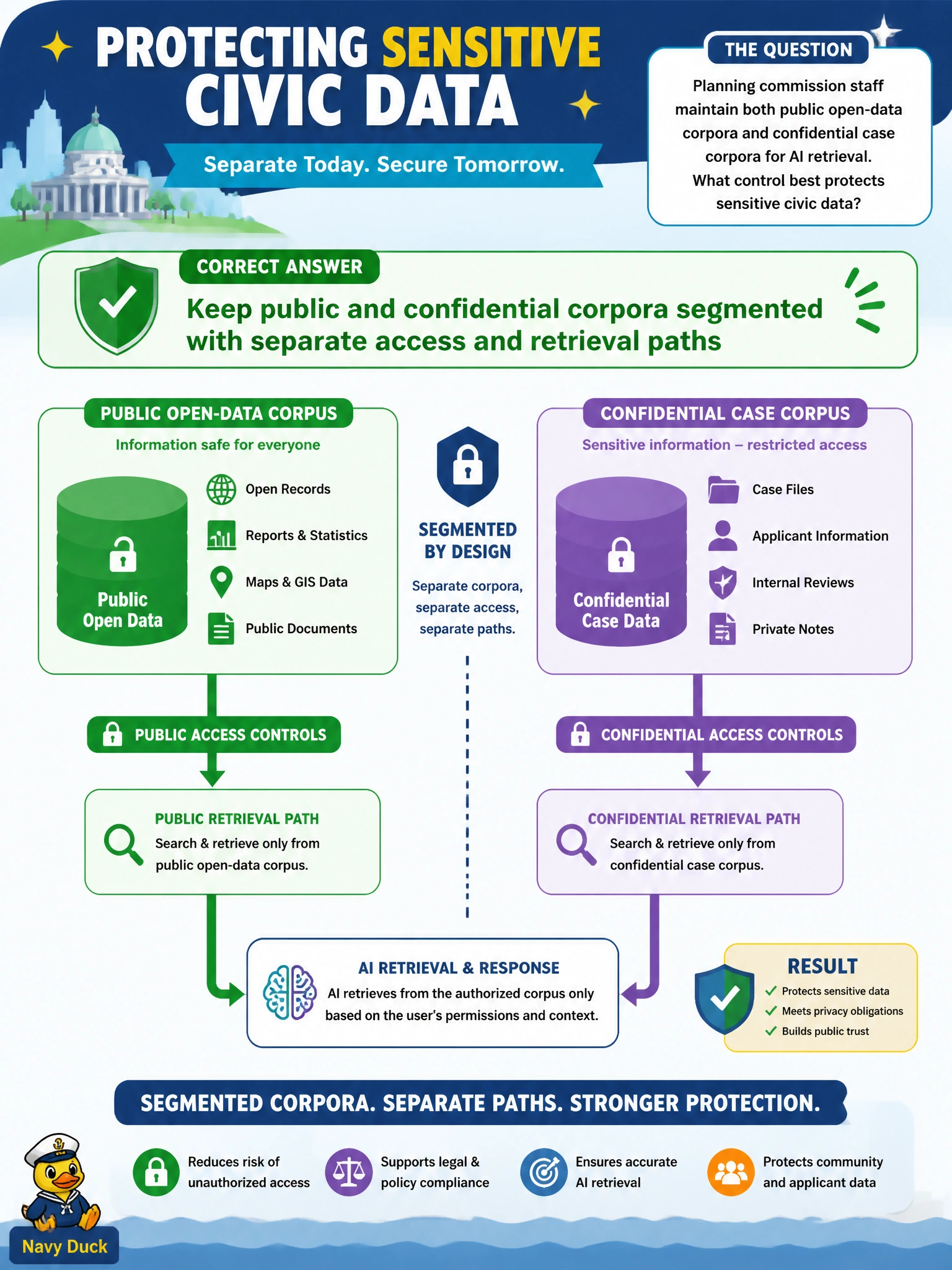
Planning commission staff maintain both public open-data corpora and confidential case corpora for AI retrieval. What control best protects sensitive civic data?
Select an answer to reveal the explanation.
Short Explanation
Public minutes and sealed cases should not live in the same drawer. Separate the open-data pile from the confidential pile, and make sure retrieval only hits what that user is allowed to see.
Full Explanation
The strongest control for planning commission staff who maintain both public open-data corpora and confidential case corpora is to keep those collections segmented with separate access and retrieval paths. Public minutes, agendas, and published datasets belong in indexes and credentials suited to broad or public retrieval. Confidential hearing materials, sealed exhibits, and sensitive case notes require tighter authN/authZ, separate indexes or collections, and retrieval policies that cannot freely cross into the open-data path. Segmentation reduces accidental disclosure when an AI assistant answers a clerk or public kiosk query and supports governance that treats sensitivity tiers differently.
Merging public and confidential corpora into one shared index fails because a single retrieval surface invites cross-contamination: a prompt or ranking error can surface sealed content beside open minutes. Granting every intern write access to the confidential corpus for training convenience violates least privilege and expands insider and error risk far beyond what AI experimentation needs. Training only on confidential cases and then publishing model weights openly can encode sensitive civic patterns into an artifact that leaves the agency’s control—effectively a data-exfiltration path dressed as open science.
Exam caveat: segmentation is about logical and access separation of corpora, not a claim that no staff member may ever see both classes of data under appropriate clearance. Operational check: verify distinct indexes or collections, separate credentials and ACLs, retrieval filters tied to role, and periodic tests that a public-facing assistant cannot return confidential case snippets.