
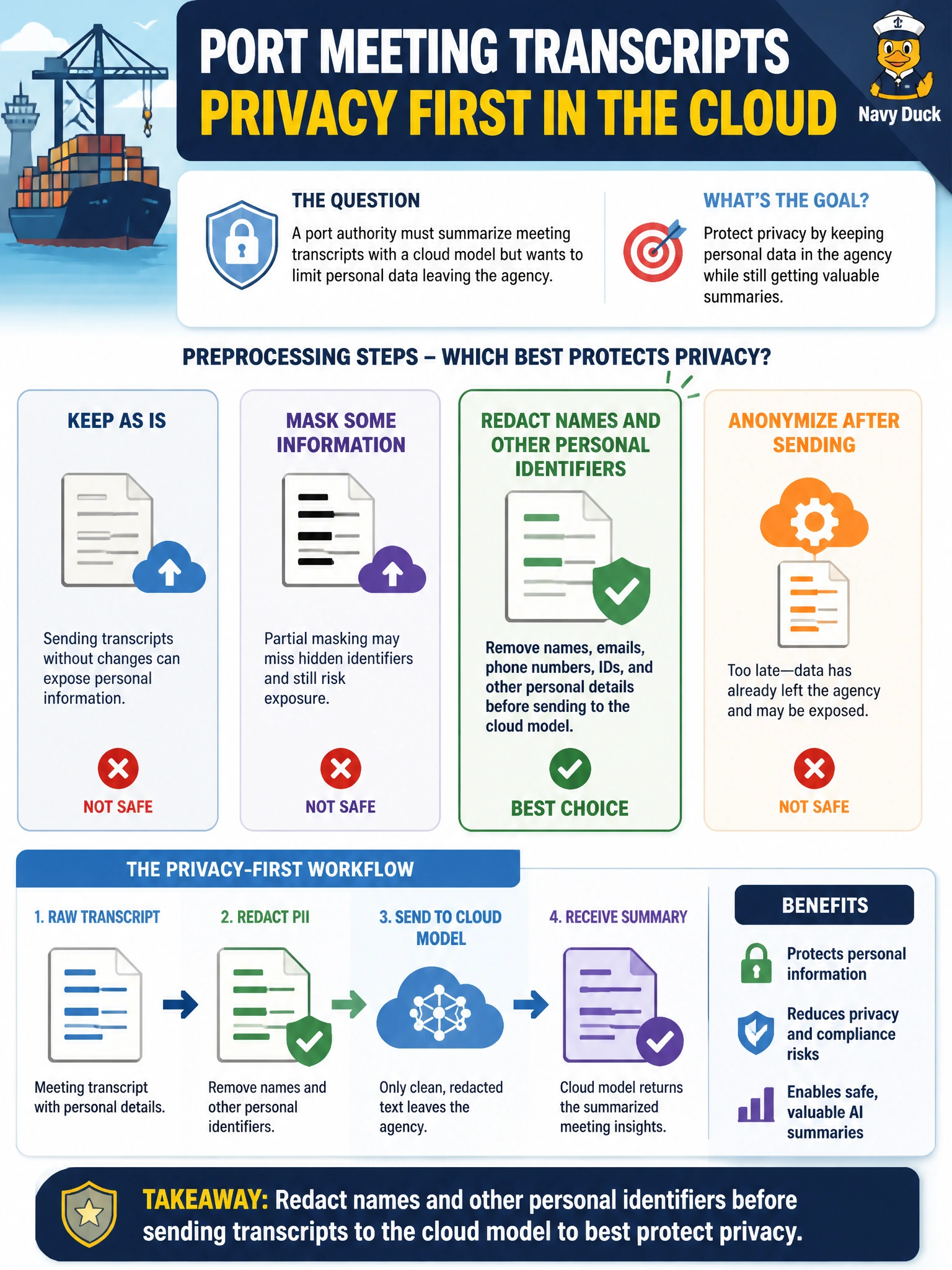
A port authority must summarize meeting transcripts with a cloud model but wants to limit personal data leaving the agency. Which preprocessing step best protects privacy?
Select an answer to reveal the explanation.
Short Explanation
Redaction is the black marker before the envelope leaves the building. Strip names and other personal bits first, then let the cloud model summarize what’s left.
Full Explanation
Sending meeting transcripts to a cloud model expands the port authority’s data boundary. Privacy-preserving preprocessing redacts names and other personal identifiers before transcripts leave the agency, reducing personal data exposure while still allowing useful summarization of motions, votes, and action items. Data minimization at the edge is a practical control when cloud generation is required for meeting productivity.
Sending full unredacted transcripts including home addresses and phone numbers maximizes unnecessary disclosure to the vendor. Increasing logging of every personal field into the vendor’s debug portal widens secondary exposure under the guise of troubleshooting. Appending employee payroll files to "improve summary richness" is unrelated scope creep and a severe privacy anti-pattern.
Exam caveat: naive keyword redaction can miss nicknames, titles, or contextual re-identification; residual risk remains if rare events uniquely identify a person. Classify outputs and restrict who can see pre- and post-redaction text.
Operational check: run a sample transcript through the redaction pipeline, verify direct identifiers are removed by a second reviewer, confirm the cloud summary still captures non-personal decisions, and retain only approved artifacts under the agency retention schedule with access controls.