
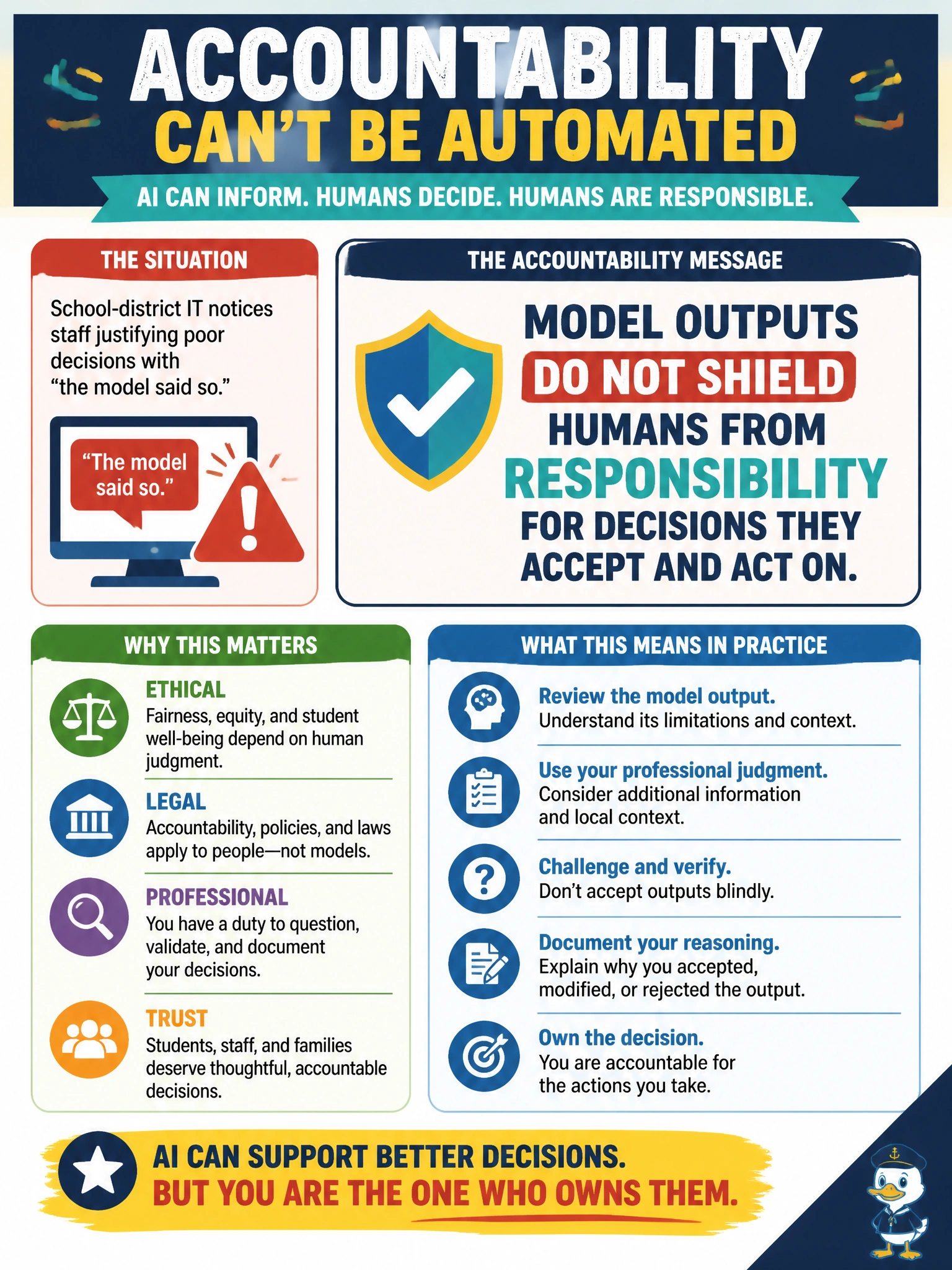
School-district IT notices staff justifying poor decisions with “the model said so.” What accountability message should training reinforce?
Select an answer to reveal the explanation.
Short Explanation
“The model said so” is not a hall pass. If a human hits send on an AI draft, that human still owns the call—accountability sticks to people, not probability scores.
Full Explanation
School-district IT noticing staff justify poor decisions with "the model said so" is watching accountability erode. Training must reinforce that generative outputs are decision support, not a liability shield: humans who accept and act on suggestions remain responsible for educational and civic impacts. Ownership stays with the decision-maker who hit send, not the probability distribution that drafted the text or a vendor logo on a portal.
Allowing staff to blame the model for any harmful outcome without review dissolves responsibility and blocks learning. Claiming only the vendor is accountable once a model is installed ignores local acceptance, configuration, and use of outputs. Treating high confidence scores as the end of accountability confuses calibration metrics with duty of care to students and families.
Exam caveat: accountability messaging must be paired with practical review steps and time to exercise them; slogans alone do not stop rubber-stamping under workload pressure. Also clarify when AI use is prohibited for certain decisions.
Operational check: include scenario-based training where staff must document independent rationale for acting on AI drafts, sample incident reviews for improper "model said so" justifications, and require supervisor attestation on high-impact actions that used generative assistance.