
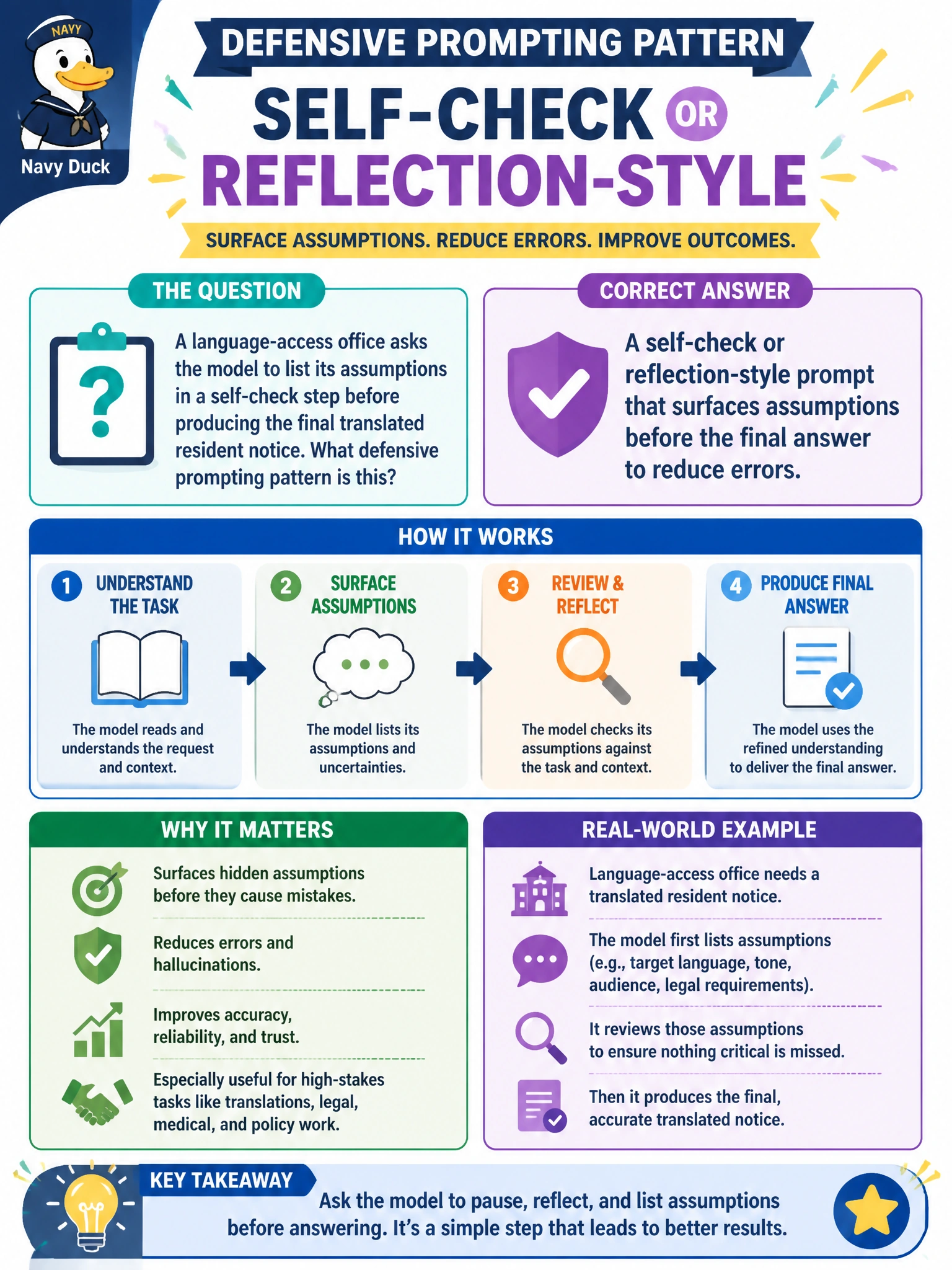
A language-access office asks the model to list its assumptions in a self-check step before producing the final translated resident notice. What defensive prompting pattern is this?
Select an answer to reveal the explanation.
Short Explanation
Before the final notice, make the model empty its pockets—list every assumption out loud—then fix the shaky bits. That self-check step catches translation landmines early. Hiding uncertainty or skipping the second look is how mistakes ship.
Full Explanation
Self-check or reflection-style defensive prompting asks the model to surface assumptions, uncertainties, or failure modes before emitting the final answer. A language-access office that requires listing assumptions prior to the final translated resident notice uses that pattern to catch silent premises about names, dialect, legal terms, or tone that could distort meaning. Making assumptions explicit lets staff correct them before publication.
Requiring the model to hide all uncertainty from reviewers fails by concept: it suppresses the very signals self-check is meant to expose. Banning any second pass over the draft notice removes the reflection stage. Rules that translators must never verify proper names increase error risk for identity-critical fields in resident notices.
Exam caveat: Self-check helps but can be shallow or fabricated if the model merely performs reflection theater—human reviewers should still validate high-impact translations. Pair reflection with glossaries for agency names and with grounding to approved source text. Distinguish self-check prompting from HITL mail gates and from retrieval grounding on related questions.
Operational check: Require an assumptions bullet list in the draft workspace before unlocking “final notice,” have a bilingual reviewer reject drafts whose assumptions about proper names or legal terms are wrong, and track defect rates before versus after the self-check step.