
A solid-waste utility chooses a local small language model for a lobby kiosk because WAN links are spotty. What primarily drove that hosting choice?
Select an answer to reveal the explanation.
Short Explanation
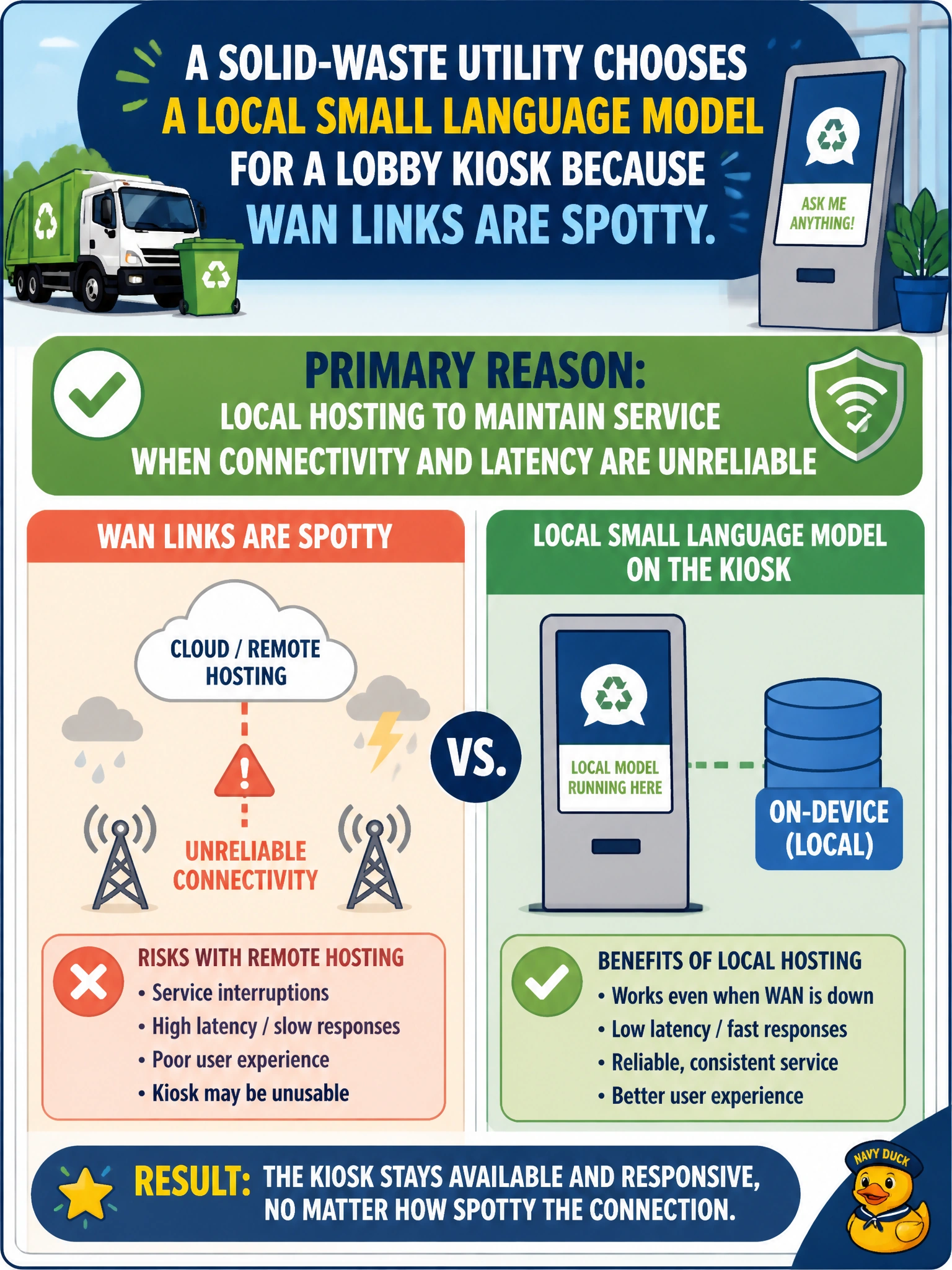
Spotty WAN means the kiosk can’t depend on a faraway brain. A local small model keeps answering when the link flaps—connectivity and latency win that argument over “biggest cloud model only.”
Full Explanation
Choosing a local small language model for a lobby kiosk because WAN links are spotty is driven by local hosting to maintain service when connectivity and latency are unreliable. Solid-waste kiosks must keep answering recycling and schedule questions when the backhaul flaps; on-device or on-premises inference avoids hard dependency on remote frontier endpoints that vanish during outages. Requiring that all prompts stream to a global public CDN increases outage exposure and may conflict with privacy expectations for even routine facility questions. Mandating only the largest cloud frontier model available prioritizes model size over availability under poor WAN conditions and fails the reliability goal. A policy that forbids any on-premises inference under all conditions would block the connectivity-driven solution the stem requires. Exam caveat: connectivity and latency sit alongside privacy, cost, and scale as first-class hosting trade-offs for civic generative deployments. Operational check: test kiosk behavior under simulated WAN loss, size the small model for the installed hardware, define a degraded-mode content pack for top FAQs, synchronize model updates when links are healthy, log local inference health, and avoid silently failing to a blank screen when the cloud path is unreachable.