
Leadership asks how an XDR platform such as Cisco XDR differs from the EDR capability the organization already runs on its endpoints. Which explanation is accurate?
Select an answer to reveal the explanation.
Short Explanation
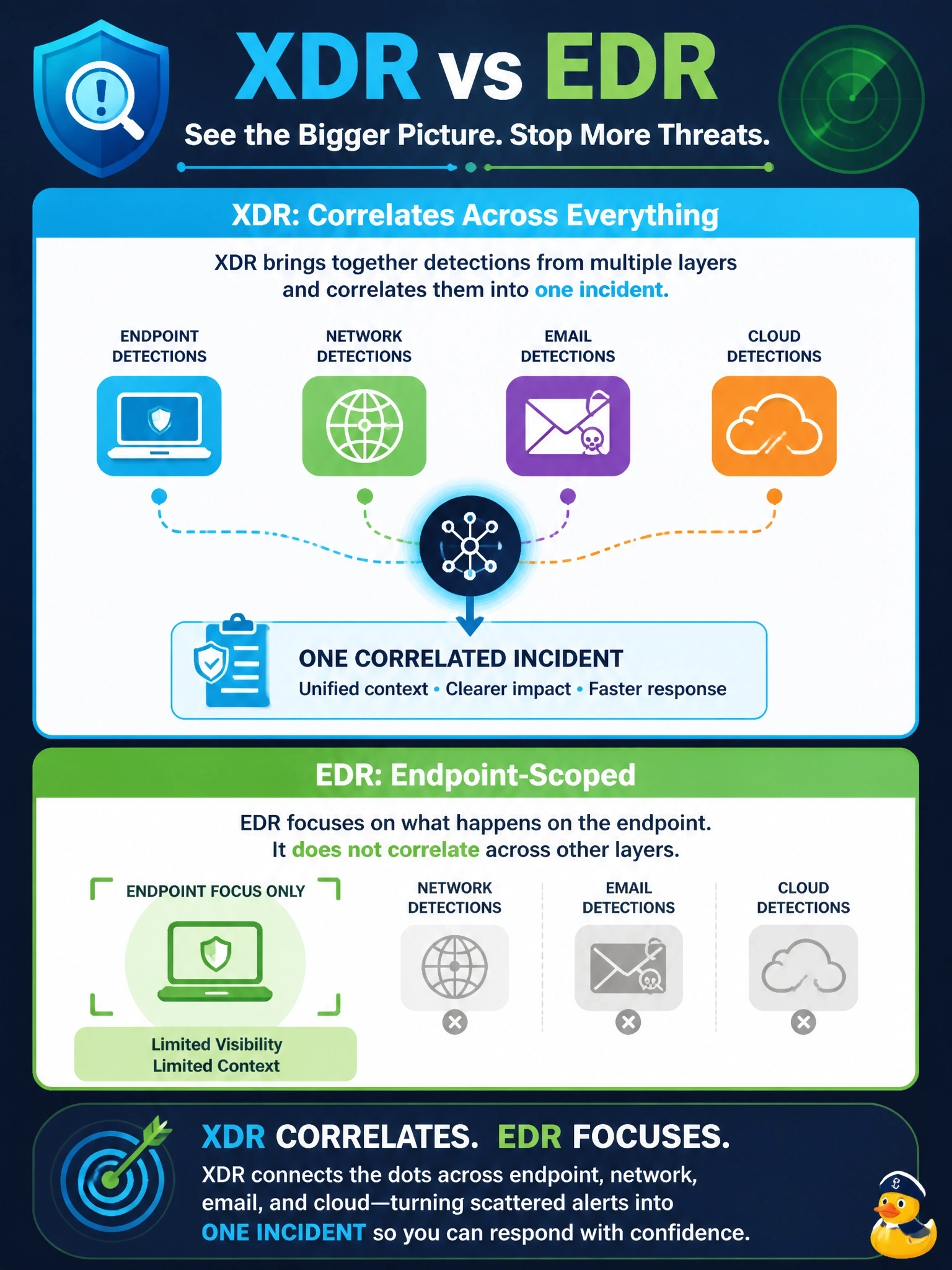
EDR is one really good security camera on each desk; XDR is the control room that stitches every camera, door sensor and mail scanner into one story. You still need the cameras. The trap is thinking XDR replaces EDR, when it actually builds on it.
Full Explanation
Endpoint detection and response focuses on the host: it collects endpoint telemetry, detects suspicious behavior and offers host-level response such as isolation or quarantine. Extended detection and response broadens the scope by ingesting telemetry and detections from several control points, typically endpoint, network, firewall, email, identity and cloud, and correlating them so that related alerts become one incident with a fuller attack picture and coordinated response options. Cisco XDR follows this model, drawing on Cisco and third-party sources, and EDR data remains one of its key inputs. Describing XDR as EDR on servers misses the cross-domain correlation that defines it; server coverage is still endpoint scope. XDR does not remove endpoint agents; endpoint telemetry is central to most investigations, and network sensors alone cannot see process activity. XDR is an active detection and response platform, not a compliance log archive, and correlation across sources is its purpose rather than something left only to EDR. Exam caveat: XDR overlaps with SIEM and SOAR, but the exam frames XDR around correlated detection and response across security controls. Operational check: trigger a test detection on an endpoint and confirm that the XDR incident shows related email, network or firewall events alongside it.