
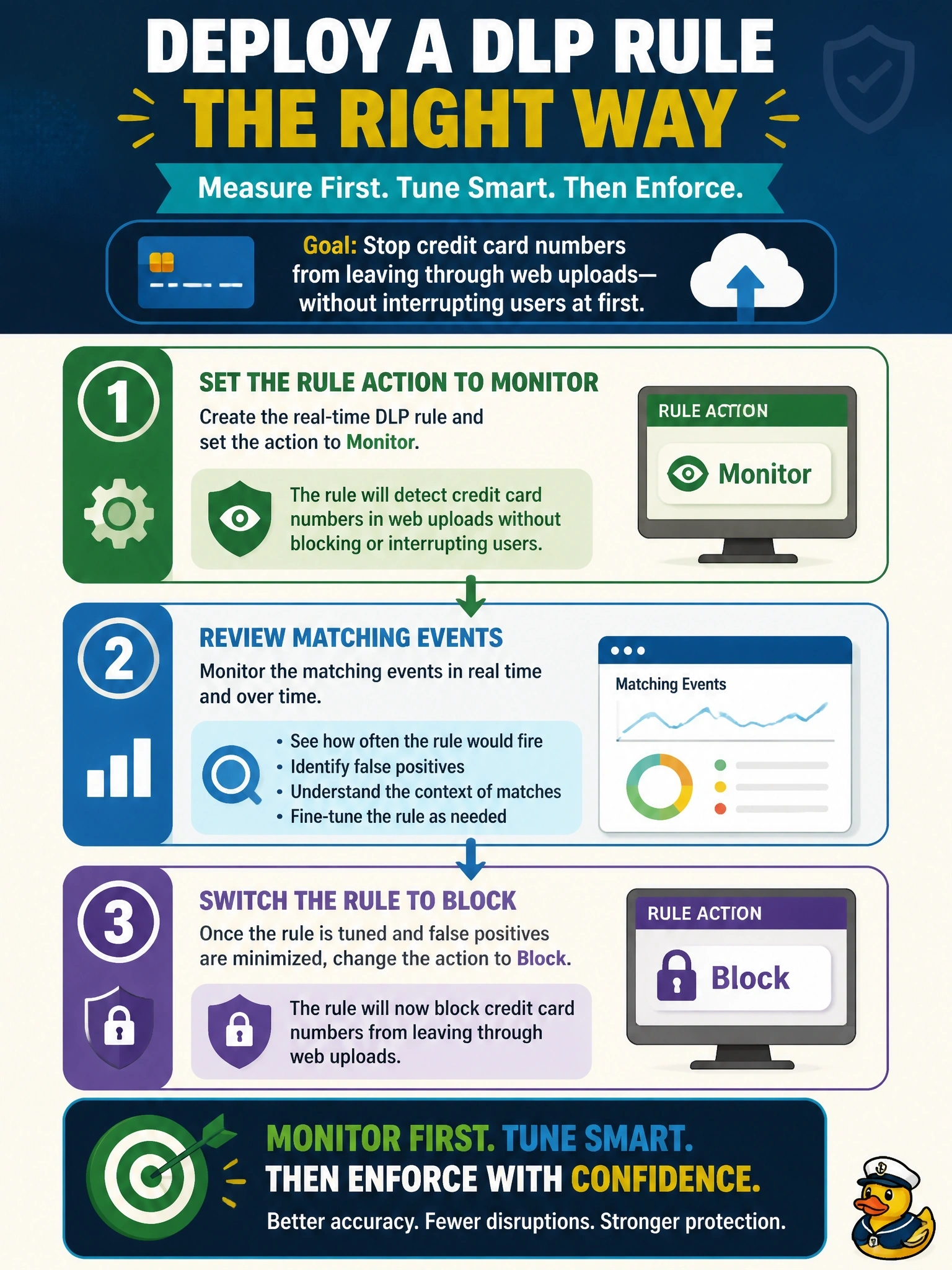
A compliance team plans a real-time DLP rule in Cisco Secure Access to stop credit card numbers from leaving through web uploads. Before enforcing anything, it wants to measure how often the rule would fire and how many matches are false positives, without interrupting users. How should the rule be deployed initially?
Select an answer to reveal the explanation.
Short Explanation
Think of it like a speed camera that only takes pictures for the first month: you learn who'd get a ticket before anyone actually gets one. Monitor mode shows you real matches and the false positives without breaking anyone's upload. The trap is turning off decryption to "go easy" — then the rule can't see anything at all.
Full Explanation
A real-time DLP rule in Cisco Secure Access inspects web proxy traffic for content that matches the selected data classifications and then applies the rule's action. Running the rule with a Monitor action first records every match, with the identity, destination and matched identifier, while letting the transfer complete. That event data shows how often the rule fires and which matches are false positives, so classifications, thresholds or exclusions can be tuned before the action is changed to Block. Starting with Block reverses that order: users are interrupted on day one and help-desk reports become the only measure of accuracy. A SaaS API rule scans files at rest in a connected cloud tenant; it is not a substitute for inline monitoring, and real-time rules do support a log-only action. Disabling HTTPS inspection does not make a rule passive; it blinds the rule, because the content of encrypted uploads can no longer be inspected and nothing is recorded. Exam caveat: monitor-then-enforce is a general rollout pattern for DLP, IPS and other controls that can produce false positives. Operational check: review DLP events for the rule over a representative period, confirm that matches are true positives, then change the action and verify that a test upload is blocked.