
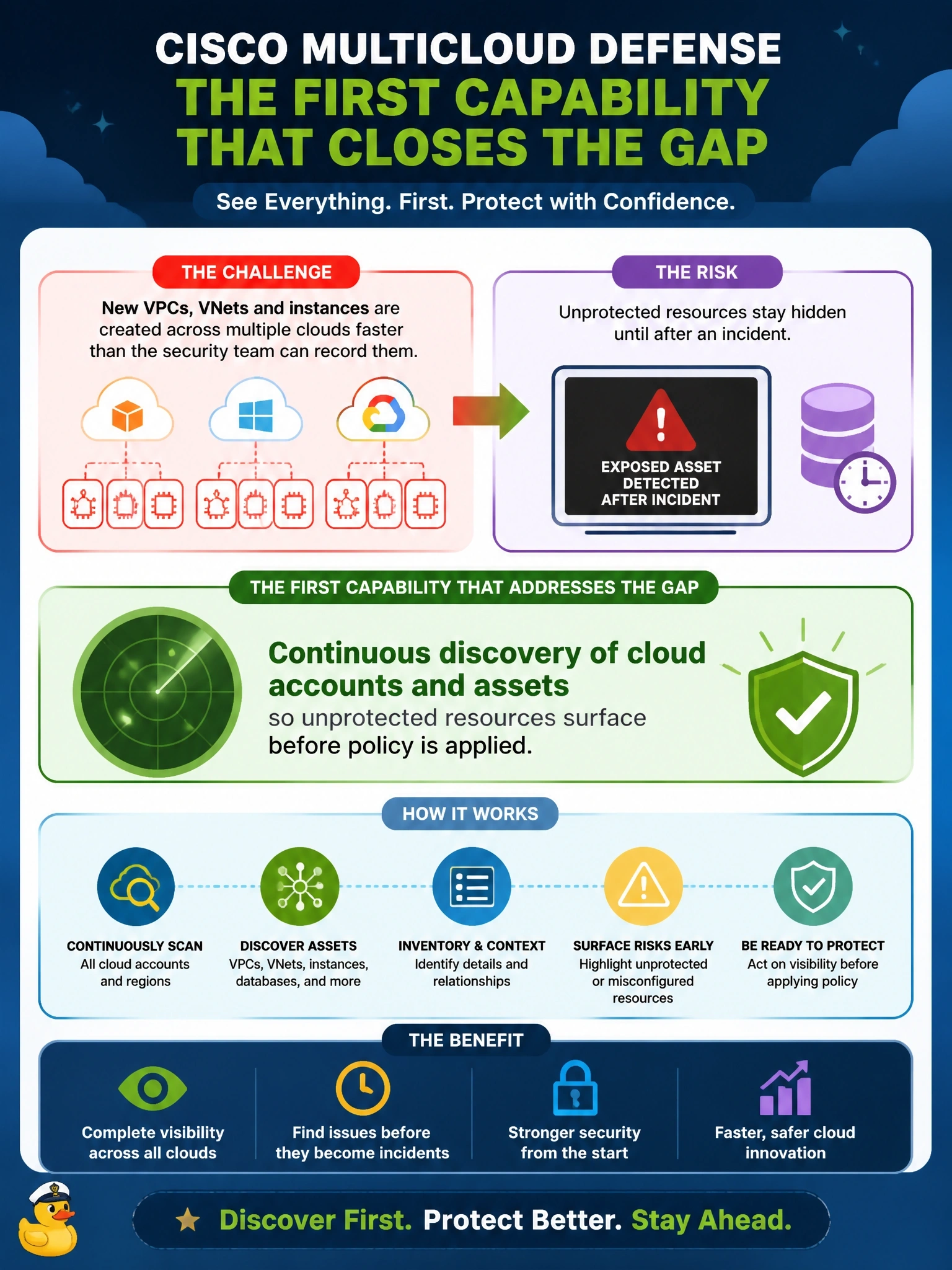
Developers create new VPCs, VNets and instances across several clouds faster than the security team can record them, so the team often learns about exposed assets only after an incident. Which Cisco Multicloud Defense capability addresses this gap first?
Select an answer to reveal the explanation.
Short Explanation
You can't protect what you don't know you own — it's like insuring a house nobody told you was built. Multicloud Defense starts with continuous asset discovery, so new VPCs and instances show up on your radar right away. The trap is reaching for a detection tool; those only help once the asset is already being watched.
Full Explanation
Cisco Multicloud Defense connects to an organization's cloud accounts and continuously discovers resources such as VPCs, VNets, instances and their network exposure. That real-time inventory gives the security team visibility into what exists and what is unprotected, which is the prerequisite for applying policy and inserting gateways where traffic needs inspection. The scenario's problem is a visibility gap, so discovery is the first capability that closes it. Sandbox detonation of downloaded files belongs to malware analysis services such as Secure Malware Analytics; it evaluates samples but does not reveal which cloud assets exist. Agent-based process monitoring requires an agent to be installed on every instance, which is exactly what fails when nobody knows the instance exists; it also addresses runtime behavior rather than inventory. Inline DNS filtering protects lookups that are steered through a resolver or gateway, but it again presumes the asset is already covered and does not enumerate resources. Exam caveat: discovery is not protection; once assets are visible, the controller still needs policy and gateways to enforce ingress, egress and east-west controls. Operational check: onboard every cloud account to the controller, review the discovered inventory for assets with public exposure, and confirm each is mapped to a policy before closing the finding.