
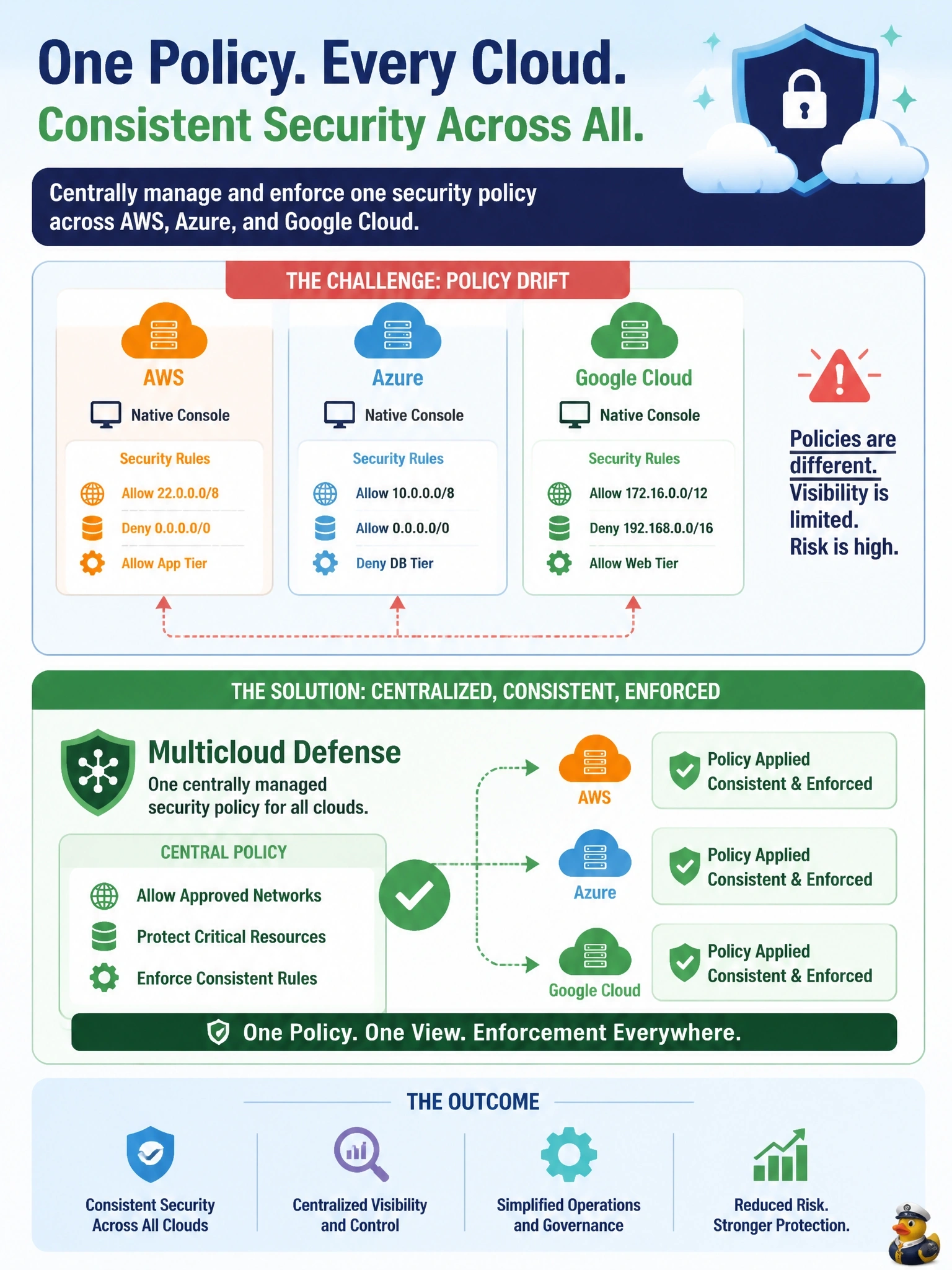
A company runs workloads in AWS, Azure and Google Cloud. Each team writes network security rules separately in each provider's native console, and the policies have drifted apart. The company wants one centrally managed policy enforced across all three. Which solution fits?
Select an answer to reveal the explanation.
Short Explanation
When you're juggling three clouds and three consoles, drift is guaranteed. Multicloud Defense gives you one control plane and one policy that's pushed out to all of them. A wiki page of rules is a hope, not enforcement.
Full Explanation
Cisco Multicloud Defense provides a single SaaS-based controller that discovers cloud assets, defines security policy once, and deploys and manages gateways that enforce that policy for ingress, egress and east-west traffic across supported providers including AWS, Azure and Google Cloud. Central policy with distributed enforcement directly addresses drift caused by separate native consoles, and it scales automatically as workloads change. Documenting native rules in a wiki records intent but enforces nothing; each provider console still holds its own rules, and drift continues whenever a team edits one. Secure Endpoint is an endpoint protection and detection product focused on malware prevention, detection and response on hosts; it is not a multicloud network policy manager. A cloud access security broker in API mode connects to SaaS applications to inspect data and activity; it does not enforce network security policy within provider virtual networks. Exam caveat: native controls remain useful as a baseline layer, and multicloud solutions often complement them rather than replace every security group. Cisco Secure Workload addresses workload microsegmentation with agents and is the other product named in this objective, so read whether the requirement is a gateway policy or per-workload segmentation. Operational check: onboard each cloud account, define one policy, deploy gateways, and confirm the same rules appear and enforce in every provider.