
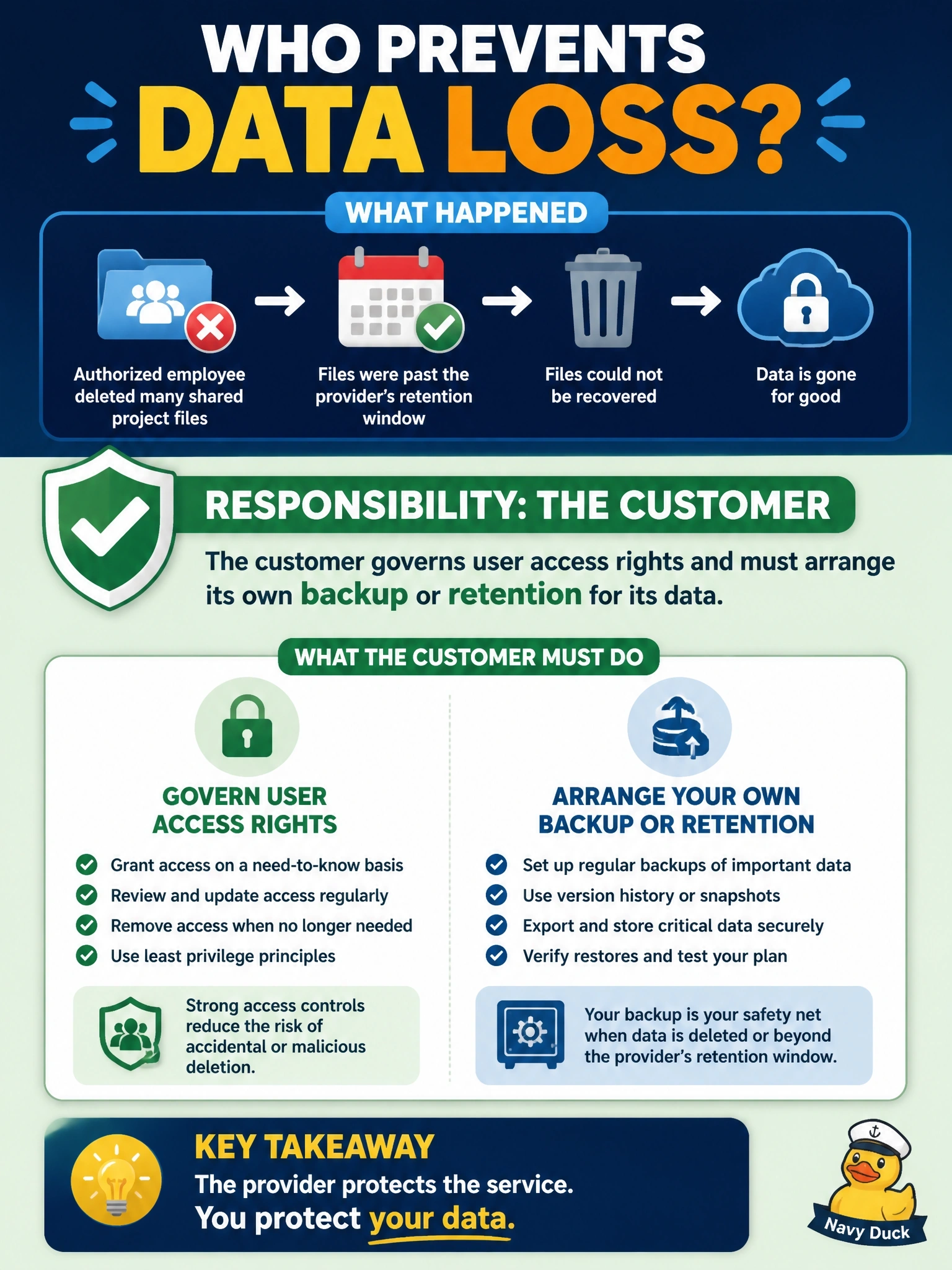
An employee with valid access to a SaaS collaboration platform deletes a large set of shared project files before leaving the company. The files are past the provider's retention window. Who was responsible for preventing this loss?
Select an answer to reveal the explanation.
Short Explanation
In every cloud model, your data and who touches it stay yours. The provider keeps the platform running, but it can't guess that a legit user deleting files is a problem. If you didn't limit rights or keep your own backups, that's the gap you need to close.
Full Explanation
Shared responsibility models consistently leave data governance and identity and access management with the customer, even in SaaS. The customer decides who receives which permissions, monitors user activity, handles offboarding, and determines whether data needs retention or backup beyond the provider's built-in features. An authorized user deleting files is a legitimate action from the platform's perspective, so preventing or recovering from it depends on customer controls such as least-privilege sharing, retention policies, offboarding procedures and third-party or native backups. Providers typically offer limited recycle-bin or retention periods; they do not guarantee indefinite restoration of customer-deleted data, so expecting restoration without time limits misreads the model. Provider liability does not arise simply because the deletion used application features; the platform worked as designed for an authorized user. The identity provider authenticated a valid user correctly; authentication proves identity and does not decide what that user is allowed to delete. Exam caveat: insider and accidental deletion scenarios are the classic reminder that SaaS resilience is not the same as customer data backup. Operational check: review retention and backup settings for critical SaaS data, confirm offboarding removes or reduces access before departure, and alert on unusual bulk deletions from a single account.