
A team is applying benchmark-style hardening to the management plane of its Cisco Secure Firewall (FTD) devices. Which set of settings falls within that scope?
Select an answer to reveal the explanation.
Short Explanation
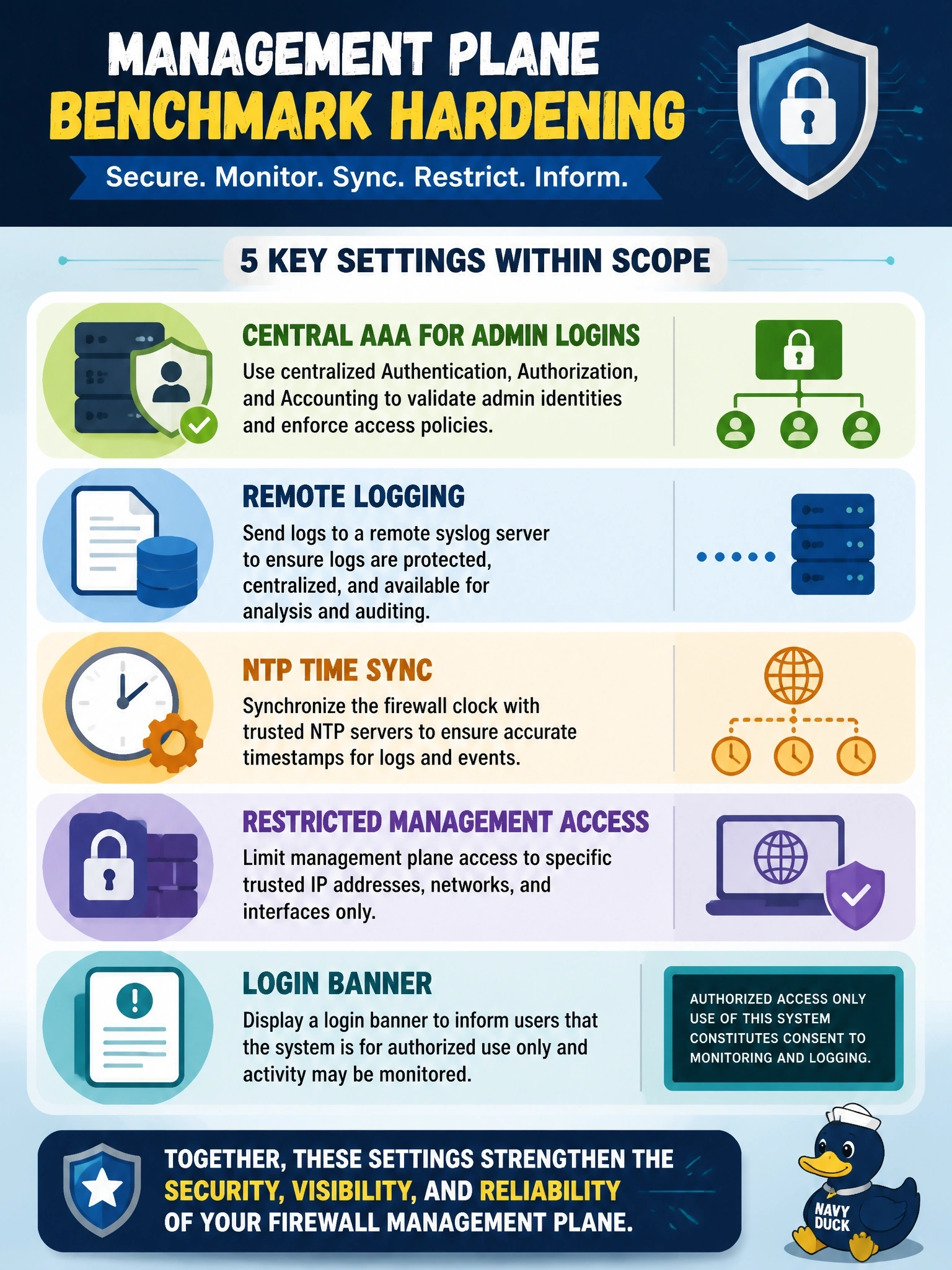
Hardening the management plane is about who can get into the control room, what they did there, and what time it was when they did it. AAA, logging, NTP, access restrictions and a banner all answer those questions. If you're tuning the data plane, you're working on traffic, not on administrators.
Full Explanation
Device benchmarks for firewalls and routers focus heavily on the management plane, the functions that let administrators configure and monitor the device. Typical recommendations include centralized AAA so each administrator has an individual account with authorization and accounting; remote logging to a protected collector so events survive a device compromise; time synchronization with NTP so timestamps can be correlated across systems; restricting management access to specific hosts or networks and to secure protocols; and a login banner stating authorized use. Together they control access, preserve accountability and support investigation. Larger intrusion rule sets, more URL categories and stricter file policies change how the firewall inspects user traffic; they are data-plane security policy, not management-plane hardening. MTU, jumbo frames and queue settings are performance tuning of data interfaces with no bearing on administrative access. NAT rules, VPN pools and DHCP scopes are traffic-handling and remote-access features, also outside the management plane. Exam caveat: some benchmark items, such as disabling unused services, span planes, but the management plane theme is access, accountability and integrity of administration. Operational check: confirm administrators authenticate against the AAA server, test that logs arrive at the collector with accurate NTP timestamps, and verify that management access from an unlisted host is refused.