
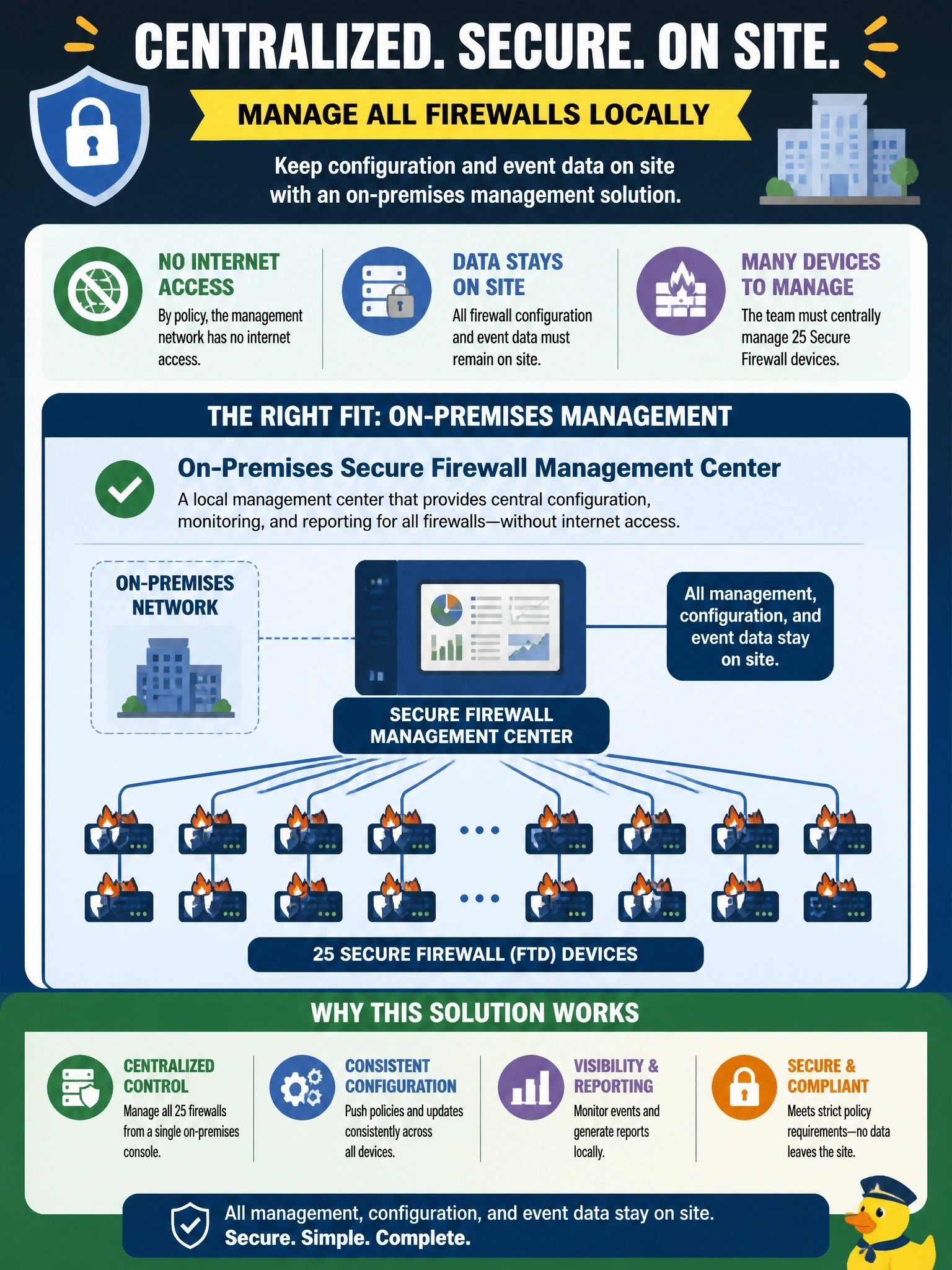
A defense contractor's management network has no internet access by policy, and all firewall configuration and event data must stay on site. The team must centrally manage 25 Cisco Secure Firewall (FTD) devices. Which management option fits?
Select an answer to reveal the explanation.
Short Explanation
When the rules say nothing leaves the building, your manager has to live in the building too. An on-premises Management Center gives you central control without a cloud dependency. The trap is the SaaS option, which is great until the network can't reach the internet.
Full Explanation
Choosing between on-premises and cloud management depends on operational constraints such as connectivity, data residency, staffing and footprint. Secure Firewall Management Center deployed on premises, as hardware or a virtual appliance, manages many devices centrally and stores configuration and events locally, so it can operate on an isolated management network with no internet path. That satisfies both the central-management need for 25 devices and the requirement that data remain on site. Cisco Security Cloud Control delivers management as a cloud service, so the devices and administrators must reach the cloud, and configuration and events are held in the service; the stated no-internet and data-locality policy rules it out. Device manager on each firewall keeps data local but provides no central management, which leaves 25 separately configured devices and fails the centralization requirement. Cisco XDR correlates detections and supports response actions across products from the cloud, but it is not the firewall's configuration manager and would also require cloud connectivity. Exam caveat: in disconnected environments, licensing and threat intelligence updates need offline handling, which is a separate design task. Operational check: confirm the Management Center and managed devices communicate only over the internal management network, and that events from all 25 devices are searchable locally.