
A company wants to manage its Cisco Secure Firewall devices from a SaaS portal, with no on-premises management appliance to install, patch or back up. Which option meets that requirement?
Select an answer to reveal the explanation.
Short Explanation
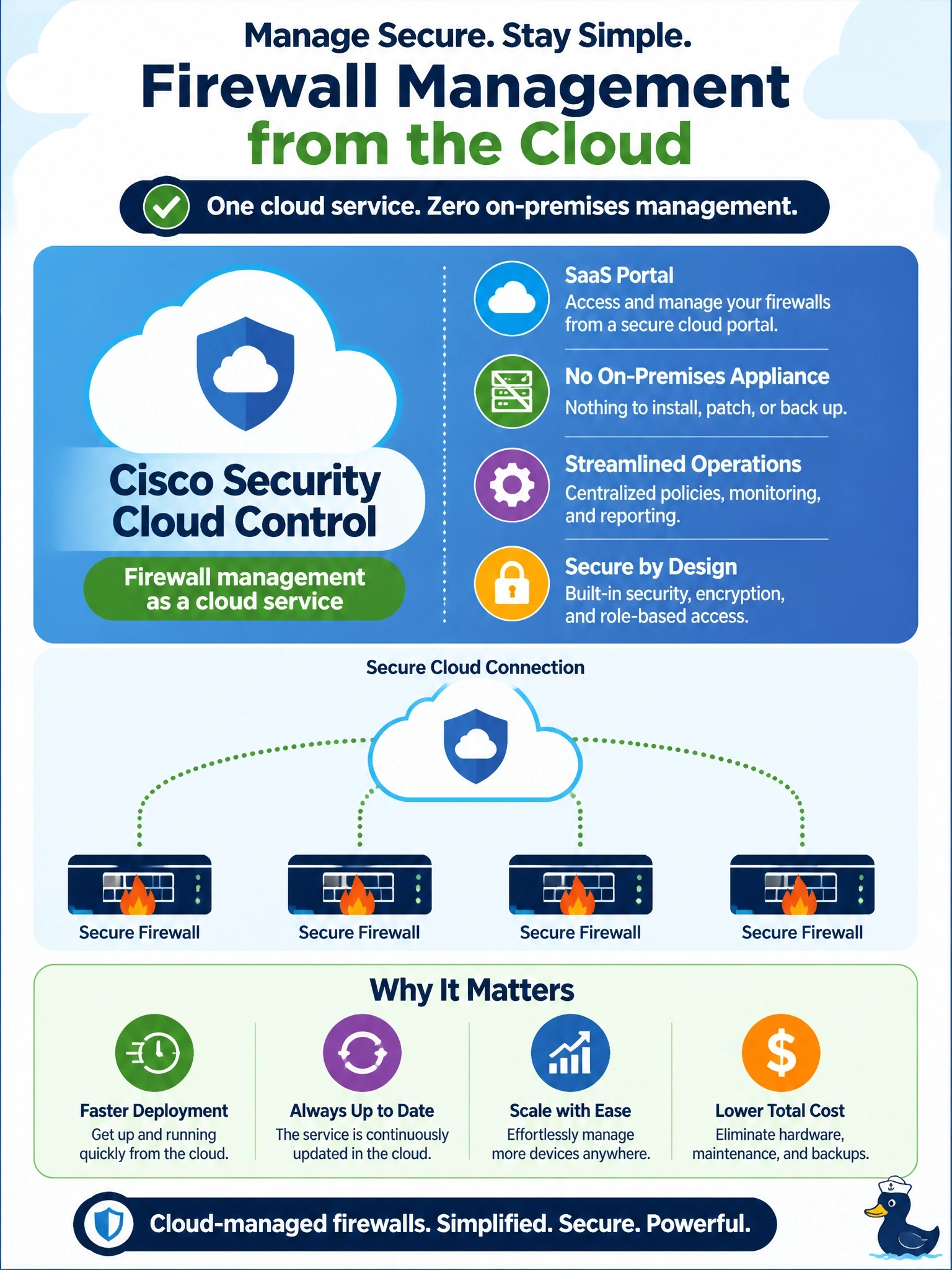
Think of it as moving from running your own email server to using a hosted mailbox: someone else keeps the lights on and patches the box. Security Cloud Control is that hosted option for firewall management. The trap is a virtual Management Center, which is still your appliance to look after even if it's a VM.
Full Explanation
Cisco Security Cloud Control, formerly known as Cisco Defense Orchestrator, is a cloud-based management platform for Cisco security products. It provides cloud-delivered firewall management for Secure Firewall threat defense devices, with the management application operated by Cisco as a service. The customer reaches it through a web portal and has no management appliance of its own to deploy, upgrade or back up, which matches the requirement. Management Center virtual runs the same software as the hardware appliance on a hypervisor the company operates; it is still an on-premises appliance that must be installed, patched and backed up, merely without dedicated hardware. Device manager runs on each firewall and avoids a separate appliance, but it is per-device management through each device's address, not a SaaS portal, and offers no central view. Cisco ISE is a network access policy platform; running it in a cloud virtual machine does not make it a firewall manager, and it does not configure firewall access control policies. Exam caveat: Security Cloud Control can also work alongside an on-premises Management Center, but the scenario's no-appliance constraint points to cloud-delivered management. Operational check: confirm the firewalls are onboarded to the Security Cloud Control tenant, show as synchronized, and accept a test policy change deployed from the portal.