
A small site has one Cisco Secure Firewall (FTD) and no central management appliance or cloud management subscription. The administrator wants to configure it through a web interface running on the device itself. Which manager fits?
Select an answer to reveal the explanation.
Short Explanation
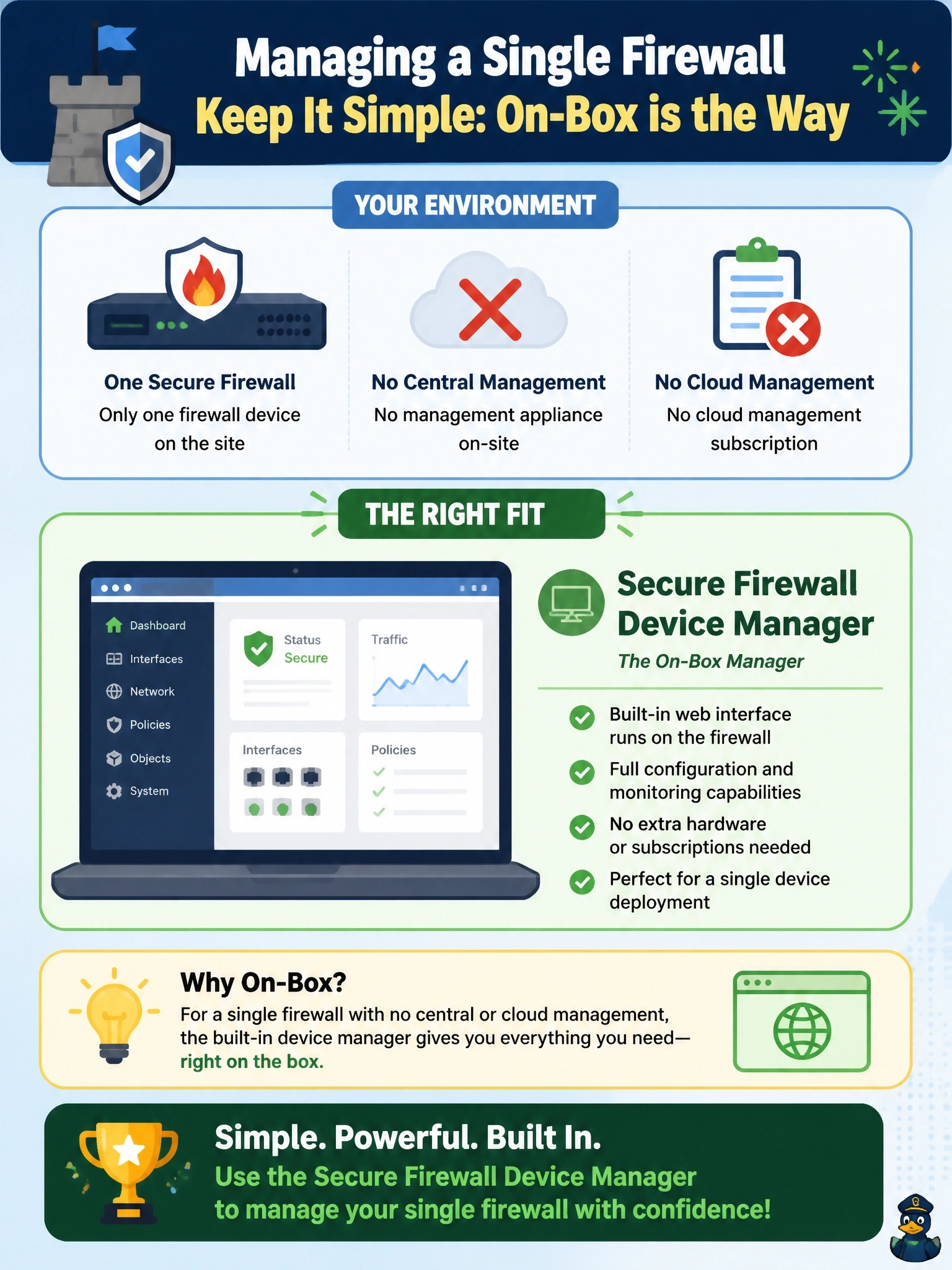
If you've only got one firewall, you don't need a control tower; you can fly it from the cockpit. Device manager is that cockpit, built into the firewall's own web interface. The trap is a central manager, which the stem has already ruled out.
Full Explanation
Cisco Secure Firewall threat defense can be managed in several ways. Secure Firewall device manager is an on-box, web-based manager included with the device and designed for a single firewall; it configures interfaces, routing, access control, NAT, VPN and threat policies without any separate appliance or subscription. That fits a small site with one device and the stated constraint of no central manager or cloud subscription. Secure Firewall Management Center is the multidevice manager, deployed as a hardware or virtual appliance or delivered from the cloud; deploying one for a single device contradicts the requirement of no central management appliance. Cisco Security Cloud Control is a cloud-based management service that requires a tenant and subscription, which the stem also excludes. Cisco ISE is an identity and policy server for network access; pxGrid shares context such as user and device information with other systems, but ISE does not act as the firewall's configuration manager. Exam caveat: a device is managed by one manager at a time, so switching later from device manager to a multidevice manager means re-registering the device and rebuilding or migrating its policy. Operational check: browse to the firewall's management address, confirm the device manager interface loads, and verify the device reports local management in its settings.