
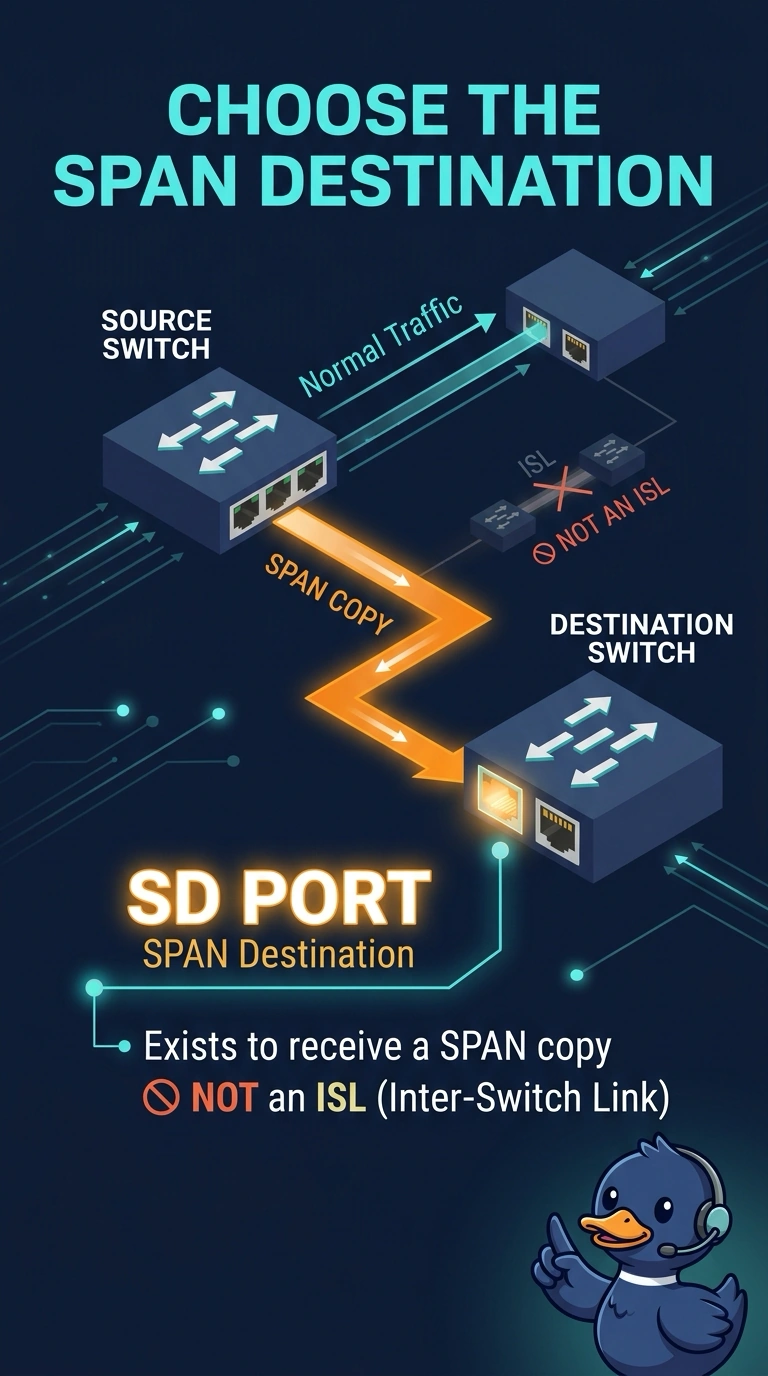
A university needs a copy of the Fibre Channel frames on one MDS port delivered to an analyzer. The SPAN session's destination is an existing ISL, and no frames arrive at the analyzer. What should the destination be?
Select an answer to reveal the explanation.
Short Explanation
You cannot hand the photocopies to the highway and expect a clerk to read them. On MDS, the SPAN destination is an SD port set aside for the analyzer. An ISL is a trunk between switches, and it does not become that destination because you named it in the session.
Full Explanation
An MDS SPAN session copies Fibre Channel frames from a source port to a destination port that has been placed in SD mode. That SD port is where the analyzer attaches. A TE or E port that is carrying an ISL stays a trunk. It is not an analyzer port, so the session has nowhere legal to send the copy. The active zoneset is the enforcement list of who may talk to whom. Activating it does not record frames. The name server lists devices that have logged in, with their FCIDs and port names. It does not store a PLOGI capture you can open later. A device alias is a fabric-wide name for a PWWN. Enhanced mode changes how that name is stored in tools such as zones. It does not mirror a port. Caveat: the SD port is dedicated to SPAN, so it is not also an ISL or a host port while it is the destination. Operational check: set an unused port to SD, point the session at it, and confirm the analyzer sees frames when the host logs in. Keep the analyzer on that SD port for the capture window only, and put the port back into a normal mode when the capture is done so it is not left unable to carry SAN traffic.