
A state university edge switch runs NPV toward a core MDS. The NPV connection is rejected, NPIV is disabled on the core, and the edge switch has no Fibre Channel domain ID. What should change on the core?
Select an answer to reveal the explanation.
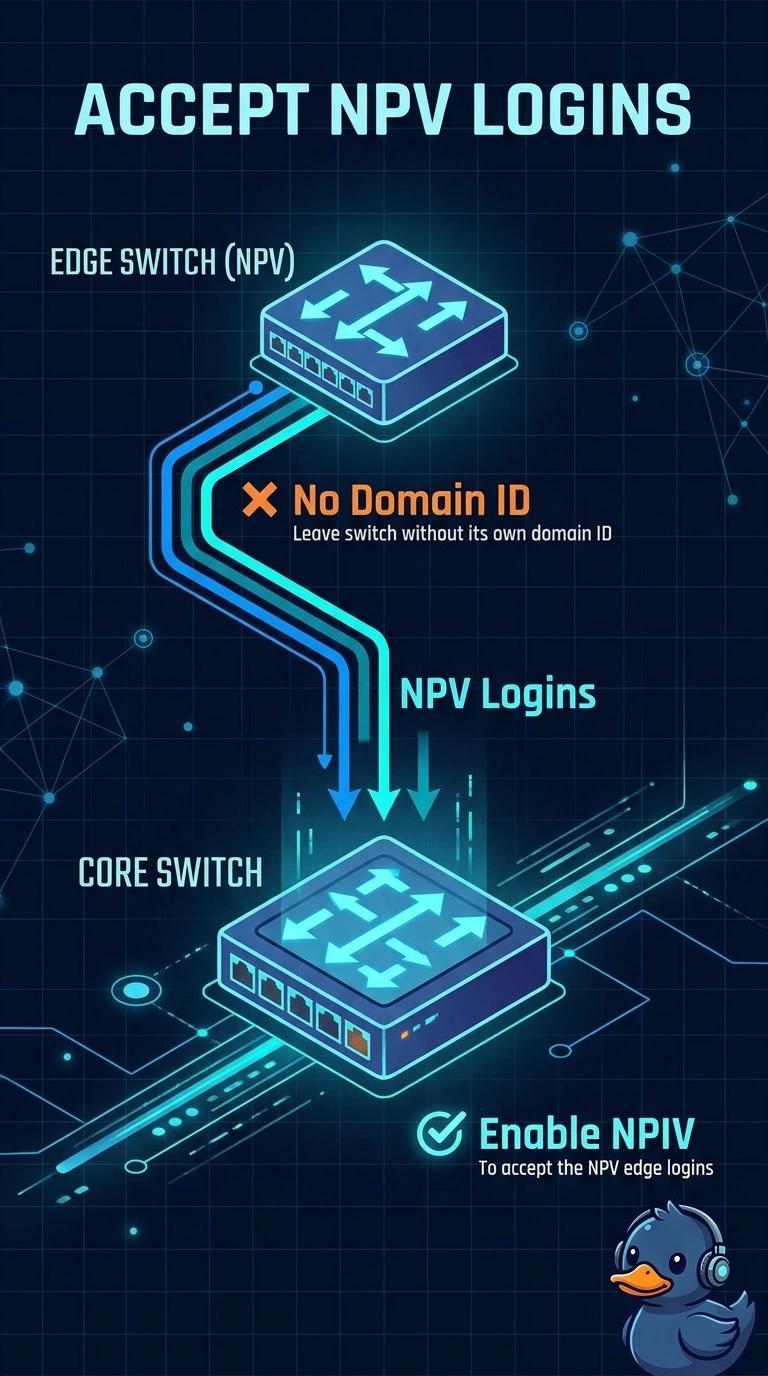
Short Explanation
An NPV edge is a gate that borrows the core's authority. You enable NPIV on the core so it accepts the edge logins, and you leave the edge without a domain ID of its own. Giving the edge a static domain ID would fight the NPV design.
Full Explanation
NPV makes the edge switch stop acting as a fabric switch. It does not take a Fibre Channel domain ID, and its upstream NP port depends on the core accepting multiple fabric logins. That acceptance is NPIV. With NPIV disabled, the core rejects the university NPV connection. Enabling NPIV on the core, and leaving the edge without a domain ID, is the change that matches the design. A static domain ID on the NPV edge would try to make it a fabric switch again. NPV edges do not join the principal election, and a domain ID is not how an NP port comes up. An empty zoneset on the edge does not enable NPIV on the core and does not bring the upstream connection up. Zoning for the hosts is enforced in the core fabric, not by an empty edge zoneset. CFS distributes selected configuration databases. It is not a prerequisite you disable so an NPV link can connect. Caveat: the edge NP port still has to land on an F port on the core, and the VSAN has to match, or NPIV alone does not finish the connection. Operational check: enable NPIV on the core, confirm the NPV upstream link comes up, and confirm the edge still has no domain ID while host FLOGIs appear on the core.