
A factory IoT network host finishes FLOGI and receives a 24-bit Fibre Channel address. The HBA was not configured with a manual Fibre Channel address. Where does that address come from?
Select an answer to reveal the explanation.
Short Explanation
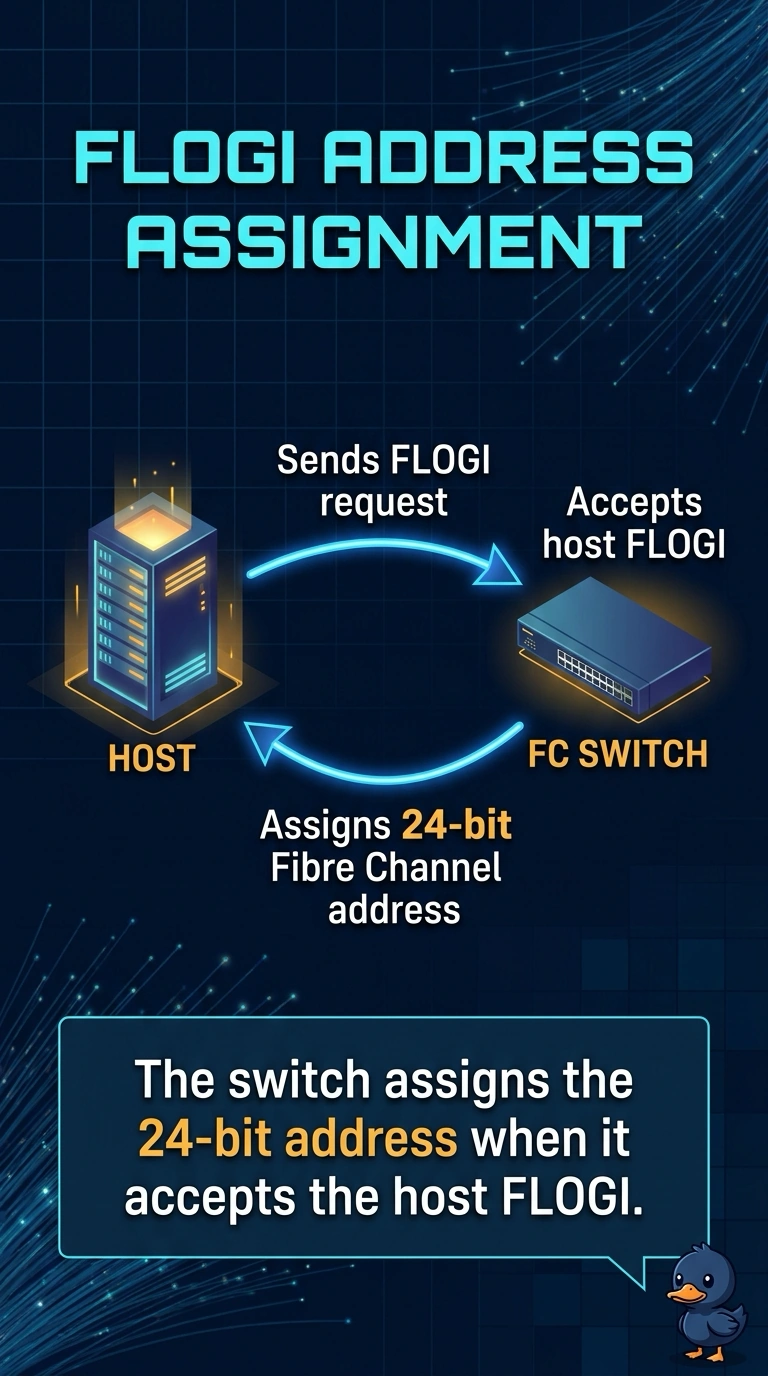
The host brings a passport, and the switch stamps the street address. You get the 24-bit Fibre Channel address from the switch at FLOGI, not from a number the HBA was configured to keep. Activating a zoneset does not mint that address.
Full Explanation
A host identifies itself to the fabric with its WWN. During FLOGI the accepting switch assigns a 24-bit Fibre Channel ID, with the domain, area, and port portions chosen by the fabric, and returns that address to the host. The factory HBA was not given a manual Fibre Channel address because HBAs are not configured with the FCID the way a NIC is configured with an IP. The switch assignment at FLOGI is the source. Zoneset activation copies zoning policy into the active enforcement plane. It does not allocate FCIDs, so a host that has not logged in still has no fabric address. The WWPN is 64 bits and is the host's permanent name. The fabric does not derive the FCID by compressing that WWN. The VSAN isolates fabric services on the switch, but it is not written into the FCID, and the name server records the address after it is assigned rather than inventing it from the VSAN number. Caveat: if the switch later changes its domain ID, the host keeps the old FCID until it performs FLOGI again. Operational check: compare the FCID in the FLOGI table with the name-server entry for that WWPN, and confirm the high byte matches the switch domain.